Important Note!
We use cookies to ensure you get the best experience on our website.
By clicking ‘Agree,’ you accept our use of cookies as outlined in our cookies policy

Midweek trading remains focused on a series of high-impact economic releases that could set the tone for major currency pairs and commodities heading into the weekend. With US crude oil inventories due later today, followed by jobless claims on Thursday and key labor and sentiment data from the US and Canada on Friday, market volatility is expected to pick up. Traders are closely watching how these figures could influence central bank expectations, particularly for the Federal Reserve and the Bank of Japan, as USDJPY continues to trade near multi-decade highs amid strong bullish momentum.
Wednesday 17:30 (GMT+3) – USA: Crude Oil Inventories (USD)
Thursday 15:30 (GMT+3) – USA: Unemployment Claims (USD)
Friday 15:30 (GMT+3) – Canada: Employment Change (CAD)
Friday 17:00 (GMT+3) – USA: Prelim UoM Consumer Sentiment (USD)
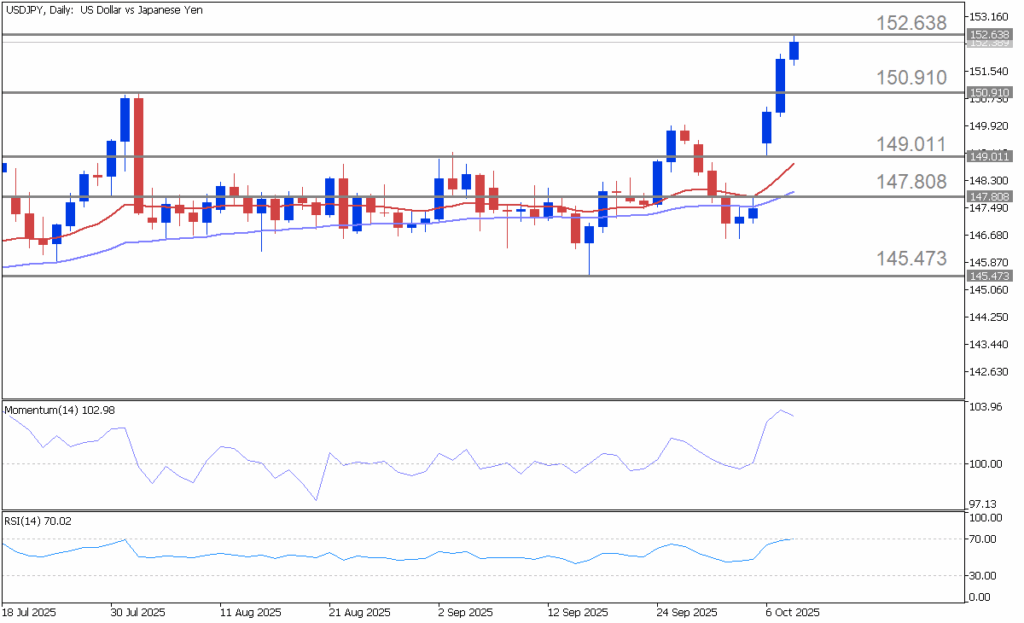
Since bottoming at 139.877 on April 22, USDJPY has staged a decisive recovery, underpinned by a failure swing reversal pattern, gaining over 9% from trough to peak. The formation of a higher low at 142.346 and the subsequent break above the prior swing high at 145.913 confirmed a bullish reversal. This shift in trend was reinforced by a “Golden Cross,” with the 20period EMA crossing above the 50period EMA, signaling firming medium term upside momentum.
Technical signals remain broadly supportive. The Momentum Oscillator is holding above the 100 baseline, and the Relative Strength Index (RSI) is hovering just above the overbought 70 threshold, pointing to sustained bullish pressure.
Price action remains comfortably above both the 20‑ and 50‑period EMAs, with both averages trending higher, reinforcing the overall constructive bias.
If buyers maintain control of the market, traders may shift their focus to the following four potential resistance levels:
152.638: The first level of resistance is projected at 152.638, which aligns with today’s daily high.
155.407: The second price target is seen at 155.407, corresponding to the 261.8% Fibonacci Extension drawn from the swing high, 149.948, to the swing low, 146.574.
158.866: The third price target is seen at 158.866, corresponding to a peak from January 10.
160.866: An additional upside target is determined at 160.866, reflecting the 423.6% Fibonacci Extension drawn from the high point, 149.948, to the low point, 146.574.
If sellers take control of the market, traders may focus on the following four key support levels:
150.910: The initial support level is seen at 150.910, representing the high point marked on August 1.
149.011: The second support level is positioned at 149.011, aligning with the daily low from October 6.
147.808: The third downside target is noted at 147.808, corresponding to the daily low from October 3.
145.473: An additional downside target is determined at 145.473, reflecting the daily low reached on September 17.
A key architect of Abenomics and economic adviser to incoming Japanese leader Sanae Takaichi said an October rate hike by the Bank of Japan would be premature. He suggested December as a more suitable time for a 25-basis-point increase, citing the need for policy stability following Takaichi’s leadership win. Takaichi, an advocate of monetary easing, is expected to maintain a cautious stance on tightening. Her victory boosted Japanese equities and weakened the yen past ¥150, reflecting investor expectations of continued stimulus and delayed rate hikes.
Japan’s 30-year government bond auction drew solid demand, easing market jitters after Sanae Takaichi’s pro-stimulus election victory sparked volatility. The bid-to-cover ratio rose above the yearly average, and yields retreated from record highs. While concerns remain over fiscal expansion and rising long-term yields, analysts said the strong auction signals investor confidence and may stabilize Japan’s bond market in the near term.
As markets digest a series of high-impact data releases, traders are positioning for potential swings across USD and JPY pairs. The yen remains under pressure as expectations grow for continued policy caution from the Bank of Japan, while strong US labor data could further support dollar strength. With USDJPY trading near multi-decade highs and technical indicators maintaining a bullish bias, short-term momentum favors the upside—though upcoming economic data will be crucial in determining whether the rally can extend or face a corrective pullback.



The week of October 26–30, 2026, promises to be particularly eventful for global financial markets, with several major central banks announcing interest rate decisions.

The XAUUSD H4 chart is showing an interesting potential bullish reversal structure after a significant decline from the 4,650–4,690 region toward the 4,080–4,085 area....


Get the FXGT App