Important Note!
We use cookies to ensure you get the best experience on our website.
By clicking ‘Agree,’ you accept our use of cookies as outlined in our cookies policy

With today’s US Unemployment Claims in focus and more key data scheduled for Friday — including Canada’s Employment Change and the US preliminary University of Michigan Consumer Sentiment — markets are bracing for potential volatility in major currency pairs. These releases come against a backdrop of mixed global signals: modest economic optimism in Germany, political turbulence in France, and Japan’s ongoing policy balancing act amid a weak yen. Together, these factors set the stage for active trading and heightened sensitivity to incoming data, particularly for pairs like EURJPY, which recently hit a record high.
Thursday 15:30 (GMT+3) – USA: Unemployment Claims (USD)
Friday 15:30 (GMT+3) – Canada: Employment Change (CAD)
Friday 17:00 (GMT+3) – USA: Prelim UoM Consumer Sentiment (USD)
Chart Analysis
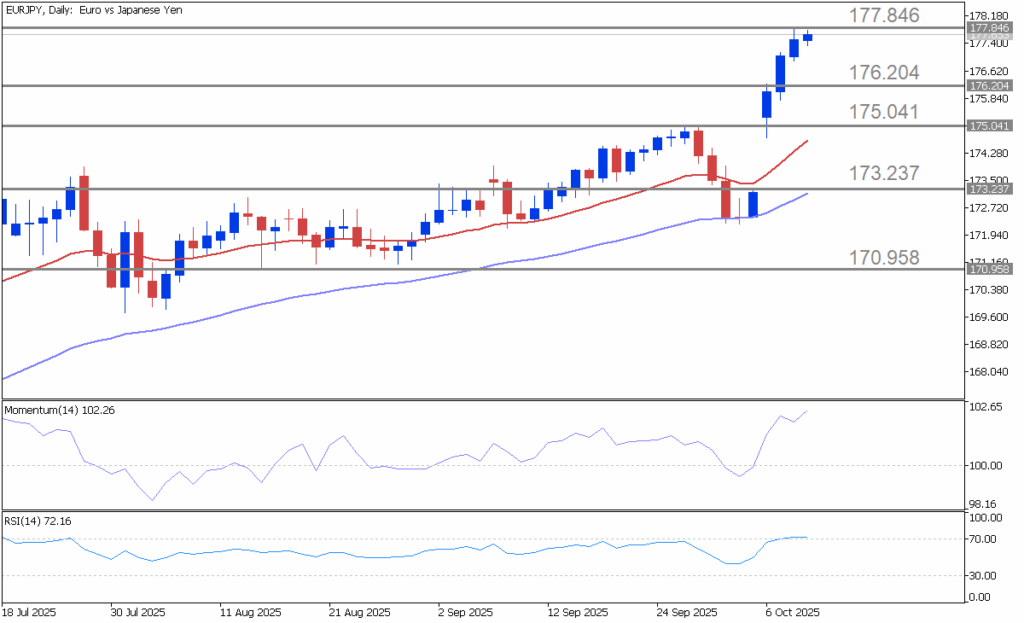
The EURJPY currency pair has broken out of a two-month consolidation phase, reaching a new 2025 record high of 177.846. The breakout was first signaled by a Morning Star candlestick reversal near the 50-period Exponential Moving Average (EMA), confirming renewed bullish momentum. This was followed by a gap up and four consecutive sessions of higher highs and higher lows, reinforcing the strength of the upward move. Prices remain firmly above the 20- and 50-period EMAs, both sloping upward and supporting a continuation bias. Momentum indicators also validate the bullish scenario — the Momentum Oscillator stays above 100, while the Relative Strength Index (RSI) remains above 70, reflecting strong buying pressure and overbought conditions typical of sustained rallies. As of writing, EURJPY trades slightly below its record peak at 177.646, with short-term pullbacks likely to attract dip-buyers within the broader uptrend.
Should the bulls maintain market control, traders may direct their attention toward the four potential resistance levels below:
177.846: The initial resistance is 177.846, which aligns with the highest exchange rate reached in 2025.
179.542: The second price target is identified at 179.542, corresponding to the 261.8% Fibonacci Extension between the swing high of 175.041 and the swing low of 172.259.
182.324: The third target is established at 182.324.
184.044: An additional price target is estimated at 184.044, corresponding to the 423.6% Fibonacci Extension drawn from the swing high of 175.041 and the swing low of 172.259.
Should the sellers take market control, traders may consider the four potential support levels listed below:
176.204: The first support level is identified at 176.204, representing the weekly support, S2, estimated using the standard Pivot Points methodology
175.041: The second support level is positioned at 175.041, aligning with a peak marked on September 26.
173.237: The third line of support is established at 173.237, representing a daily high from October 3.
170.958: An additional downward target is observed at 170.958, reflecting a daily low from August 14.
Germany slightly raised its 2025 growth outlook to 0.2%, helped by a large government spending plan aimed at reviving the economy. Officials expect domestic demand to drive recovery as exports struggle with trade tensions and weak global demand.
European bond yields rose after French Prime Minister Sebastien Lecornu unexpectedly resigned, deepening France’s political crisis. The turmoil pushed French and German long-term yields higher as investors demanded a larger risk premium for French debt. The rise followed earlier pressure on global bond markets after Japan’s 30-year yields hit record highs. Meanwhile, German industrial orders fell again in August, highlighting continued weakness in Europe’s largest economy.
Japan’s weak yen is seen as beneficial for the economy, making domestic manufacturing more viable at around ¥140–¥150 per dollar. Rising import costs, while a concern, could be offset through aggressive government spending aimed at stimulating growth. The Bank of Japan is expected to raise rates once more to 0.75% by early 2026 and hold steady until 2027, when stronger domestic demand may prompt gradual tightening.
As markets digest today’s US labor data and await Friday’s releases from Canada and the US, traders should remain alert to potential shifts in sentiment and volatility. The EURJPY’s technical structure continues to favor the bulls, with strong momentum and clear trend alignment supporting further upside potential. However, given the overbought conditions and the influence of upcoming economic data, short-term pullbacks are possible before the broader uptrend resumes. Overall, market participants are likely to focus on how this week’s data flow and global developments influence risk appetite and cross-currency dynamics heading into next week.



Financial markets were shaped by a busy week of economic data, central bank decisions, and corporate earnings.

Markets face a busy week of high-impact economic events, with central bank policy, inflation, employment, growth and energy data all in focus.

Get the FXGT App