Important Note!
We use cookies to ensure you get the best experience on our website.
By clicking ‘Agree,’ you accept our use of cookies as outlined in our cookies policy

This week, New Zealand’s economy remains in sharp focus as the Reserve Bank of New Zealand (RBNZ) takes steps to strengthen financial oversight and support stability amid mixed economic signals. The central bank’s move to establish a new Financial Policy Committee (FPC) comes at a time when business confidence is weakening, inflation pressures are resurfacing, and the housing market is showing tentative signs of recovery after months of decline. Together, these developments highlight the delicate balance policymakers face as they navigate slowing growth, easing monetary conditions, and efforts to foster greater competition within the nation’s banking sector.
The Reserve Bank of New Zealand (RBNZ) announced plans to establish a new Financial Policy Committee (FPC) that will have the authority to set prudential banking requirements and make decisions on mortgage lending ratios. The initiative follows recommendations from a recent parliamentary inquiry into banking competition and aims to strengthen the central bank’s financial policy framework.
The move comes as New Zealand’s government pushes for greater competition in a sector dominated by four major Australian-owned banks — Westpac, ASB, Bank of New Zealand, and ANZ. The new committee will include the RBNZ chair, governor, three board members, and up to two independent external members.
Deputy Chair Rodger Finlay said the FPC will enhance policy focus and expertise to ensure the stability of New Zealand’s financial system. The committee is expected to become operational in early 2026, following the RBNZ’s earlier proposal to ease capital requirements for lenders to support credit availability and reduce borrowing costs.
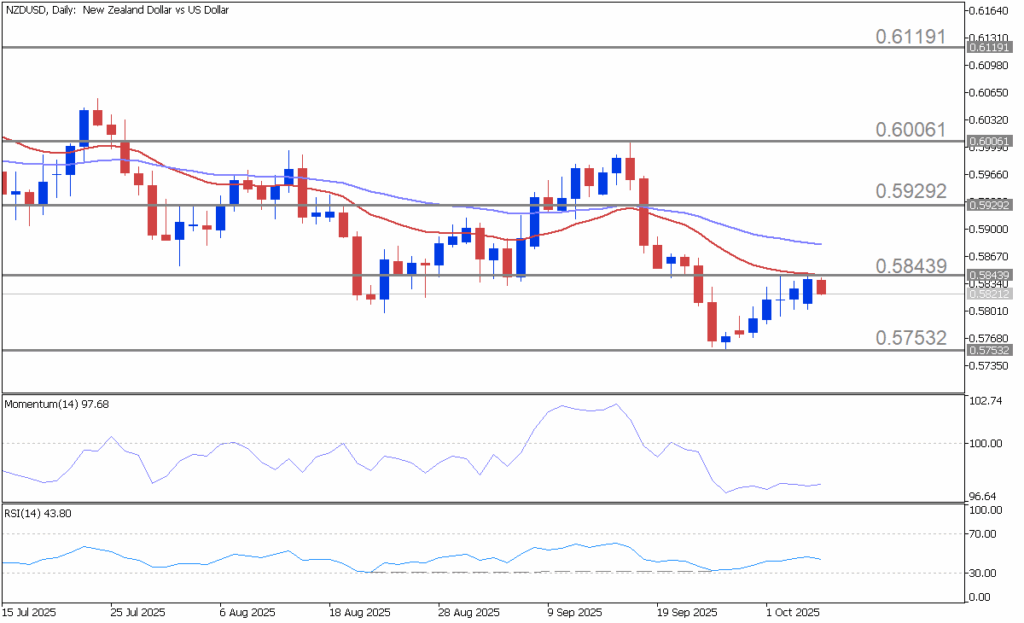
Since bottoming at 0.57532 on September 26, NZDUSD has rebounded modestly, gaining over 1.5% as traders reassessed the near-term outlook. Prices, however, have encountered resistance at the 20-period Exponential Moving Average (EMA), which remains positioned below the 50-period EMA, underscoring a persistent bearish bias and limited upside momentum.
From a technical standpoint, momentum indicators confirm the subdued tone. The Momentum Oscillator remains firmly anchored below the 100 baseline, suggesting continued selling pressure, while the Relative Strength Index (RSI) holds beneath the 50 neutral line, reflecting the absence of strong buying interest. Yet, a developing bullish divergence between price and RSI is emerging, hinting at the early stages of a potential corrective recovery if buyers manage to sustain traction above the immediate resistance zone.
New Zealand house prices rose 0.1% in September, marking the first increase in six months, according to property consultancy Cotality’s home value index. The modest uptick follows a revised 0.4% drop in August and comes as lower mortgage interest rates begin to stimulate demand. However, prices remain 0.2% lower than a year ago.
Economists cautioned that the rebound is still fragile, with a large supply of homes for sale and lingering buyer caution expected to limit further gains. Mortgage rates, now at their lowest in three years after the Reserve Bank’s rate cuts, could fall further, offering relief to borrowers and potential support for housing demand in 2026.
While the broader economy remains weak — contracting 0.9% in the second quarter and facing a five-year-high jobless rate — a gradual recovery in consumer spending may stabilize the property market. Analysts suggest that sustained, moderate price growth could emerge next year, though a sharp rebound remains unlikely.
Business confidence in New Zealand declined in the third quarter of 2025 as inflation pressures rose, according to the New Zealand Institute of Economic Research (NZIER). A net 18% of firms expected business conditions to improve, down from 22% in the previous quarter. On a seasonally adjusted basis, optimism fell to 15% from 26%, and capacity utilization eased slightly to 89.1%.
NZIER’s principal economist said that while firms were somewhat more upbeat about the future, they remained cautious about hiring, investment, and pricing. Inflation pressures intensified, with a net 11% of firms raising prices compared with 1% reporting price cuts previously. They noted that economic growth likely stagnated in the third quarter, with a small contraction possible.
New Zealand’s economy has contracted in three of the past five quarters, including a 0.9% decline in the second quarter. The weakness is expected to push the Reserve Bank of New Zealand (RBNZ) toward cutting its 3.0% cash rate at Wednesday’s policy meeting. Most economists expect a 25-basis-point reduction, though a 50-point cut remains possible. NZIER’s base case also sees a 25-basis-point cut but said the survey data would not deter a larger move if the central bank chose to act more aggressively.
New Zealand’s economic outlook remains mixed as policymakers balance efforts to stabilize growth, curb inflation, and strengthen financial oversight. The Reserve Bank’s upcoming policy decisions, including the establishment of the new Financial Policy Committee, signal a more proactive approach to managing both systemic risks and competition in the banking sector. Meanwhile, tentative signs of recovery in housing and the Kiwi’s modest rebound in currency markets point to early, yet fragile, signs of stabilization. However, with business confidence still subdued and economic growth uneven, sustained improvement will likely depend on further monetary easing and a gradual revival in domestic demand heading into 2026.



Financial markets were shaped by a busy week of economic data, central bank decisions, and corporate earnings.

This week brings several high-impact economic events that could create significant volatility across major currencies.

Get the FXGT App