Important Note!
We use cookies to ensure you get the best experience on our website.
By clicking ‘Agree,’ you accept our use of cookies as outlined in our cookies policy

Markets are turning their attention to a busy second half of the week, with key data and central bank decisions lined up. Later today, the US PPI release will provide the first major inflation signal, followed by the ECB’s rate decision and US CPI on Thursday. Weekly jobless claims, UK GDP, and US consumer sentiment will round out the week. These reports come at a critical juncture, as weaker labor market data has heightened expectations for Fed rate cuts, making each release a potential market mover.
Wednesday 15:30 (GMT+3) – USA: PPI m/m (USD)
Thursday 15:15 (GMT+3) – Europe: Main Refinancing Rate (EUR)
Thursday 17:30 (GMT+3) – USA: CPI m/m (USD)
Thursday 15:30 (GMT+3) – USA: Unemployment Claims (USD)
Friday 09:00 (GMT+3) – UK: GDP m/m (GBP)
Friday 17:00 (GMT+3) – USA: Prelim UoM Consumer Sentiment (USD)
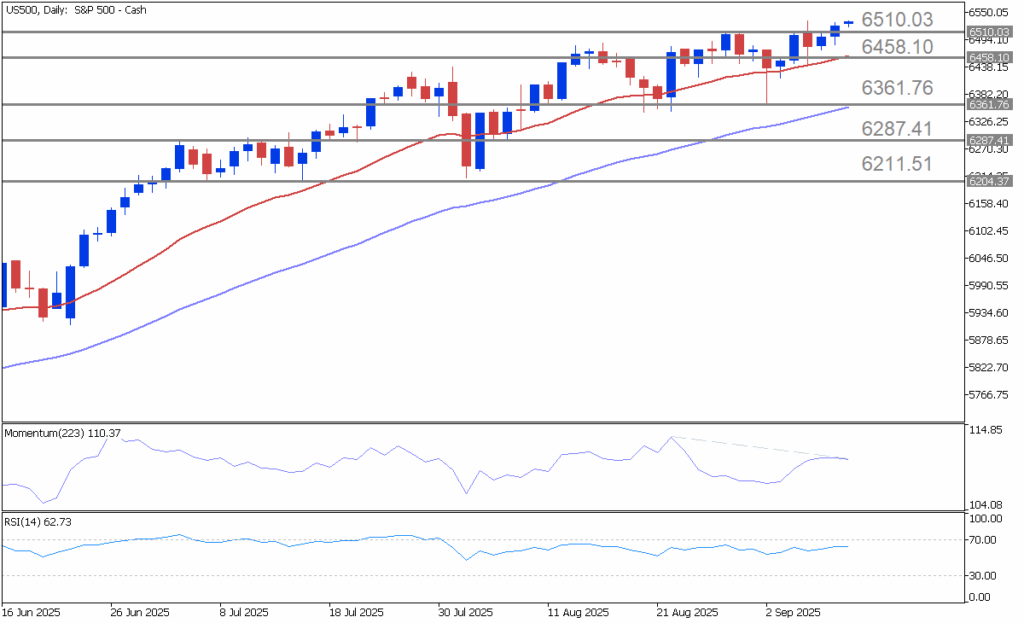
Since bottoming at 4,800.73 on April 7, the S&P 500 has been in a sustained uptrend. The advance began with a failure swing reversal, as the subsequent trough at 5,100.90 held above the prior low, and gained traction with a breakout above key resistance at 5,492.67. This shift in market structure established a sequence of higher highs and higher lows, confirming a bullish bias.
Trend strength has been reinforced by a “Golden Cross” between the 20- and 50-period EMAs, with both averages rising and the shorter-term EMA leading. Price remains comfortably above both levels, underscoring ongoing upward momentum. The breakout through 6,510.03 set a new all-time high, opening the scope for further gains.
Momentum signals remain supportive: the Momentum oscillator is holding above its 100 baseline, and the RSI is sustaining readings above 50. That said, a negative divergence between price and the Momentum oscillator has developed, suggesting the potential for a short-term pullback within the broader uptrend.
Should the bulls maintain market control, traders may direct their attention toward the four potential resistance levels below:
6601.66: The initial resistance is 6601.66, which aligns with the 161.8% Fibonacci Extension drawn from 6510.031 to 6361.76.
6725.14: The second price target is identified at 6725.14, corresponding to the weekly resistance, R3, calculated using the standard Pivot Point methodology.
6898.20: The third target is established at 6898.20.
6989.93: An additional price target is estimated at 6989.93, mirroring the 423.6% Fibonacci Extension drawn from 6510.031 to 6361.76.
Should the sellers take market control, traders may consider the four potential support levels listed below:
6458.10: The first support level is identified at 6458.10, representing the weekly Pivot Point, PP, calculated using the standard methodology.
6361.76: The second support level is positioned at 6361.76, corresponding to the daily low from September 2.
6287.41: The third line of support is established at 6287.41, representing the weekly support, S2, estimated using the standard Pivot Points methodology.
6211.51: An additional downward target is observed at 6211.51, reflecting the trough marked on August 1.
The US labor market is weaker than previously thought, with the Bureau of Labor Statistics revising job growth down by 1.2 million over the past 16 months. The sharp downgrade, along with sluggish August hiring and declining worker confidence, has intensified pressure on the Federal Reserve to begin cutting interest rates. Markets now expect the Fed to deliver rate cuts at each of its three remaining meetings this year, starting with at least a quarter-point move on September 17. While some economists argue the revisions could justify a larger cut, others caution that the data may overstate the slowdown. The White House, meanwhile, has seized on the figures to step up criticism of Fed Chair Jerome Powell and demand faster policy easing.
In summary, markets enter the latter half of the week at a critical crossroads. Technicals continue to point to a strong uptrend in the S&P 500, but soft labor data and upcoming inflation reports leave room for volatility. With expectations firmly tilted toward Fed rate cuts, each release in the days ahead could shape both monetary policy and market momentum.



Financial markets were shaped by a busy week of economic data, central bank decisions, and corporate earnings.

Markets face a busy week of high-impact economic events, with central bank policy, inflation, employment, growth and energy data all in focus.

Get the FXGT App