Important Note!
We use cookies to ensure you get the best experience on our website.
By clicking ‘Agree,’ you accept our use of cookies as outlined in our cookies policy
Have you ever looked at a chart or a trading platform and seen two prices for the same currency, side by side? Maybe you’ve heard terms like “bid” and “ask” thrown around and wondered what they actually mean. If so, you’re in the right place. Understanding the bid and ask prices is not just a detail; it’s the foundation of how the Forex market really works and determining when and how you enter or exit a trade.
You may have noticed that currencies on any Foreign Exchange are always traded in pairs. When you see a quote of, let’s say, EUR/USD, you are looking at the exchange rate of the Euro priced against the US Dollar. But it’s not as simple as a single price. Every time you want to buy or sell a currency pair, there will always be a pair of prices we speak of – the Bid and the Ask. These two prices are the basis of every transaction, representing the current supply and demand in the market.
Bid vs ask in Forex is one of the first things beginners must learn. In this guide, we break down forex quotes, the bid ask formula, and how spreads affect your trades, using real examples and clear explanations you can apply today.
A forex quote shows you the current price of one currency relative to another, and always comes as a currency pair, like GBP/USD or USD/JPY. In simple terms, it tells you how much of the second currency is required to buy one unit of the first.
For a complete overview of the basics, be sure to read our article: What Is Forex? It’s the perfect companion to this guide.
Let’s take a common example: EUR/USD 1.0850/1.0852.
What does this tell us?
This quote tells us that for 1 Euro, you will get approximately 1.08 US Dollars. However, as we’re about to explore, whether you’re buying or selling that Euro will determine which of those two numbers you interact with. This dual-price system is crucial for understanding the costs associated with trading.
Once you feel comfortable with the fundamentals, be sure to check out our related article, How Do I Trade Forex?, to learn about the actual mechanics of a trade.
Let’s start with the bid price. In the quote EUR/USD 1.0850/1.0852, the bid price is the first number: 1.0850. So, what exactly does it represent?
The bid price is the highest price a buyer (or a broker) is willing to pay for the base currency at a given moment. More importantly, from a trader’s perspective, the bid price is the price at which you can sell the base currency to your broker.
Imagine you have some Euros and you want to sell them to buy US Dollars. The bid price is the rate your broker is offering to buy those Euros from you.
Let’s use our example:
EUR/USD 1.0850/1.0852
Think of it this way: when you want to get rid of something (sell), you look at what someone else is willing to bid for it. Your broker is essentially the “someone else” in this scenario, bidding for your currency.
The bid price is always lower than the ask price (which we’ll discuss next in the article). This difference is how brokers and liquidity providers make money, forming what is known as the “spread.”
Now let’s turn our attention to the ask price, sometimes also called the offer price. In our example quote EUR/USD 1.0850/1.0852, the ask price is the second number: 1.0852. What does it signify?
The ask price is the lowest price that a seller (or an “asker”) is willing to accept for the base currency at a given moment. For you, the trader, the ask price is the price at which you can buy the base currency from your broker.
Imagine you want to acquire Euros using your US Dollars. The ask price is the rate your broker is offering to sell those Euros to you.
Let’s use our example quote again:
Think of it from the perspective of purchasing an item: when you want to buy something, you look at what the seller is asking for it. In this case, your broker is the “seller,” asking a specific price for the currency you wish to acquire.
As mentioned, the ask price is always higher than the bid price.
To make it easier for you to comprehend, we will contrast the bid and ask prices side-by-side and spotlight their basic differences. This table will serve as a visual summary to help you differentiate:
| Feature | Bid Price | Ask Price |
| Definition | Price at which you can sell the base currency | Price at which you can buy the base currency |
| Who sets it? | Buyers / Broker (market demand) | Sellers / Broker (market supply) |
| Perspective | The price your broker is willing to buy from you | The price your broker is willing to sell to you |
| Position | Always the lower of the two prices in a quote | Always the higher of the two prices in a quote |
| Action | Used for opening a sell order | Used for opening a buy order |
| Location in quote | Usually left side of the quote | Usually right side of the quote |
This table clarifies that whenever you decide to enter a trade, whether you’re buying or selling a currency pair, you always interact with either the bid or the ask price, never a single, universal price. This is something that you must understand as a beginner in Forex.
Now that you understand Bid and Ask prices individually, it’s time to connect them to one of the most important concepts in Forex trading: the spread.
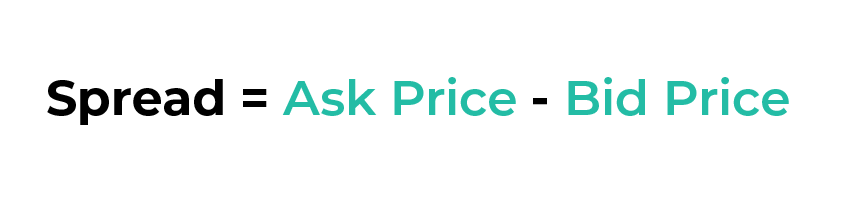
The spread is the difference between the bid and ask prices. It represents the broker’s compensation for executing the trade.
Let’s go back to our example:
EUR/USD 1.0850/1.0852, where
Spread = 1.0852 – 1.0850 = 0.0002
This difference, 0.0002, is typically measured in “pips.” A pip (percentage in point) is the smallest price increment in Forex. For most currency pairs, a pip is the fourth decimal place. So, a difference of 0.0002 means the spread is 2 pips.
The spread is a dynamic element and can change based on various factors such as market volatility, liquidity, and the specific currency pair being traded.
Spreads are especially important for scalpers and day traders, as they directly affect profitability. To truly grasp the concept of the spread, we recommend our detailed article, What is Spread? Understanding Its Significance in Trading, which includes examples and a deeper explanation.
Now that you have a solid theoretical understanding of bid and ask, let’s look at how you’ll encounter them in the real world – on a trading platform. Most Forex trading platforms are designed to display these prices clearly, but knowing what to look for will make your trading experience smoother.
When you log into a trading platform like FXGT.com Trader or MetaTrader 4/5, you’ll typically see a “Market Watch” or “Symbols” window. This is where you’ll find a list of available currency pairs and their real-time quotes. Depending on your broker’s interface, the bid and ask may be highlighted in different colors (e.g., red for bid and green for ask), or labeled clearly. Some might just show two numbers, with the lower one always being the bid and the higher one the ask.
In your trading terminal, it might look like this visual representation:
| Symbol | Bid | Ask |
| EUR/USD | 1.0850 | 1.0852 |
| GBP/JPY | 180.25 | 180.30 |
You might also notice a line or a visual representation of the spread between the bid and ask prices on some charting tools. This is often called the “bid/ask line” or “spread line.”
It’s a common mistake for beginners to overlook the spread and only focus on one price. Always remember that when you open a position, you’re paying the spread upfront. This is why a buy order immediately starts in negative territory, and a sell order also reflects the spread. Familiarizing yourself with how your specific platform displays these prices is a crucial step in becoming a confident trader.
If you’re ready to start exploring the world of Foreign Exchange trading, begin your journey by registering at FXGT.com. Once you register, you can access the world’s most liquid market and trade CFDs on major, minor, and exotic FX pairs. For a full list of the Forex assets available, visit the Forex section.
Bid and ask are at the core of every forex quote, and understanding them is non-negotiable for anyone who wants to start trading with confidence. To recap:
Make these core concepts the foundation of your trading journey and continuously build on your understanding of them. Pay attention to the bid/ask prices on your trading platform, observe how the spread fluctuates, and always consider its impact on your potential profits. Mastering this will help you navigate forex quotes, choose the right entry and exit points, and manage your trading costs with clarity.
Explore more trading guides and tips on our FXGT Blog.


The USDCAD H4 chart is showing an important potential transition from a prolonged corrective decline into a new bullish Elliott Wave structure.


Gold (XAUUSD) continues to maintain a bullish Elliott Wave structure on the H4 timeframe.

Get the FXGT App