Important Note!
We use cookies to ensure you get the best experience on our website.
By clicking ‘Agree,’ you accept our use of cookies as outlined in our cookies policy

Markets are bracing for a busy Thursday with several high-impact economic releases on the calendar. Focus is on US inflation data and unemployment claims, alongside the European Central Bank’s policy decision. These reports come at a critical moment, with gold holding near record highs and traders positioning ahead of an expected Federal Reserve rate cut next week. The outcomes could set the tone for near-term moves across the dollar, precious metals, and broader risk assets.
Thursday 15:15 (GMT+3) – Europe: Main Refinancing Rate (EUR)
Thursday 17:30 (GMT+3) – USA: CPI m/m (USD)
Thursday 15:30 (GMT+3) – USA: Unemployment Claims (USD)
Friday 09:00 am (GMT+3) – UK: GDP m/m (GBP)
Friday 17:00 (GMT+3) – USA: Prelim UoM Consumer Sentiment (USD)
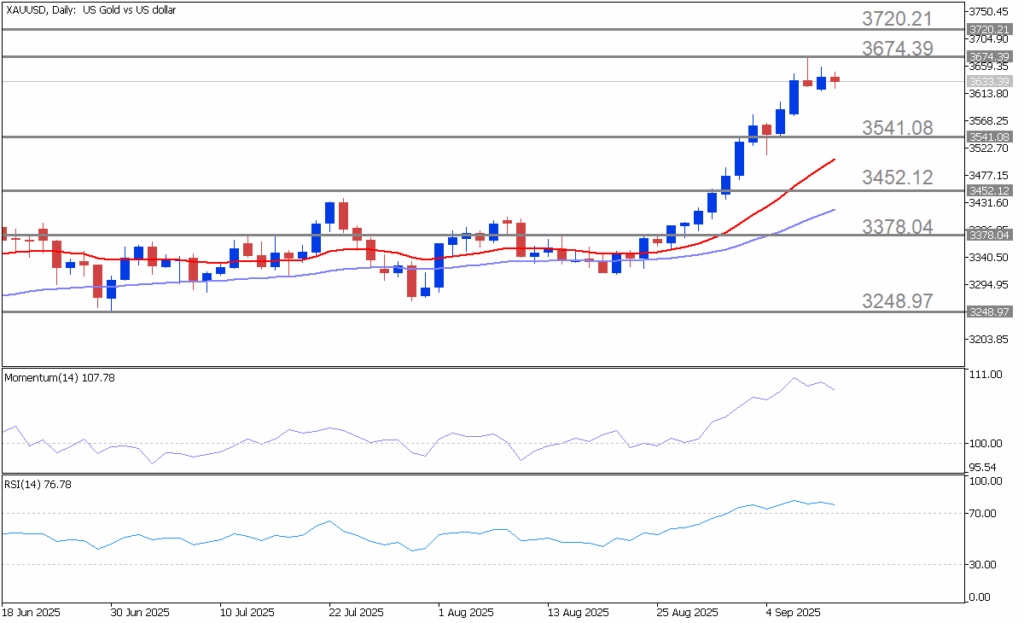
Gold extended its rally to a fresh record high of $3,674.39 per troy ounce on September 9, underpinned by supportive macroeconomic and geopolitical drivers. The move reflects a confluence of factors: growing safe-haven demand amid geopolitical tensions, heightened uncertainty surrounding the US and global economy, and market expectations of an imminent Federal Reserve rate cut.
From a technical perspective, the uptrend remains firmly intact. Spot prices continue to trade above the 50-period Exponential Moving Average, while momentum oscillators reinforce bullish sentiment — the Momentum oscillator is above the 100 threshold, and the Relative Strength Index (RSI) remains above 50, indicating intensifying buying pressure. Additionally, the widening of Bollinger Bands and sustained closes above the upper band highlight the strength of the current move.
That said, near-term caution is warranted. The emergence of a Shooting Star candlestick formation signals the possibility of an impending corrective pullback before the broader uptrend resumes.
Should the bulls maintain market control, traders may direct their attention toward the four potential resistance levels below:
3,674.39: The initial resistance is set at $3,674.39, which corresponds to the daily high reached on September 9.
3,720.21: The second price objective is projected at $3,720.21, corresponding to the 423.6% Fibonacci Extension, calculated between the swing high of $3,407.94 and the swing low of $3,311.44.
3,780.35: The third price target is established at $3,780.35, aligning with the 261.8% Fibonacci Extension level, calculated from $3,452.12 to $3,248.97.
3,983.32: An additional price target is seen at $3,983.32.
Should the sellers take market control, traders may consider the four potential support levels listed below:
3,541.08: The initial support level is identified at 3,541.08, based on the weekly Pivot Point, PP, calculated using the standard methodology.
3,452.12: The second support level is positioned at 3,452.12, corresponding to the daily high established on June 16.
3,378.04: The third support level is situated at 3,378.04, in alignment with the weekly support, S2, estimated using the standard Pivot Points methodology.
3,248.97: An additional downside target is noted at 3,248.97, corresponding to the daily low established on July 30.
Gold prices eased slightly on Thursday, holding near record highs as investors awaited key US consumer inflation data. Spot gold slipped 0.3% to $3,629.71 per ounce after hitting an all-time high of $3,674.39 earlier in the week, while US gold futures fell 0.4% to $3,666.70. The dip follows weaker-than-expected producer price data, reinforcing expectations that the Federal Reserve will cut rates next week. Markets are watching CPI figures, forecast at 0.3% monthly and 2.9% annually, alongside jobless claims for further signals on monetary policy. Lower interest rates generally support gold, though a stronger CPI could weigh on prices in the short term. Silver, platinum, and palladium also edged lower.
On the other hand, the US dollar was little changed on Wednesday as traders waited for the August inflation report. The dollar initially rose after Poland shot down Russian drones, boosting safe-haven demand, but gains faded when weaker US producer price data reinforced expectations of a Fed rate cut next week. Markets now fully expect the Fed to cut rates by 25 basis points, with some even betting on a bigger move and more cuts later this year. Meanwhile, the euro weakened on geopolitical tensions but found support as the European Central Bank is seen largely done with rate cuts, unlike the Fed.
In summary, gold remains supported by safe-haven demand, Fed rate cut expectations, and ongoing geopolitical uncertainty, but near-term risks of a corrective pullback cannot be overlooked. With key economic data and central bank decisions due, market volatility is likely to remain elevated. Traders should watch the upcoming releases closely, as they will be pivotal in shaping short-term direction for both gold and the US dollar.



Gold (XAUUSD) is currently showing signs of a potential recovery after experiencing a sharp corrective decline from the recent high area.


Gold (XAUUSD) on the H4 timeframe is showing signs of a significant corrective phase following the strong bullish advance seen throughout August.

Get the FXGT App