Important Note!
We use cookies to ensure you get the best experience on our website.
By clicking ‘Agree,’ you accept our use of cookies as outlined in our cookies policy

This week’s trading landscape is set against a backdrop of key economic releases from Australia, the UK, and the United States, each with the potential to influence currency, commodity, and equity markets. In particular, employment data, GDP growth, inflation metrics, and consumer sentiment figures will be closely watched by traders seeking to gauge the health of major economies and anticipate central bank policy moves. Against this macroeconomic backdrop, crude oil prices remain under pressure, with technical signals pointing to a prevailing bearish trend reinforced by recent fundamental data.
Thursday 04:30 am (GMT+3) – Australia: Employment Change (AUD)
Thursday 9:00 am (GMT+3) – UK: GDP m/m (GBP)
Thursday 15:30 (GMT+3) – USA: PPI m/m (USD)
Friday 15:30 (GMT+3) – USA: Retail Sales m/m (USD)
Friday 17:00 (GMT+3) – USA: Prelim UoM Consumer Sentiment (USD)
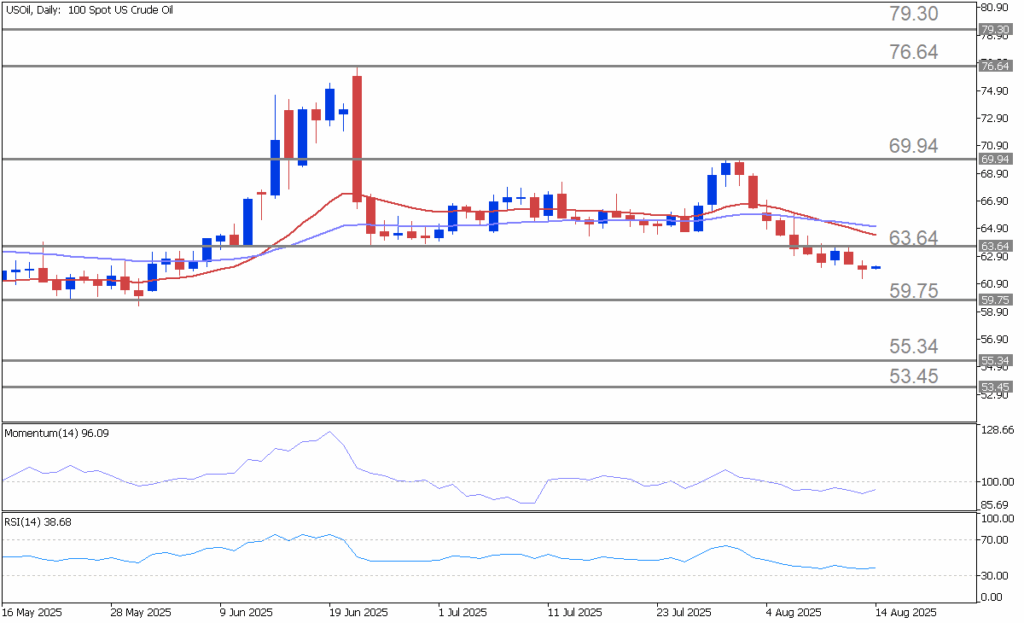
Crude Oil has been in a sustained downtrend since peaking at $76.64 per barrel on June 23, where price action printed a Bearish Engulfing candlestick pattern, signaling a potential reversal. A subsequent consolidation phase from June to August ended with a breakdown below the lower range boundary at $63.64, paving the way for further downside.
The bearish bias was reinforced by a “Death Cross” signal, as the 20-period Exponential Moving Average (EMA) crossed below the 50-period EMA, amplifying selling pressure. Momentum indicators align with this outlook — the Momentum Oscillator remains below the 100 baseline, and the Relative Strength Index (RSI) is holding under the 50 level — both consistent with prevailing bearish sentiment.
Should the buyers take market control, traders may direct their attention toward the four potential resistance levels below:
63.64: The first price target is determined at 63.64, representing the lower boundary of the consolidation phase in the months of June and August.
69.94: The second target is set at 69.94, corresponding to the upper boundary of the consolidation phase.
76.64: The third price target is established at 76.64, which reflects the swing high from June 23.
79.30: An additional resistance is seen at 79.30, aligning with the high point marked on January 15.
Should the sellers keep market control, traders may consider the four potential support levels listed below:
59.75: The primary downside target is observed at 59.75, corresponding to the 161.8% Fibonacci Extension drawn from the lower boundary to the upper boundary of the consolidation phase.
55.34: The second support level is identified at 55.34, representing the swing low marked on May 5.
53.45: The third support line is established at 53.45, corresponding to the 261.8% Fibonacci Extension drawn from the lower boundary to the upper boundary of the consolidation phase.
47.15: An additional downward target is recognized at 47.15.
U.S. oil refineries ran at high capacity last week, processing 17.2 million barrels of Crude Oil per day — slightly more than the week before — and operating at 96.4% of capacity. Gasoline and diesel (distillate fuel) production both rose.
Crude oil imports jumped to 6.9 million barrels per day, the highest in recent weeks, although the four-week average remains slightly lower than last year’s levels. Gasoline imports were steady, while diesel imports stayed low.
Commercial crude oil stockpiles grew by 3 million barrels but are still about 6% below the typical level for this time of year. Gasoline inventories dipped slightly, diesel stocks rose, and propane supplies saw a large increase. Overall, total petroleum inventories climbed by 7.5 million barrels.
Fuel demand over the past month was up nearly 3% from last year, driven in part by higher jet fuel use, though gasoline and diesel demand were slightly lower compared to a year ago.
With crude oil prices locked in a clear downtrend and fundamentals reflecting rising inventories alongside robust refinery activity, the market remains tilted toward a bearish bias. This week’s high-impact economic releases could inject volatility across asset classes, potentially influencing crude demand expectations and short-term price momentum. Traders should remain alert to both macroeconomic surprises and technical breakouts from key support or resistance levels.



The EURUSD H4 chart shows a developing bullish Elliott Wave structure following the completion of a significant corrective decline.


Gold (XAUUSD) is currently showing signs of a potential recovery after experiencing a sharp corrective decline from the recent high area.

Get the FXGT App