Important Note!
We use cookies to ensure you get the best experience on our website.
By clicking ‘Agree,’ you accept our use of cookies as outlined in our cookies policy

Markets are entering Friday’s session with attention firmly on upcoming US retail sales and consumer sentiment data, both of which could shape short-term sentiment and volatility. While the S&P 500 continues to post record highs, underlying economic signals are sending mixed messages, with tech-led momentum masking signs of slower consumer demand, rising corporate stress, and concentrated market leadership. Traders will be watching whether today’s data reinforces the bullish trend or adds weight to concerns of a near-term pullback.
Friday 15:30 (GMT+3) – USA: Retail Sales m/m (USD)
Friday 17:00 (GMT+3) – USA: Prelim UoM Consumer Sentiment (USD)
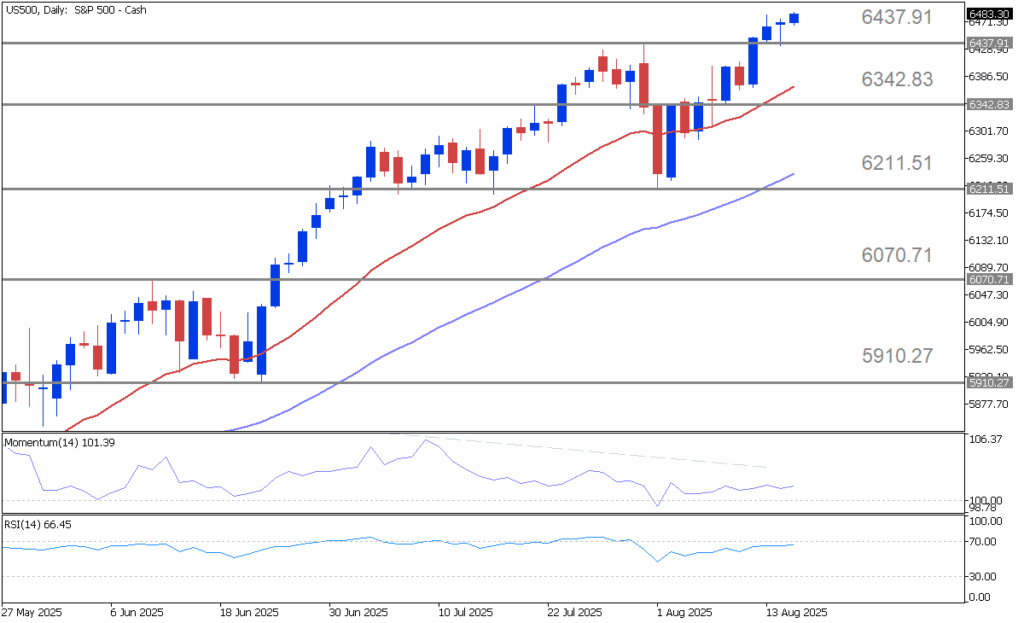
Since bottoming at 4,800.73 on April 7, the S&P 500 has been in a sustained uptrend. The advance began with a failure swing reversal, as the subsequent trough at 5,100.90 held above the prior low, and gained traction with a breakout above key resistance at 5,492.67. This shift in market structure established a sequence of higher highs and higher lows, confirming a bullish bias.
Trend strength has been reinforced by a “Golden Cross” between the 20- and 50-period EMAs, with both averages rising and the shorter-term EMA leading. Price remains comfortably above both levels, underscoring ongoing upward momentum. The breakout through 6,437.91 set a new all-time high, opening the scope for further gains.
Momentum signals remain supportive: the Momentum oscillator is holding above its 100 baseline, and the RSI is sustaining readings above 50. That said, a negative divergence between price and the Momentum oscillator has developed, suggesting the potential for a short-term pullback within the broader uptrend.
Should the bulls maintain market control, traders may direct their attention toward the four potential resistance levels below:
6577.83: The initial resistance is 6587.83, which aligns with the 161.8% Fibonacci Extension drawn from 6437.91 to 6211.51.
6638.22: The second price target is identified at 6638.22, corresponding to the weekly resistance, R3, calculated using the standard Pivot Point methodology.
6804.23: The third target is established at 6804.23, which reflects the 261.8% Fibonacci Extension drawn from 6437.91 to 6211.51.
7170.54: An additional price target is estimated at 7170.54, mirroring the 423.6% Fibonacci Extension drawn from 6437.91 to 6211.51.
Should the sellers take market control, traders may consider the four potential support levels listed below:
6437.91: The first support level is identified at 6437.91, representing the swing high from July 31.
6342.83: The second support level is positioned at 6342.83, corresponding to the weekly Pivot Point, PP, calculated using the standard methodology.
6211.51: The third line of support is established at 6211.51, representing the swing low from August 1.
6070.71: An additional downward target is observed at 6070.71, reflecting the peak from June 11.
Analysts warn that while the US economy appears steady on the surface, several underlying factors point to growing vulnerabilities.
They note that real investment in AI-sensitive sectors has surged 53 percent since 2019, while all other sectors have grown just 0.3 percent. Software and IT equipment spending is contributing a record share to GDP, but investment elsewhere fell in the first half of the year.
According to analysts, consumer spending is losing momentum, with personal consumption up only 0.9 percent in the second quarter, the slowest pace since the pandemic, and flat in real terms in the first half. They also highlight that corporate bankruptcies in July were the highest since July 2020, and year-to-date filings are the worst since 2010, heavily concentrated in consumer discretionary and industrial sectors.
Analysts further caution that market concentration is reaching extreme levels, with Nvidia representing 8 percent of the S&P 500 market value and the top ten stocks accounting for 40 percent of the index and 30 percent of earnings. They believe this leaves both Wall Street and the broader economy more vulnerable if the drivers of these dominant companies weaken.
With the S&P 500 holding near record highs, the technical outlook remains constructive, but stretched momentum and softening fundamentals suggest the market is vulnerable to short-term swings. Upcoming retail sales and consumer sentiment data could act as the next catalyst, either reinforcing bullish momentum or triggering the corrective phase that technical signals have begun to warn of.



Financial markets were shaped by a busy week of economic data, central bank decisions, and corporate earnings.

Markets face a busy week of high-impact economic events, with central bank policy, inflation, employment, growth and energy data all in focus.

Get the FXGT App