Important Note!
We use cookies to ensure you get the best experience on our website.
By clicking ‘Agree,’ you accept our use of cookies as outlined in our cookies policy

This week’s high-impact events include Australia’s employment change, UK GDP, and several key U.S. releases — PPI, retail sales, and preliminary consumer sentiment. The outcomes could shape market expectations for growth, inflation, and monetary policy across major economies.
On the fundamentals side, the RBA cut the cash rate to 3.60%, marking 75 basis points of easing this year as inflation trends back toward target. Labour market conditions have eased slightly but remain tight, while global trade policy uncertainty continues to cloud the outlook. The central bank remains cautious, ready to adjust policy if international developments materially affect Australia’s economy.
Thursday 04:30 am (GMT+3) – Australia: Employment Change (AUD)
Thursday 9:00 am (GMT+3) – UK: GDP m/m (GBP)
Thursday 15:30 (GMT+3) – USA: PPI m/m (USD)
Friday 15:30 (GMT+3) – USA: Retail Sales m/m (USD)
Friday 17:00 (GMT+3) – USA: Prelim UoM Consumer Sentiment (USD)
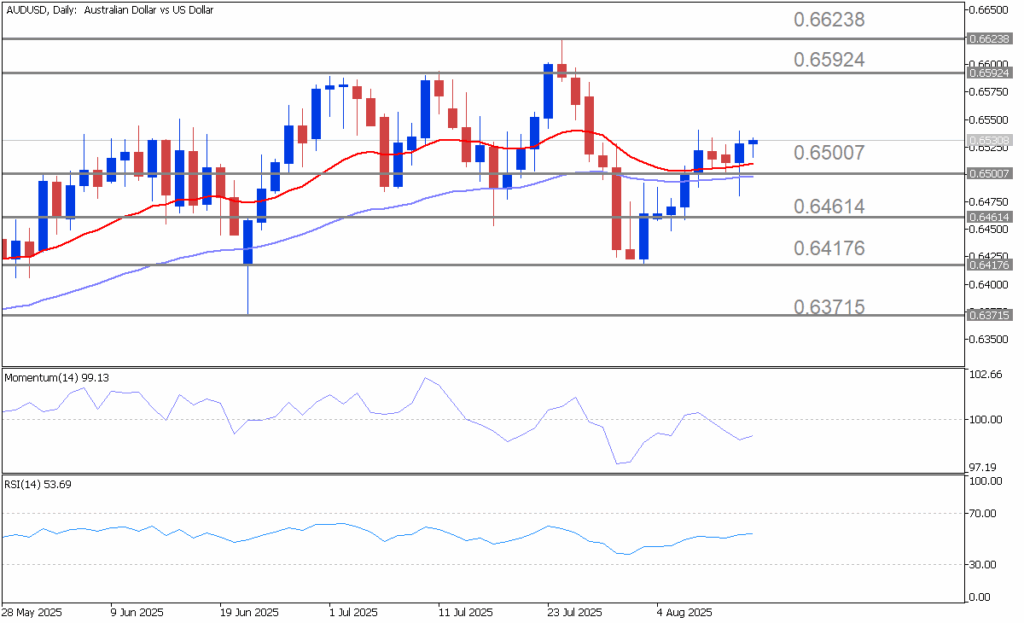
Since bottoming at 0.59124 on April 9, AUDUSD has established a clear bullish trajectory, underpinned by a consistent sequence of higher highs and higher lows. The initial trend reversal was signaled by an Inverted Hammer, with confirmation coming from a subsequent “Three White Soldiers” pattern — a combination that underscored a shift toward bullish sentiment.
This constructive structure has been further validated by a bullish crossover between the 20- and 50-period EMAs (Golden Cross), reinforcing the case for continued upside.
Momentum readings, however, present a mixed picture: the Momentum Oscillator has slipped below the 100 mark, pointing to fading short-term strength, while the RSI remains above 50, reflecting an underlying positive bias.
A sustained break above 0.66238 would reassert bullish momentum and open the path for further gains.
Should the buyers maintain market control, traders may direct their attention toward the four potential resistance levels below:
0.65924: The initial resistance level is set at 0.65924, reflecting the weekly resistance, R2, calculated using the standard Pivot Points methodology.
0.66238: The second price target is set at 0.66238, representing the highest price reached in 2025.
0.66866: The third price objective is observed at 0.66866.
0.69411: An additional upside target is projected at 0.69411.
Should the sellers take market control, traders may consider the four potential support levels listed below:
0.65007: The initial support level is estimated at 0.65007, representing the weekly Pivot Point, PP, estimated using the standard methodology.
0.64614: The second level is seen at 0.64614, corresponding to the weekly support, S1, estimated using the standard Pivot Points methodology.
0.64176: The third support level is identified at 0.64176, reflecting the swing low marked on August 1.
0.63715: An additional downside target is 0.63715, mirroring the daily low from June 23.
Australia’s central bank cut the cash rate target by 25 basis points to 3.60%, marking a total easing of 75 basis points this year. Inflation has continued to moderate, with underlying inflation at 2.7% and headline inflation at 2.1% in the June quarter, both in line with forecasts. Labour market conditions have eased slightly but remain relatively tight, while wage growth has slowed without a corresponding lift in productivity.
Global uncertainty remains high, particularly around trade policy, and domestic demand is recovering gradually. Risks to the outlook include slower-than-expected consumption growth or stronger-than-expected labour market resilience. The Board judged further easing appropriate to support price stability and full employment, but remains cautious, ready to adjust policy if international developments significantly impact Australia’s economy. The decision was unanimous.
In summary, the week ahead offers several catalysts that could drive volatility, with economic releases from Australia, the UK, and the U.S. set to shape sentiment across currencies and commodities. While Australia’s monetary policy stance has shifted toward easing amid moderating inflation, the RBA remains vigilant in the face of global uncertainty and domestic risks. Traders should stay alert to incoming data, as surprises in growth, inflation, or labour market figures could quickly alter market expectations and price dynamics.



Financial markets were shaped by a busy week of economic data, central bank decisions, and corporate earnings.

Markets face a busy week of high-impact economic events, with central bank policy, inflation, employment, growth and energy data all in focus.

Get the FXGT App