Important Note!
We use cookies to ensure you get the best experience on our website.
By clicking ‘Agree,’ you accept our use of cookies as outlined in our cookies policy

While global markets await key PMI data from Germany, the UK, and the US, much of the spotlight remains on Netflix (NFLX) following its sharp post-earnings selloff. After hitting a high of $1,340.77 in late June, the stock has dropped over 14%, pressured by a one-time $619 million tax charge and a broader tech sector pullback.
Despite the setback, Netflix continues to show solid fundamentals, with improving valuation metrics and strong financial stability. However, technical signals now point to a bearish trend, as prices fell below key moving averages and formed a “Death Cross” pattern, suggesting potential for further downside unless buyers step in. Traders will be watching closely to see if upcoming market volatility and macro data trigger renewed buying interest or deepen the correction.
Friday 10:30 am (GMT+3) – Germany: Flash Manufacturing PMI (EUR)
Friday 10:30 am (GMT+3) – Germany: Flash Services PMI (EUR)
Friday 11:30 am (GMT+3) – UK: Flash Manufacturing PMI (GBP)
Friday 11:30 am (GMT+3) – UK: Flash Services PMI (GBP)
Friday 16:45 (GMT+3) – USA: Flash Manufacturing PMI (USD)
Friday 16:45 (GMT+3) – USA: Flash Services PMI (USD)
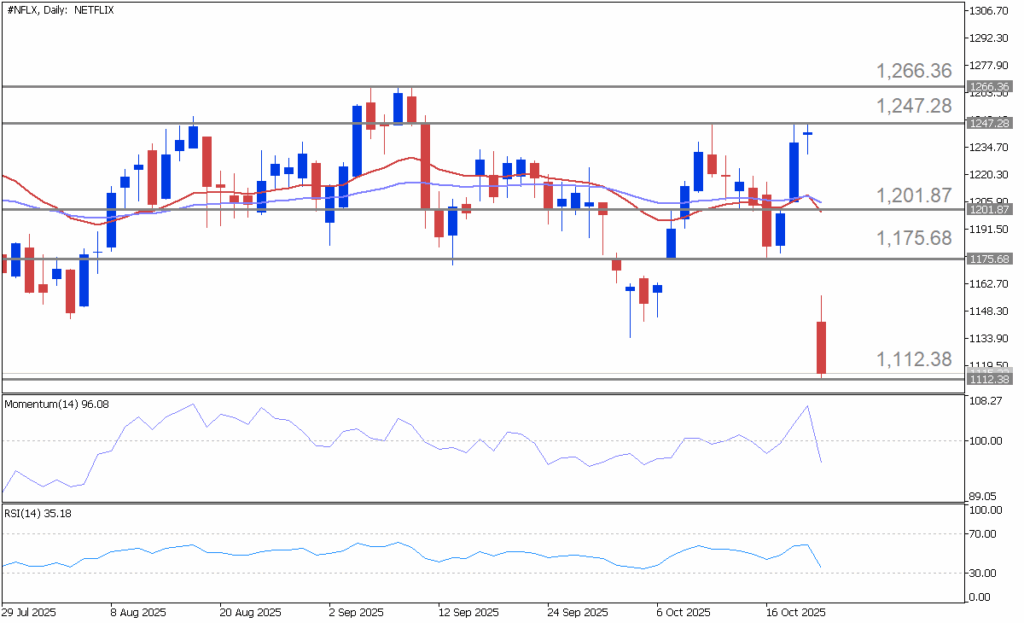
Following its June 30 high of $1,340.77, Netflix (NFLX) shares have declined over 14%, entering an eleven-week consolidation phase before breaking decisively lower. The stock breached the lower boundary at $1,134.41 with a sharp gap down exceeding 10%, confirming a clear downside breakout.
The initial warning came from a non-failure swing, as price first exceeded the previous peak at $1,247.28 before dropping below the trough at $1,175.68, signaling the potential for a trend reversal. Further technical confirmation emerged as prices fell below both the 20- and 50-period Exponential Moving Averages (EMAs), underscoring increased selling momentum.
A “Death Cross” pattern—where the 20-period EMA crossed beneath the 50-period EMA—strengthened the bearish outlook. Momentum indicators also corroborate the weakness: the Momentum Oscillator slipped below 100, and the Relative Strength Index (RSI) fell under 50, reflecting sustained downward pressure.
As of the latest session, NFLX trades at $1,115.33, maintaining a bearish technical bias with potential for further downside unless strong buying support emerges.
Should the bulls take market control, traders may direct their attention toward the four potential resistance levels below:
1,175.68: The initial resistance is 1,175.68, which aligns with the daily low reached on October 16.
1,201.87 The second price target is identified at 1,201.87, corresponding to the weekly Pivot Point, PP, calculated using the standard Pivot Points methodology.
1,247.28: The third target is established at 1,247.28, reflecting the daily high marked on October 20.
1,266.36: An additional price target is estimated at 1,266.36, corresponding to the peak from September 10.
Should the sellers maintain market control, traders may consider the four potential support levels listed below:
1,112.38: The first support level is identified at 1,112.38, representing the daily low marked on October 23.
1,061.60: The second support level is positioned at 1,061.60, aligning with a peak marked on February 9.
988.23: The third line of support is noted at 988.23.
943.98: An additional downward target is observed at 943.98, reflecting the 423.6% Fibonacci Extension drawn from 1,175.68 to 1,247.28.
Netflix shares fell 10% after its Q3 earnings report, as a $619 million tax charge tied to a Brazilian dispute weighed on results. Despite this one-time hit, the company posted 17% revenue growth and maintained a healthy operating margin. Investor sentiment turned cautious following the drop, reflecting broader weakness in tech stocks. Looking ahead, Netflix remains optimistic about cash flow and engagement, with plans to expand its content portfolio and explore strategic acquisitions, including possible Warner Bros. assets.
Netflix’s financial position strengthened in Q3 2025, with valuation metrics showing improvement and debt levels slightly lower. The company’s P/E ratio fell from 55.63x to 48.84x, and its EV/EBITDA ratio declined from 20.38x to 17.76x, indicating the stock is trading at a more attractive valuation relative to its earnings and overall enterprise value.
While the operating margin dipped slightly to 29.14%, Netflix continues to use its assets efficiently, maintaining a strong return on assets (19.46%). The debt-to-equity ratio improved to 0.56, and interest coverage rose to 17.45, signaling solid debt management and financial stability. The company still doesn’t pay dividends, focusing instead on reinvesting profits to support future growth.
Netflix remains under pressure both technically and sentimentally following its steep post-earnings decline. Despite strong fundamentals and improving valuation ratios, the stock’s recent “Death Cross” formation and sustained weakness below key support levels highlight a bearish short-term outlook.
For now, momentum favors the sellers, with downside risks persisting unless the price regains ground above critical resistance areas. However, Netflix’s solid balance sheet, steady revenue growth, and strategic focus on content expansion suggest that long-term fundamentals remain intact, offering potential recovery opportunities once market sentiment stabilizes.



Financial markets were shaped by a busy week of economic data, central bank decisions, and corporate earnings.

Markets face a busy week of high-impact economic events, with central bank policy, inflation, employment, growth and energy data all in focus.

Get the FXGT App