Important Note!
We use cookies to ensure you get the best experience on our website.
By clicking ‘Agree,’ you accept our use of cookies as outlined in our cookies policy

With today’s UK CPI release already in focus, markets are closely monitoring inflation dynamics for clues on the Bank of England’s next policy move. Attention will then shift to Friday, when a series of Flash PMI reports from Germany, the UK, and the US will provide fresh insights into business activity across the manufacturing and services sectors.
These data releases come at a crucial time for the euro, pound, and dollar, as investors gauge whether easing inflation and mixed growth trends justify further policy adjustments. The results are likely to influence near-term volatility, particularly if they highlight diverging economic momentum among major economies.
Wednesday 09:00 am (GMT+3) – UK: CPI y/y (GBP)
Friday 10:30 am (GMT+3) – Germany: Flash Manufacturing PMI (EUR)
Friday 10:30 am (GMT+3) – Germany: Flash Services PMI (EUR)
Friday 11:30 am (GMT+3) – UK: Flash Manufacturing PMI (GBP)
Friday 11:30 am (GMT+3) – UK: Flash Services PMI (GBP)
Friday 16:45 (GMT+3) – USA: Flash Manufacturing PMI (USD)
Friday 16:45 (GMT+3) – USA: Flash Services PMI (USD)
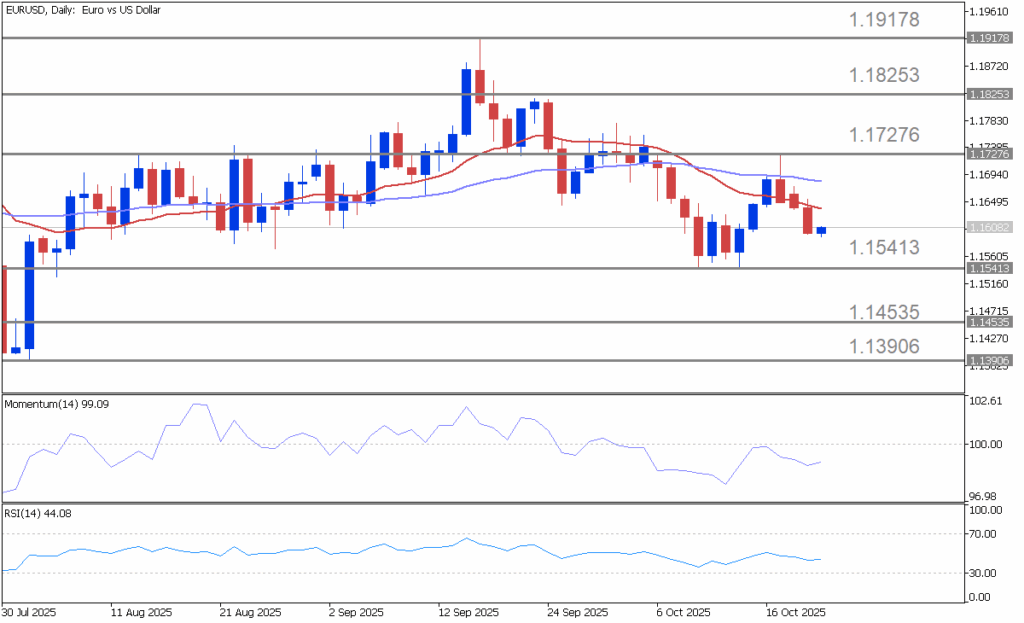
Since peaking at 1.19178 on September 17, the EURUSD has declined by more than 2.5%, tracing a clear pattern of lower highs and lower lows that signals a shift toward bearish market sentiment. The initial technical trigger emerged with a Bearish Harami formation, later confirmed by a failure swing pattern—where the rally to 1.18192 failed to exceed the prior high, followed by a break below 1.17253, opening the path for further downside momentum.
Adding to the bearish confirmation, a “Death Cross” developed as the 20-period EMA crossed below the 50-period EMA, signaling a strengthening downtrend. Momentum indicators reinforce this view: the Momentum Oscillator remains firmly below the 100 line, suggesting persistent weakness, while the RSI holds below its 50 midpoint, pointing to continued selling pressure in the pair.
Should the buyers take market control, traders may direct their attention toward the four potential resistance levels below:
1.17276: The initial price target is set at 1.17276, reflecting the peak from October 17.
1.18253: The second resistance level is established at 1.18253, which mirrors the weekly resistance, R2, calculated using the standard Pivot Points methodology.
1.19178: The third price objective is observed at 1.19178, corresponding to the peak marked on September 17.
1.22654: An additional upside target is projected at 1.22654.
Should the sellers maintain market control, traders may consider the four potential support levels listed below:
1.15413: The initial support level is seen at 1.15413, corresponding to the trough marked on October 9.
1.14535: The second support level is estimated at 1.14535, representing the weekly support, S2, estimated using the standard Pivot Points methodology.
1.13906: The third support level is identified at 1.13906, reflecting the low point from August 1.
1.12399: An additional downside target is 1.12399, mirroring the 261.8% Fibonacci Extension drawn from 1.15413 to 1.17276.
The European Central Bank has achieved a “soft landing,” bringing inflation back to 2% while keeping the economy resilient. Recent interest-rate cuts and easing inflation have created conditions that support investment, sustainable growth, and financial stability.
The global economy’s ongoing transition could help strengthen the euro’s role as a reserve currency, but this would require completing the EU’s banking and capital markets unions, removing internal trade barriers, and increasing investment in technology, defense, and green initiatives.
On another note, Germany has emerged as a driver of change in Europe by expanding public spending and leveraging its borrowing capacity to strengthen defense and infrastructure. Fiscal policy is expected to play a larger supportive role across the region, particularly in countries ramping up military investments.
Germany’s new initiatives signal a shift toward more proactive economic leadership in Europe, with broader efforts to enhance competitiveness, including proposals for a unified European stock market to better rival the U.S. and Asia.
Overall, the market outlook for the EURUSD remains cautious as traders balance improving inflation dynamics in Europe against lingering growth concerns. While the ECB’s policy stance and Germany’s fiscal expansion provide some medium-term support, technical signals continue to favor a bearish bias in the short term. Upcoming UK and U.S. PMI data, alongside eurozone figures, are likely to dictate near-term direction and volatility. A stronger set of PMI readings could offer temporary relief for risk sentiment, but weak results may reinforce downside pressure on the euro, keeping sellers in control.



Financial markets were shaped by a busy week of economic data, central bank decisions, and corporate earnings.

Gold (XAUUSD) is currently showing signs of a potential recovery after experiencing a sharp corrective decline from the recent high area.


Get the FXGT App