Important Note!
We use cookies to ensure you get the best experience on our website.
By clicking ‘Agree,’ you accept our use of cookies as outlined in our cookies policy

Friday’s trading session is expected to be highly eventful, with a series of flash PMI releases from major economies—Germany, the UK, and the US—set to provide fresh insights into global manufacturing and services activity. These data points often serve as early indicators of economic momentum and can trigger sharp movements across currencies, particularly the euro, pound, and dollar pairs. Traders will be closely monitoring the results for signs of economic resilience or weakness, which could influence central bank expectations and short-term market sentiment ahead of the weekend.
Friday 10:30 am (GMT+3) – Germany: Flash Manufacturing PMI (EUR)
Friday 10:30 am (GMT+3) – Germany: Flash Services PMI (EUR)
Friday 11:30 am (GMT+3) – UK: Flash Manufacturing PMI (GBP)
Friday 11:30 am (GMT+3) – UK: Flash Services PMI (GBP)
Friday 16:45 (GMT+3) – USA: Flash Manufacturing PMI (USD)
Friday 16:45 (GMT+3) – USA: Flash Services PMI (USD)
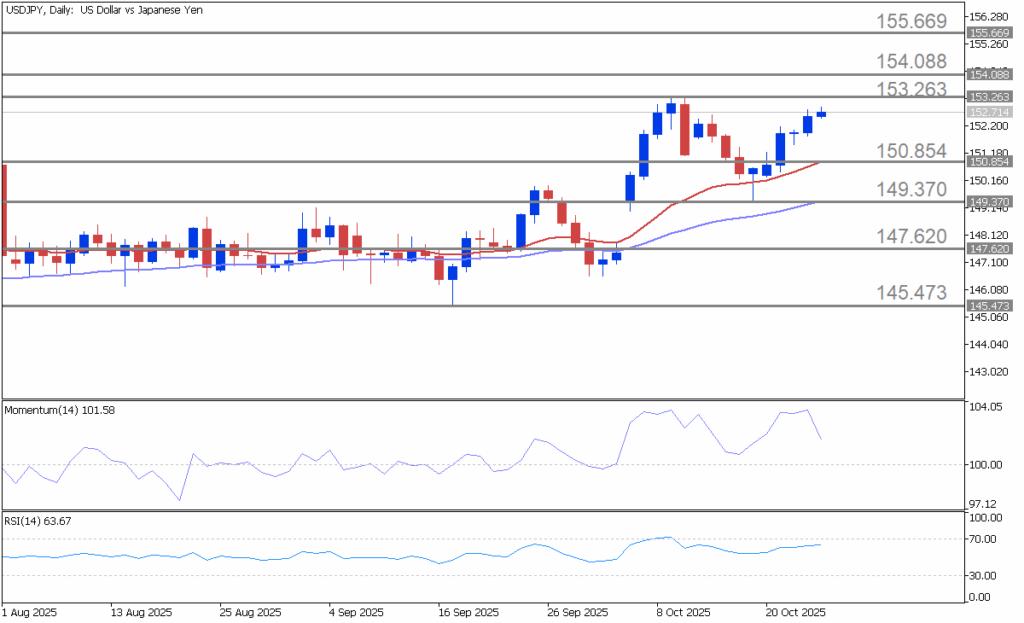
Since breaking out of a two-month consolidation phase, USDJPY extended its upward trajectory, reaching 153.263 on October 10 and signaling renewed bullish momentum. The initial breakout was marked by a strong breakaway gap, confirming the bulls’ commitment to drive the pair higher. Prices have since remained above both the 20- and 50-period Exponential Moving Averages (EMAs), with both slopes pointing upward — a clear sign of trend continuation and underlying market strength.
From an analytical standpoint, technical indicators continue to support the bullish outlook. The Momentum Oscillator is firmly positioned above the 100 baseline, while the Relative Strength Index (RSI) hovers near the overbought 70 level, reflecting persistent buying pressure. A decisive break above the recent high at 153.263 would likely open the door for further gains toward the next resistance zone, reinforcing the prevailing bullish bias.
If buyers maintain control of the market, traders may shift their focus to the following four potential resistance levels:
153.263: The first level of resistance is projected at 153.263, which aligns with the daily high from October 10.
154.088: The second price target is seen at 154.088, corresponding to the weekly resistance, R2, calculated using the standard Pivot Points methodology.
155.669: The third price target is seen at 155.669, corresponding to the 161.8% Fibonacci Extension drawn from the high point, 153.263, to the low point, 149.370.
159.562: An additional upside target is determined at 159.562, reflecting the 423.6% Fibonacci Extension drawn from the high point, 153.263, to the low point, 149.370.
If sellers take control of the market, traders may focus on the following four key support levels:
150.854: The initial support level is seen at 150.854, representing the weekly Pivot Point, PP, estimated using the standard methodology.
149.370: The second support level is positioned at 149.370, aligning with the low point from October 17.
147.620: The third downside target is noted at 147.620, corresponding to the weekly support, S2, calculated using the standard Pivot Points methodology.
145.473: An additional downside target is determined at 145.473, reflecting the daily low reached on September 17.
Japan’s inflation picked up in September, adding urgency to Prime Minister Sanae Takaichi’s pledge to tackle the cost-of-living squeeze. Official data showed consumer prices rose 2.9% year-on-year, up from 2.7% in August, while core inflation—excluding fresh food and energy—eased slightly to 3.0% from 3.3%.
A key driver of discontent has been soaring rice prices, which surged 48.6% from a year earlier after weather-related supply issues and panic buying last year. The persistence of elevated prices helped oust Takaichi’s predecessor, highlighting inflation as a central political challenge.
Takaichi, Japan’s first woman prime minister, has directed her cabinet to design measures to ease household burdens while maintaining that monetary policy decisions rest with the Bank of Japan (BoJ). The BoJ has begun normalizing its ultra-loose policy amid inflation consistently above its 2% target, with economists expecting a possible rate hike early next year.
While Takaichi supports a proactive fiscal policy to sustain growth, she faces the delicate task of balancing inflation control with voter relief and financial stability.
On another note, top US and Chinese officials are meeting in Kuala Lumpur to defuse rising trade tensions ahead of next week’s planned Trump–Xi summit. The talks follow President Trump’s threat to impose 100% tariffs on Chinese goods starting November 1 in response to Beijing’s new export controls on rare earth minerals—materials critical for electronics, electric vehicles, and defense systems.
US Treasury Secretary Scott Bessent and Trade Representative Jamieson Greer will meet Chinese Vice Premier He Lifeng on the sidelines of the ASEAN Summit to seek a new truce and prevent a full-blown trade war. The rare earth dispute has become a flashpoint, with Washington accusing Beijing of weaponizing its dominance in the sector.
Analysts say both sides are under pressure to avoid escalation. A deal could keep critical supply chains open and allow the Trump–Xi meeting to proceed. Failure, however, risks triggering fresh tariffs and deepening economic strain between the world’s two largest economies.
Friday’s session is shaping up to be pivotal, with flash PMI releases and ongoing geopolitical developments likely to set the tone for market sentiment. Stronger-than-expected data from Europe or the US could reinforce expectations of tighter monetary policy, while weaker readings may reignite concerns about slowing global growth. Meanwhile, trade negotiations between the US and China, alongside Japan’s inflation dynamics, continue to shape the broader risk landscape. Traders should remain alert to potential volatility as technical momentum in USDJPY aligns with shifting fundamental drivers heading into the weekend.



Gold (XAUUSD) is currently showing signs of a potential recovery after experiencing a sharp corrective decline from the recent high area.


Gold (XAUUSD) on the H4 timeframe is showing signs of a significant corrective phase following the strong bullish advance seen throughout August.

Get the FXGT App