Important Note!
We use cookies to ensure you get the best experience on our website.
By clicking ‘Agree,’ you accept our use of cookies as outlined in our cookies policy
The Nasdaq 100 continues to command market attention as technology stocks drive major indices to fresh record highs. Investor sentiment remains upbeat, fueled by optimism around corporate earnings and strong momentum in key growth sectors. However, the sharp pace of gains has also sparked debate about whether the market is becoming overextended. With traders balancing bullish enthusiasm against signs of economic unevenness and shifting monetary policy expectations, attention now turns to the technical landscape to gauge whether the rally can sustain its strength or if a period of consolidation lies ahead.
Friday 03:30 am (GMT+2) – China: Manufacturing PMI (CNY)
Friday 14:30 (GMT+2) – Canada: GDP m/m (CAD)
Friday Tentative – USA: Core PCE Price Index m/m (USD)
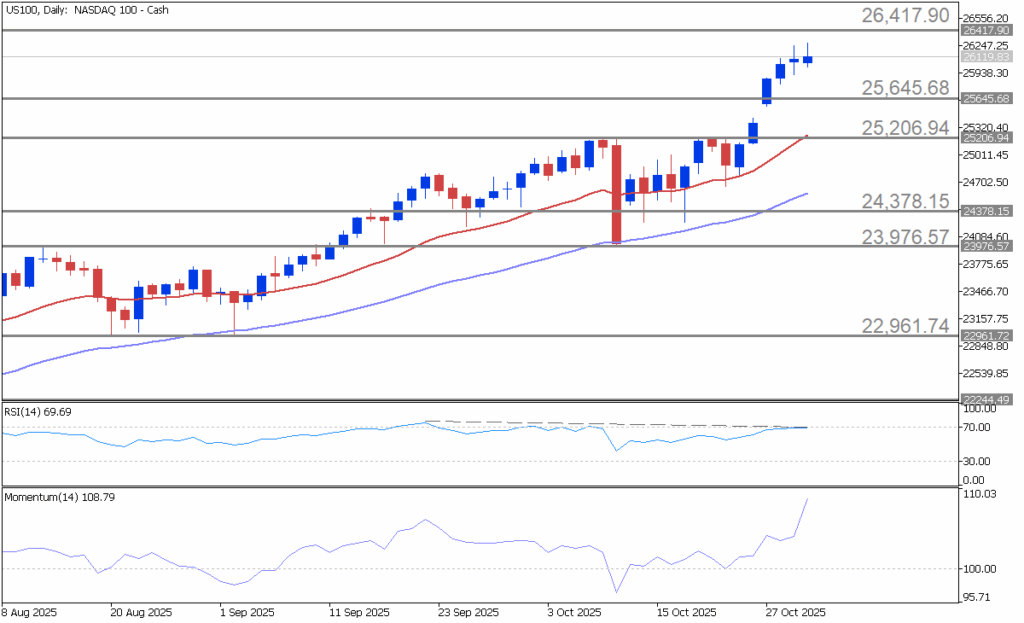
Since bottoming at $16,313.88 on April 7, the Nasdaq 100 Index has staged a powerful rally, supported by strong technical and fundamental drivers, gaining over 60% and repeatedly setting new all-time highs. Prices remain well above both the 20- and 50-period Exponential Moving Averages (EMAs), with both slopes pointing upward—confirming the persistence of bullish momentum and trend continuation.
Momentum indicators further validate the upside bias, with the Momentum Oscillator holding firmly above 100 and the Relative Strength Index (RSI) staying above 50, highlighting sustained buying pressure and market confidence. However, a developing negative divergence between price and RSI signals early warning signs of exhaustion, suggesting that the rally could soon face consolidation or a short-term corrective pullback before resuming higher.
If buyers maintain control of the market, traders may shift their focus to the following four potential resistance levels:
26,417.90: The initial price target is established at $26,417.90, corresponding to the weekly resistance, R3, calculated using the standard Pivot Points methodology.
27,197.68: The second level of resistance is seen at $27,197.68 reflecting the 261.8% Fibonacci Extension drawn from $25,206.94 to $23,976.57.
28,428.05: The third price target is determined at $28,428.05.
29,188.42: An additional price objective is estimated at $29,188.42, mirroring the 423.6% Fibonacci Extension drawn from $25,206.94 to $23,976.57.
If sellers take control of the market, traders may focus on the following four key support levels:
25,645.68: The initial support level is established at $25,645.68, representing the weekly resistance, R1, estimated using the standard methodology.
25,206.94: The second support level is seen at $25,206.94, aligning with the peak from October 10.
24,378.15: The third downside target is $24,378.15, corresponding to the weekly support, S2, estimated using the standard methodology.
23,976.57: An additional downside target is observed at $23,976.57, reflecting the trough marked on October 10.
The Nasdaq 100 Index is now about 18% above its 200-day moving average — the highest stretch since July 2024, when a similar move was followed by a 13% drop. The index’s rapid climb looks a lot like gold’s recent overextension before its pullback.
At the same time, the economy shows clear signs of uneven growth. Consumer confidence among political independents fell to 49.5 in October, close to multi-year lows and far below the level seen in early 2020. How people feel about the economy now depends heavily on income, stock ownership, and the type of work they do.
Manufacturing data also remains weak. The Dallas Fed index stayed negative at -5, only slightly better than September’s -8.7, while the outlook for the next six months fell to a five-month low. Business feedback continues to show mixed conditions, with manufacturing still in a slump even as parts of the market, especially tech, stay strong.
In short, the Nasdaq 100 looks overheated, while the broader economy continues to struggle with uneven growth.
On the Federal Reserve front, the Fed cut interest rates for the second meeting in a row, lowering the benchmark rate to a range of 3.75%–4%. It also announced plans to end its balance sheet reduction program on December 1. However, Chair Jerome Powell cautioned that another rate cut in December is not guaranteed, citing divided opinions within the committee. The Fed noted rising risks to employment and continued inflation pressures, while data uncertainty from the government shutdown has complicated policy decisions.
In conclusion, the Nasdaq 100 remains in a powerful uptrend, supported by strong momentum and investor optimism. However, with the index significantly stretched above long-term averages and early signs of technical fatigue emerging, traders should stay alert for a potential pause or short-term correction. While the broader economic landscape remains uneven and policy uncertainty lingers, the medium-term outlook for the index stays constructive as long as key support levels hold and bullish sentiment continues to dominate.



Financial markets were shaped by a busy week of economic data, central bank decisions, and corporate earnings.

Markets face a busy week of high-impact economic events, with central bank policy, inflation, employment, growth and energy data all in focus.

Get the FXGT App