Important Note!
We use cookies to ensure you get the best experience on our website.
By clicking ‘Agree,’ you accept our use of cookies as outlined in our cookies policy

The week wraps up with traders closely monitoring developments in the United States following the Federal Reserve’s latest rate decision, which introduced fresh uncertainty to the U.S. dollar’s outlook. Market participants remain cautious as policy direction, and interest rate expectations continue to shape sentiment. Against this backdrop, GBPUSD extends its recent decline, with technical indicators pointing to sustained bearish momentum while traders watch for potential signs of stabilization or further downside movement.
Friday 03:30 am (GMT+2) – China: Manufacturing PMI (CNY)
Friday 14:30 (GMT+2) – Canada: GDP m/m (CAD)
Friday Tentative – USA: Core PCE Price Index m/m (USD)
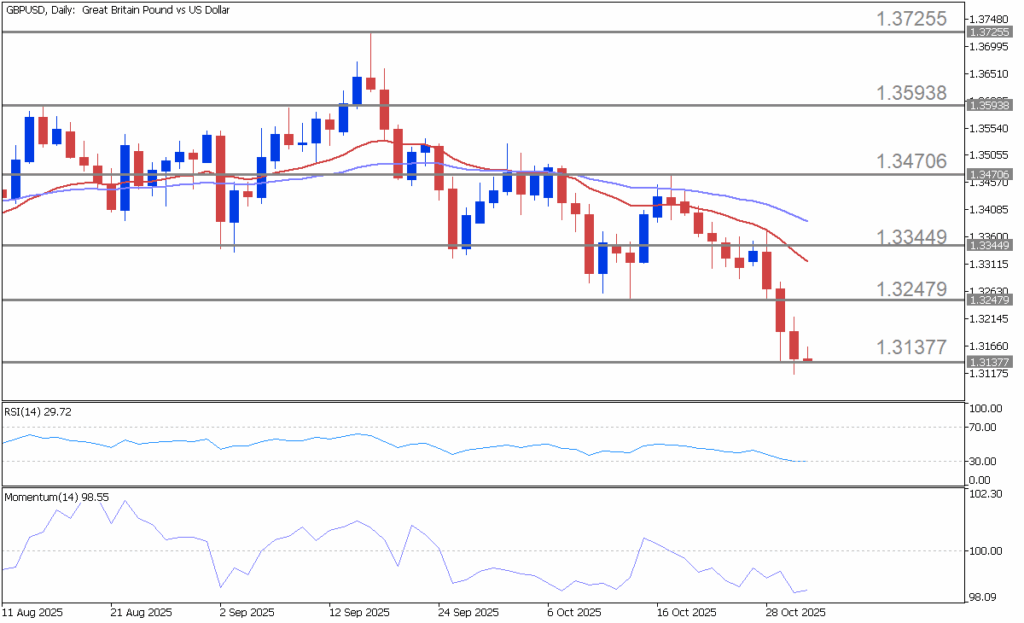
Since peaking at 1.37255 on September 17, GBPUSD has declined by more than 4%, confirming a shift in market sentiment. The initial bearish signal emerged with the formation of a Shooting Star candlestick, followed by a classic failure swing pattern — where the subsequent high at 1.35358 failed to exceed the prior peak, and prices later broke below the 1.34522 trough. The development of a “Death Cross,” as the 20-period Exponential Moving Average (EMA) crossed beneath the 50-period EMA, further reinforced the downside bias. Currently, prices remain below both EMAs, which continue to slope downward, signaling sustained bearish momentum. Supporting indicators, including the Momentum oscillator and the Relative Strength Index (RSI), remain below their respective neutral baselines (100 and 50), confirming the prevailing downward trend.
Should the bulls take market control, traders may direct their attention toward the four potential resistance levels below:
1.32479: The initial resistance is set at 1.32479, reflecting the trough marked on October 14.
1.33449: The second price target is identified at 1.33449, corresponding to the weekly Pivot Point, PP, calculated using the standard methodology.
1.34706: The third target is established at 1.34706, aligning with the daily high recorded on October 17.
1.35938: An additional price target is determined at 1.35938, corresponding to the high point from August 14.
Should the sellers maintain market control, traders may consider the four potential support levels listed below:
1.31377: The first price target is established at 1.31377, reflecting the low point marked on August 1.
1.29932: The second line of support is seen at 1.29932, representing the 261.8% Fibonacci Extension drawn from the swing low of 1.33229 to the swing high of 1.35229.
1.27894: The third support line is determined at 1.27894.
1.26634: An additional downward target is observed at 1.26634, corresponding to the 423.6% Fibonacci Extension drawn from the swing low of 1.33229 to the swing high of 1.35229.
UK business activity showed signs of recovery in October, while consumers unexpectedly boosted spending, offering finance minister Rachel Reeves some relief ahead of the November 26 budget. Data showed that the composite PMI for services and manufacturing picked up after nearly stalling in September, suggesting growing optimism despite concerns over possible tax hikes. Retail sales rose 0.5% in September, defying expectations of a decline.
Inflation remained steady, government borrowing was slightly better than forecast, and consumer confidence improved modestly. Economists said the data paints a cautiously positive picture for the UK economy, though growth remains too weak to ease the cost-of-living strain. The combination of easing inflation and a cooling job market has revived speculation that the Bank of England could cut interest rates in early 2026 or even February next year.
The Federal Reserve reduced its benchmark interest rate by 0.25 percentage points to a range of 3.75%–4%. Still, Chair Jerome Powell cautioned that another cut in December “is not a foregone conclusion,” surprising markets. Analysts were split on whether the Fed will ease again at the Dec. 9–10 meeting, viewing this as a pivotal moment for Powell’s leadership as his term nears its end. Some economists suggested the Fed wants to keep flexibility amid limited data from the ongoing government shutdown, noting that markets may be too confident about another rate cut.
Overall, GBPUSD remains under pronounced bearish pressure, with technical factors favoring continued downside momentum. The pair’s sustained position below key moving averages, coupled with weak momentum indicators, suggests sellers remain in control for now. While short-term corrections toward resistance levels are possible, the broader outlook stays negative unless price action breaks decisively above key resistance zones. Traders will likely stay cautious ahead of upcoming U.S. data releases, which could inject fresh volatility and determine whether the current downtrend deepens or begins to stabilize.



Gold (XAUUSD) is currently showing signs of a potential recovery after experiencing a sharp corrective decline from the recent high area.


Gold (XAUUSD) on the H4 timeframe is showing signs of a significant corrective phase following the strong bullish advance seen throughout August.

Get the FXGT App