Important Note!
We use cookies to ensure you get the best experience on our website.
By clicking ‘Agree,’ you accept our use of cookies as outlined in our cookies policy

The Australian dollar strengthened this week after inflation data came in hotter than expected, with prices rising 3.5% year-on-year — the highest in more than a year. The stronger reading has reinforced expectations that the Reserve Bank of Australia will keep interest rates unchanged for longer, dampening hopes of near-term policy easing. This development has provided support to the AUDUSD pair, which recently broke out of a prolonged consolidation phase.
However, market attention now turns to the upcoming Federal Funds Rate decision by the US Federal Reserve later today. While a 0.25% rate cut is widely anticipated, traders will be watching the accompanying statement for clues on how much further the Fed intends to ease policy amid signs of slowing growth and persistent labor market concerns. The outcome could determine whether the AUDUSD rally extends or faces renewed pressure in the days ahead.
Wednesday 15:45 (GMT+2) – Canada: Overnight Rate (CAD)
Wednesday 20:00 (GMT+2) – USA: Federal Funds Rate (USD)
Thursday Tentative – Japan: BOJ Policy Rate (JPY)
Thursday Tentative – USA: Advance GDP q/q (USD)
Thursday 15:15 (GMT+2) – Europe: Main Refinancing Rate (EUR)
Friday 03:30 am (GMT+2) – China: Manufacturing PMI (CNY)
Friday 14:30 (GMT+2) – Canada: GDP m/m (CAD)
Friday Tentative – USA: Core PCE Price Index m/m (USD)
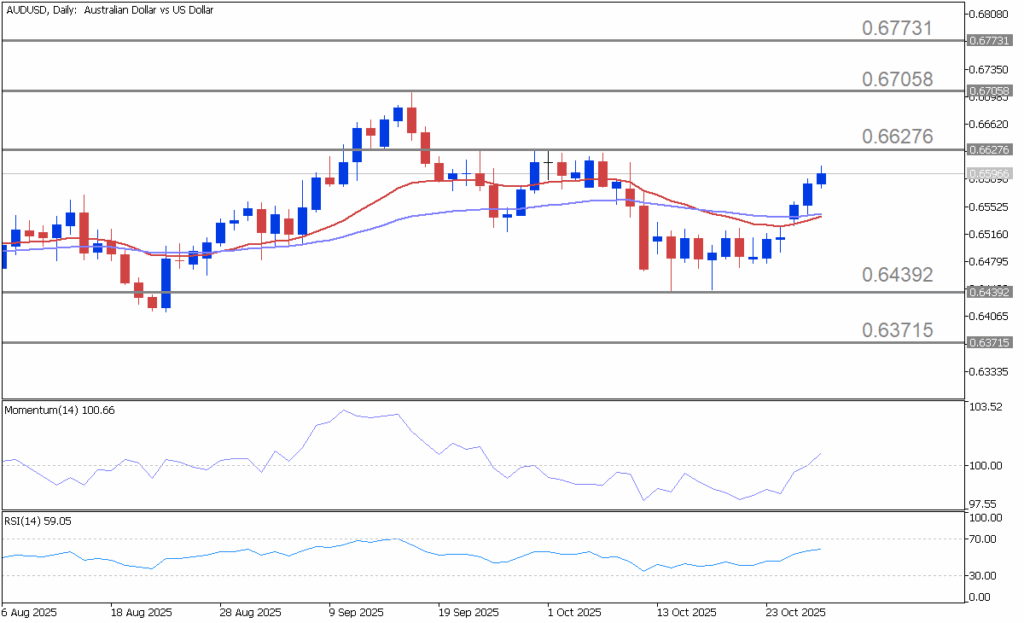
Since hitting a low of 0.64392 on October 14, the AUDUSD pair has broken out of an eleven-day consolidation, gaining over 2% from trough to peak. The stronger-than-expected inflation data has reinforced expectations that the Reserve Bank of Australia will maintain a cautious stance, likely delaying any near-term rate cuts as policymakers assess persistent price pressures and broader economic resilience.
From a technical perspective, a key catalyst behind the recovery was the pair’s breakout above both the 20- and 50-period Exponential Moving Averages (EMAs), with both lines now turning upward—an encouraging signal of potential uptrend continuation. However, the shorter EMA has yet to decisively cross above the longer EMA, suggesting confirmation is still pending. Meanwhile, the Momentum oscillator has advanced beyond the 100 level, and the Relative Strength Index (RSI) remains firmly above the 50 threshold, both reinforcing sustained bullish momentum and improving sentiment toward the Australian dollar.
If buyers maintain control of the market, traders may shift their focus to the following four potential resistance levels:
0.66276: The first level of resistance is determined at 0.66276, which reflects the high point from October 1.
0.67058: The second resistance level is projected at 0.67058, which aligns with the peak marked on September 17.
0.67731: The third price target is established at 0.67731.
0.68302: An additional price objective is estimated at 0.68302, mirroring the 423.6% Fibonacci Extension drawn from 0.65315 to 0.64392.
If sellers take control of the market, traders may focus on the following four key support levels:
0.65034: The initial support level is seen at 0.65034, representing the weekly Pivot Point, PP, calculated using the standard methodology.
0.64392: The second support level is positioned at 0.64392, aligning with the low point marked on October 14.
0.63715: The third downside target is noted at 0.63715.
0.61693: An additional downside target is determined at 0.61693, reflecting the 423.6% Fibonacci Extension drawn from 0.65194 to 0.66276.
Australia’s inflation rose faster than expected in the third quarter, climbing 3.5% year-on-year — the highest in more than a year and above economists’ 3.1% forecast. The rise, led by higher housing, recreation, and transport costs, pushed inflation above the Reserve Bank of Australia’s 2–3% target band for the first time since mid-2024.
The underlying trimmed mean inflation also increased to 3%, indicating renewed price pressures. Following the data, the ASX 200 slipped nearly 0.8% while the Australian dollar strengthened slightly against the US dollar.
The stronger-than-expected figures are likely to delay expectations of any near-term rate cuts, as policymakers face growing challenges in bringing inflation back under control amid concerns that the disinflation process is losing momentum.
On another note, the Federal Reserve is widely expected to deliver a second straight 0.25% rate cut this week, bringing its benchmark rate to a 4%–4.25% range. However, policymakers face deeper challenges beyond the cut — including limited economic data due to the government shutdown, uncertainty over future rate moves, and the timeline for ending balance sheet reductions.
While inflation has slowed to around 3%, concerns over a weakening labor market are driving the Fed’s dovish stance. Markets anticipate further cuts in December and early 2026, though officials remain divided on how quickly to ease policy and when to halt quantitative tightening.
The Australian dollar gained strength after hotter-than-expected inflation data showed prices rising 3.5% year-on-year, easing prospects of near-term RBA rate cuts. The upbeat figures supported the AUDUSD pair, which broke out of consolidation with improving technical momentum. Traders now shift focus to the upcoming Federal Reserve rate decision, where a 0.25% cut is widely expected. The Fed’s policy tone will be key in determining whether the recent AUDUSD rally continues or faces renewed pressure.



Gold (XAUUSD) is currently showing signs of a potential recovery after experiencing a sharp corrective decline from the recent high area.


Gold (XAUUSD) on the H4 timeframe is showing signs of a significant corrective phase following the strong bullish advance seen throughout August.

Get the FXGT App