Important Note!
We use cookies to ensure you get the best experience on our website.
By clicking ‘Agree,’ you accept our use of cookies as outlined in our cookies policy

Traders head into Friday’s session focused on high-impact releases from both the UK and the US, with UK GDP and US consumer sentiment expected to set the tone for currency markets. Against this backdrop, AUDUSD has been staging an impressive recovery, supported by Australia’s economic resilience and diverging monetary policy paths between the Reserve Bank of Australia and the Federal Reserve. With momentum indicators flashing strength but early signs of bearish divergence emerging, market participants are watching key technical levels closely while weighing incoming data and central bank signals.
Friday 09:00 am (GMT+3) – UK: GDP m/m (GBP)
Friday 17:00 (GMT+3) – USA: Prelim UoM Consumer Sentiment (USD)
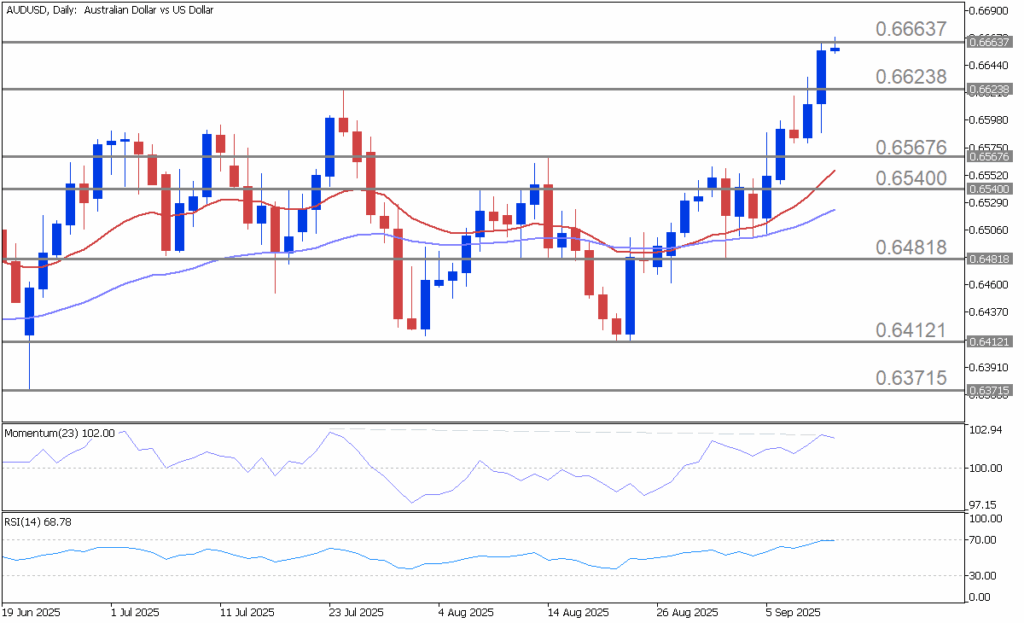
Since establishing a low at 0.59124 on April 29, the AUDUSD pair has advanced more than 12.5% from trough to peak, underscoring the currency’s strong recovery. The Reserve Bank of Australia’s hawkish stance, in contrast to growing expectations of Federal Reserve easing in September, has enhanced the relative appeal of the Australian dollar among traders.
A key technical catalyst behind this rally was the emergence of a “Golden Cross,” where the 20-period Exponential Moving Average (EMA) crossed above the 50-period EMA, signaling a bullish shift in trend. At present, AUDUSD remains firmly above both moving averages. Meanwhile, the Momentum oscillator is holding above the 100 level, and the Relative Strength Index (RSI) is hovering near the 70 overbought threshold—both indicative of sustained bullish momentum.
That said, a bearish divergence has begun to develop between the Momentum oscillator and price action. This divergence raises caution, as it may foreshadow a potential corrective phase following the sharp appreciation.
If buyers maintain control of the market, traders may shift their focus to the following four potential resistance levels:
0.66637: The first level of resistance is determined at 0.66637, which reflects the 161.8% Fibonacci Extension drawn from 0.65676 to 0.64121.
0.67036: The second resistance level is projected at 0.67036, which aligns with the weekly resistance, R3, calculated using the standard Pivot Points methodology.
0.68192: The third price target is established at 0.68192, which corresponds to the 261.8% Fibonacci Extension drawn from 0.65676 to 0.64121.
0.70708: An additional price objective is estimated at 0.70708, mirroring the 423.6% Fibonacci Extension drawn from 0.65676 to 0.64121.
If sellers take control of the market, traders may focus on the following four key support levels:
0.66238: The initial support level is seen at 0.66238, representing the daily high marked on July 24.
0.65676: The second support level is positioned at 0.65676, aligning with the swing high from August 14.
0.65400: The third downside target is noted at 0.65400, corresponding to the weekly Pivot Point, PP, calculated using the standard methodology.
0.64818: An additional downside target is determined at 0.64818, reflecting the daily low from September 2.
The Australian economy continues to demonstrate resilience, with household spending rising for six consecutive months on the back of solid incomes, a strong labour market, and earlier rate cuts. Commonwealth Bank data shows consumer demand holding firm across most categories, aligning with ABS figures that confirmed stronger-than-expected GDP growth in the June quarter.
This sustained momentum has shifted expectations for monetary policy. While markets anticipate one further rate cut in November, the Reserve Bank is widely expected to keep the cash rate unchanged at 3.60% in its September meeting. Economists caution that robust consumer activity could limit the scope for additional easing, leaving mortgage holders with only modest relief ahead.
On the other hand, new applications for unemployment benefits in the US jumped to 263,000 in the week ending September 6, the highest level in nearly three years. That’s 27,000 more than the previous week. The 4-week moving average was 240,500, an increase of 9,750 from the previous week’s revised average. These figures suggest that the job market is showing signs of cooling.
Markets widely expect the Federal Reserve to cut interest rates by a quarter point at its September 17 meeting, though traders still see a small chance of a larger half-point move. The shift toward easing gained traction after a weak August jobs report showed payrolls barely grew and unemployment hit a near four-year high. Most analysts think the Fed will stick with a smaller cut while keeping the door open for more reductions later this year.
In summary, AUDUSD’s rally reflects both Australia’s economic resilience and diverging policy paths between the RBA and the Fed. While technical signals point to continued strength, the emergence of bearish divergence suggests caution is warranted. With high-impact data releases and central bank decisions approaching, traders should closely monitor key levels as the balance between growth, inflation, and monetary policy continues to drive market direction.



Gold (XAUUSD) is currently showing signs of a potential recovery after experiencing a sharp corrective decline from the recent high area.


Gold (XAUUSD) on the H4 timeframe is showing signs of a significant corrective phase following the strong bullish advance seen throughout August.

Get the FXGT App