Important Note!
We use cookies to ensure you get the best experience on our website.
By clicking ‘Agree,’ you accept our use of cookies as outlined in our cookies policy

As the week progresses, market attention turns to the Bank of England’s rate decision later today, followed by key North American employment data on Friday. Canada’s Employment Change and the U.S. Non-Farm Payrolls report are expected to offer important signals on labor market conditions and could influence expectations for future monetary policy moves.
Against this backdrop, EURUSD continues to trade under bearish pressure, with technical indicators and recent fundamentals supporting a cautious outlook ahead of these high-impact releases.
Thursday 14:00 (GMT+2) – UK: Official Bank Rate (GBP)
Friday 15:30 (GMT+2) – Canada: Employment Change (CAD)
Friday Tentative – USA: Non-Farm Employment Change (USD)
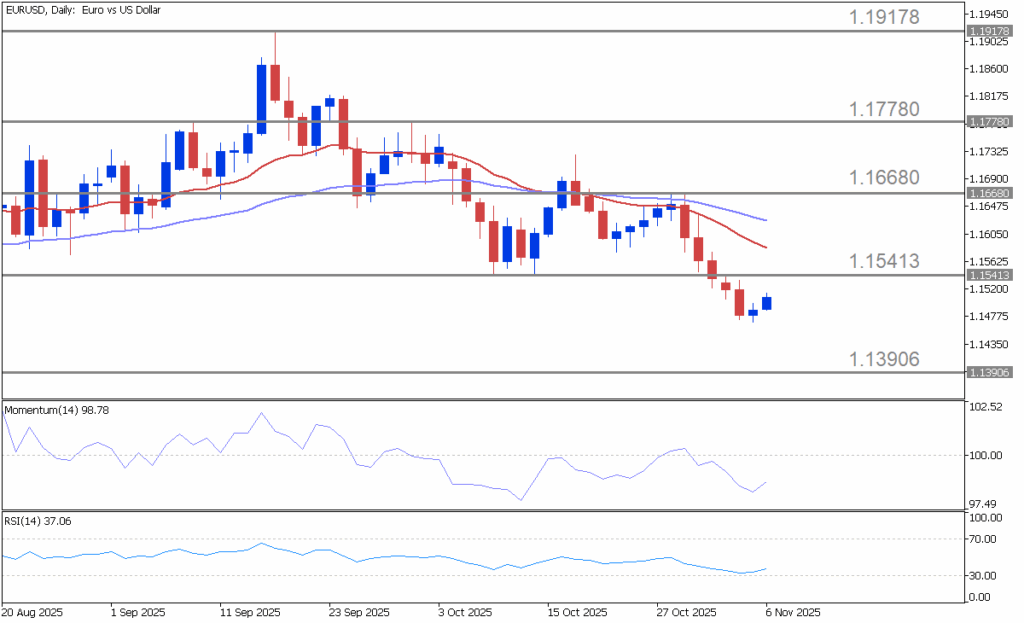
Since peaking at 1.19178 on September 17, the EURUSD has fallen over 3.5%, establishing a consistent sequence of lower highs and lower lows that underscores a clear shift toward bearish market sentiment. The initial downside signal emerged with a Bearish Harami formation, later validated by a failure swing pattern — where the rally to 1.18192 failed to surpass the previous high, followed by a decisive break below 1.17253, paving the way for continued downside momentum.
Further confirming the bearish bias, a “Death Cross” formed as the 20-period Exponential Moving Average (EMA) moved beneath the 50-period EMA, reinforcing the prevailing downtrend. Momentum indicators align with this outlook: the Momentum Oscillator remains entrenched below the 100 line, indicating sustained weakness, while the Relative Strength Index (RSI) stays under the 50 threshold, reflecting ongoing selling pressure in the pair.
Should the buyers take market control, traders may direct their attention toward the four potential resistance levels below:
1.15413: The initial price target is set at 1.15413, reflecting the trough from October 9.
1.16680: The second resistance level is established at 1.16680, which mirrors the peak formed on October 28.
1.17780: The third price objective is observed at 1.17780, corresponding to the peak marked on October 17.
1.19178: An additional upside target is set at 1.19178 — the high recorded on September 17.
Should the sellers maintain market control, traders may consider the four potential support levels listed below:
1.13906: The initial support level is seen at 1.13906, corresponding to the trough marked on August 1.
1.12834: The second support level is estimated at 1.12834, representing the 423.6% Fibonacci Extension drawn from 1.15762 to 1.16680.
1.12399: The third support level is identified at 1.12399, reflecting the 261.8% Fibonacci Extension drawn from 1.15413 to 1.17276.
1.12094: An additional downside target is 1.12094.
The euro zone economy expanded at its fastest pace since May 2023, with October’s HCOB Composite PMI rising to 52.5 from 51.2, marking the tenth straight month of growth. The improvement was driven by a strong rebound in the services sector, where activity climbed to a 17-month high of 53.0, while manufacturing remained stagnant.
Spain led growth with a 56.0 reading, followed by Germany’s 53.9, its best in over two years. Italy and Ireland also showed solid expansion, but France stayed in contraction at 47.7.
Employment rose at the fastest rate in 16 months, supported by service-sector hiring, while manufacturers continued cutting jobs. Input cost pressures eased even as companies raised selling prices at the strongest pace in seven months. The European Central Bank kept interest rates steady at 2%, saying policy remains “in a good place” as inflation nears target and economic momentum improves.
On the other side of the Atlantic, private-sector hiring rebounded in October, with ADP reporting 42,000 new jobs after two months of losses. Gains were concentrated in trade, transportation, health, and finance, while leisure, information, and business services saw declines. Economists called the recovery modest and uneven, with small-business weakness and falling leisure jobs raising concerns about consumer strength. With the government shutdown halting official data releases, ADP’s figures have become a key gauge of labor market health, even as the Fed weighs rate policy amid limited visibility and ongoing inflation.
With several high-impact data releases approaching, market volatility is likely to increase as traders react to fresh policy cues from the Bank of England and labor market updates from North America. While euro zone fundamentals show gradual improvement, EURUSD remains weighed down by technical weakness and stronger U.S. dollar sentiment. Unless upcoming data surprises significantly in favor of the euro, the pair may remain under pressure, with sellers retaining control in the near term.



Gold (XAUUSD) is currently showing signs of a potential recovery after experiencing a sharp corrective decline from the recent high area.


Gold (XAUUSD) on the H4 timeframe is showing signs of a significant corrective phase following the strong bullish advance seen throughout August.

Get the FXGT App