Important Note!
We use cookies to ensure you get the best experience on our website.
By clicking ‘Agree,’ you accept our use of cookies as outlined in our cookies policy

With today’s ADP Non-Farm Employment Change report in focus, traders are bracing for potential volatility across major markets. The release is expected to provide an early gauge of US labor market conditions ahead of broader employment data later in the week. Market participants will be watching closely for signs of strength or weakness that could influence sentiment toward the US dollar and, by extension, gold prices.
Wednesday 15:15 (GMT+2) – USA: ADP Non-Farm Employment Change (USD)
Wednesday 17:00 (GMT+2) – USA: ISM Services PMI (USD)
Wednesday 17:30 (GMT+2) – USA: Crude Oil Inventories (USD)
Thursday 14:00 (GMT+2) – UK: Official Bank Rate (GBP)
Friday 15:30 (GMT+2) – Canada: Employment Change (CAD)
Friday Tentative – USA: Non-Farm Employment Change (USD)
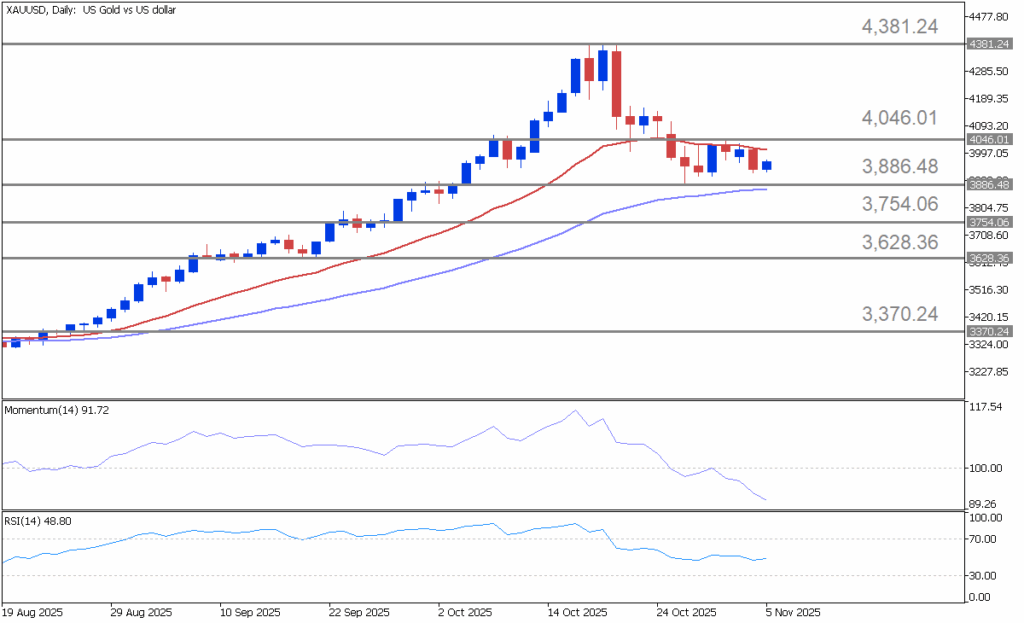
Since reaching an all-time high of $4,381.24 on October 20, gold has registered losses of more than 11% from peak to trough. The inability of bulls to sustain the rally, combined with a resurgent US dollar and a more hawkish Federal Reserve outlook, has pressured the precious metal. Prices have slipped below the monthly Pivot Point and the 20-period Exponential Moving Average (EMA), suggesting that bullish momentum is fading.
From a technical standpoint, the broader uptrend remains intact as long as spot prices hold above the 50-period EMA. However, a decisive breach below $3,886.48 could trigger a deeper correction toward the next support area. Momentum indicators reinforce the bearish bias: the Momentum oscillator has dropped below the 100 mark, while the Relative Strength Index (RSI) remains under 50, reflecting sustained selling pressure and waning bullish conviction among traders.
Should the bulls maintain market control, traders may direct their attention toward the four potential resistance levels below:
4,046.01: The initial resistance is set at $4,046.01, which corresponds to the daily high reached on October 31.
4,381.24: The second price objective is projected at $4,381.24, corresponding to the all-time high reached on October 20.
4,629.59: The third price target is established at $4,659.29, aligning with the monthly resistance, R2, calculated using the standard Pivot Points methodology.
4,877.94: An additional price target is seen at $4,877.94, mirroring monthly resistance, R3, calculated using the standard Pivot Points methodology.
Should the sellers take market control, traders may consider the four potential support levels listed below:
3,886.48: The initial support level is identified at $3,886.48, mirroring the daily low marked on October 28.
3,754.06: The second support level is positioned at $3,754.06, reflecting the monthly support, S1, calculated using the standard Pivot Points methodology.
3,628.36: The third support level is situated at $3,628.36, in alignment with the 261.8% Fibonacci Extension drawn from 3,886.48 to 4,046.01.
3,370.24: An additional downside target is noted at $3,370.24, corresponding to the 423.6% Fibonacci Extension drawn from 3,886.48 to 4,046.01.
Gold prices slumped sharply as the US dollar climbed to multi-month highs, and traders reassessed the Federal Reserve’s rate outlook. Despite gold’s more than 50% surge this year, the rally has lost steam amid doubts over further Fed rate cuts. Chair Jerome Powell recently warned against assuming another cut in December, and several policymakers have since echoed a cautious stance. Analysts say a “hesitant Fed and strong dollar” are driving today’s selloff, with futures now pricing in only a two-thirds chance of another rate reduction next month.
Gold remains under pressure as traders weigh a firmer dollar and shifting expectations for US monetary policy. While the broader uptrend is still technically intact, weakening momentum and failure to hold key support levels could expose the metal to further downside risk. Today’s ADP employment report, along with upcoming US labor data, may serve as catalysts for short-term volatility and directional cues. Until clearer signs of easing emerge from the Federal Reserve, gold is likely to trade cautiously within a consolidative to corrective phase.



Gold (XAUUSD) is currently showing signs of a potential recovery after experiencing a sharp corrective decline from the recent high area.


Gold (XAUUSD) on the H4 timeframe is showing signs of a significant corrective phase following the strong bullish advance seen throughout August.

Get the FXGT App