Important Note!
We use cookies to ensure you get the best experience on our website.
By clicking ‘Agree,’ you accept our use of cookies as outlined in our cookies policy

The GBPJPY pair has maintained a bearish tone in recent sessions, extending its decline after failing to sustain gains above 205.000 earlier in October. Technical indicators continue to signal downside momentum, with the pair trading below key moving averages and momentum gauges showing persistent selling pressure. Fundamentally, diverging monetary outlooks between the Bank of England—tilting toward rate cuts—and Japan—where household spending remains sluggish amid inflation concerns—add to the pair’s downward bias.
Friday 15:30 (GMT+2) – Canada: Employment Change (CAD)
Friday Tentative – USA: Non-Farm Employment Change (USD)
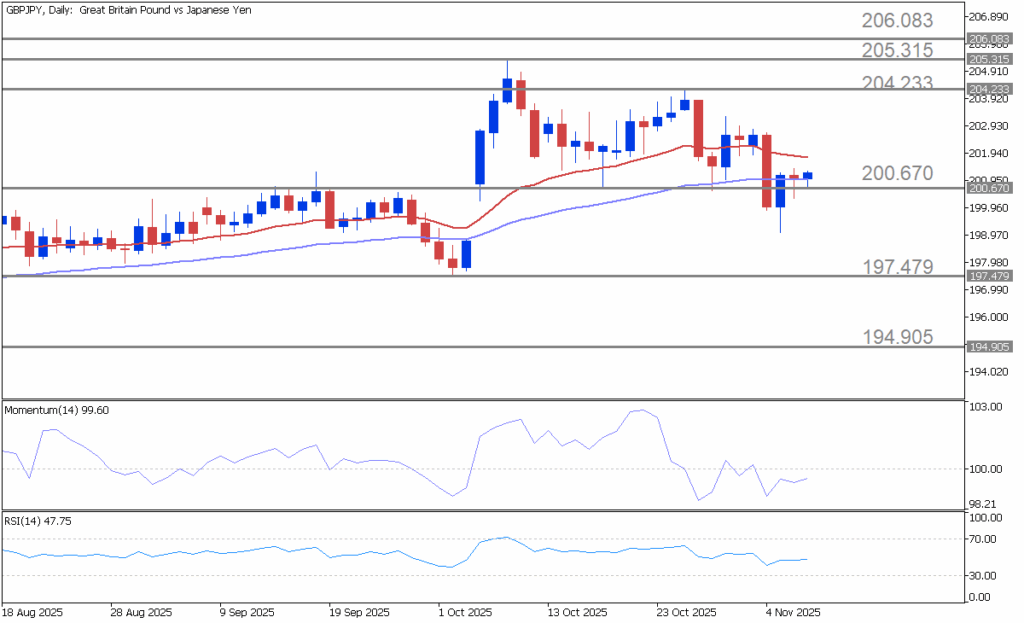
Since peaking at 205.315 on October 8—the highest level recorded this year—GBPJPY has entered a sustained downward trend. The initial reversal was signaled by a failure swing, where the subsequent peak at 204.233 failed to surpass the prior high. This pattern culminated in a break below the key support level at 200.670, paving the way for further downside momentum.
The pair has since traded below the 50-period Exponential Moving Average (EMA), establishing a sequence of lower highs and lower lows. While the 20-period EMA has yet to cross below the 50-period EMA, bearish sentiment remains intact. The Momentum oscillator remains below the 100 baseline, and the Relative Strength Index (RSI) continues to print below the 50 mark—both suggesting sustained selling pressure and the potential for continued weakness in the near term.
Should the buyers take market control, traders may direct their attention toward the four potential resistance levels below:
202.405: The first price target is identified at 202.405, reflecting the weekly Pivot Point, PP, calculated using the standard methodology.
204.233: The second target is seen at 204.233, corresponding to the peak reached on October 27.
205.315: The third price target is determined at 205.315, which corresponds to the daily high from October 8.
206.083: An additional resistance is seen at 206.083, aligning with the weekly resistance, R2, estimated using the standard Pivot Points methodology.
Should the sellers keep market control, traders may consider the four potential support levels listed below:
200.670: The initial support is identified at 200.670, corresponding to the trough marked on October 17.
198.727: The second support level is 198.717, representing the weekly support, S2, calculated using the standard Pivot Points methodology.
197.479: The third support line is established at 197.479, representing the trough from October 2.
194.905: An additional downward target is observed at 194.905, corresponding to the 261.8% Fibonacci Extension drawn from 200.670 to 204.233.
The Bank of England kept rates at 4.00% for a third straight meeting, with a narrow 5–4 vote showing growing support for cuts. Governor Andrew Bailey called it a “closer call,” and markets now see a 70% chance of a 25bps cut on December 18. The Bank said inflation has peaked and risks are more balanced, hinting at gradual easing ahead. Forecasts remain steady, with inflation seen at 2% by 2027 and modest GDP growth. Markets stayed calm, but upcoming data could shape expectations before the next meeting.
Japan’s household spending rose 1.8% in September, marking a fifth straight monthly gain but falling short of the 2.5% forecast. The increase, driven by entertainment and transport spending, offered limited support to an economy that likely contracted in the third quarter. Weak spending on education and housing, declining exports, and reduced purchasing power due to falling real wages continue to weigh on growth. Prime Minister Sanae Takaichi has announced new measures to ease living costs, though the yen’s weakness and persistent inflation remain key concerns.
In summary, GBPJPY remains under bearish pressure as technical signals and market structure point to further downside potential. With the pair holding below key moving averages and momentum indicators confirming weak sentiment, sellers currently maintain control. On the fundamental side, the BoE’s dovish tilt contrasts with Japan’s fragile but steady consumer activity, reinforcing a cautious outlook. Unless a clear shift in momentum or policy expectations emerges, the pair may continue to drift lower toward its next support levels.



Gold (XAUUSD) is currently showing signs of a potential recovery after experiencing a sharp corrective decline from the recent high area.


Gold (XAUUSD) on the H4 timeframe is showing signs of a significant corrective phase following the strong bullish advance seen throughout August.

Get the FXGT App