Important Note!
We use cookies to ensure you get the best experience on our website.
By clicking ‘Agree,’ you accept our use of cookies as outlined in our cookies policy

Markets are heading into a pivotal stretch of data and central bank decisions, with volatility likely to rise around high-impact releases. Investors will be watching Australia’s labor market report, the Bank of England’s rate decision, and the Bank of Japan’s policy update for fresh signals on the global policy outlook. Against this backdrop, U.S. equities remain firmly in an uptrend, while the Federal Reserve’s recent quarter-point cut and cautious forward guidance continue to shape sentiment across asset classes.
Thursday 04:30 am (GMT+3) – Australia: Employment Change (AUD)
Thursday 14:00 (GMT+3) – UK: Official Bank Rate (GBP)
Friday Tentative – Japan: BOJ Policy Rate (JPY)
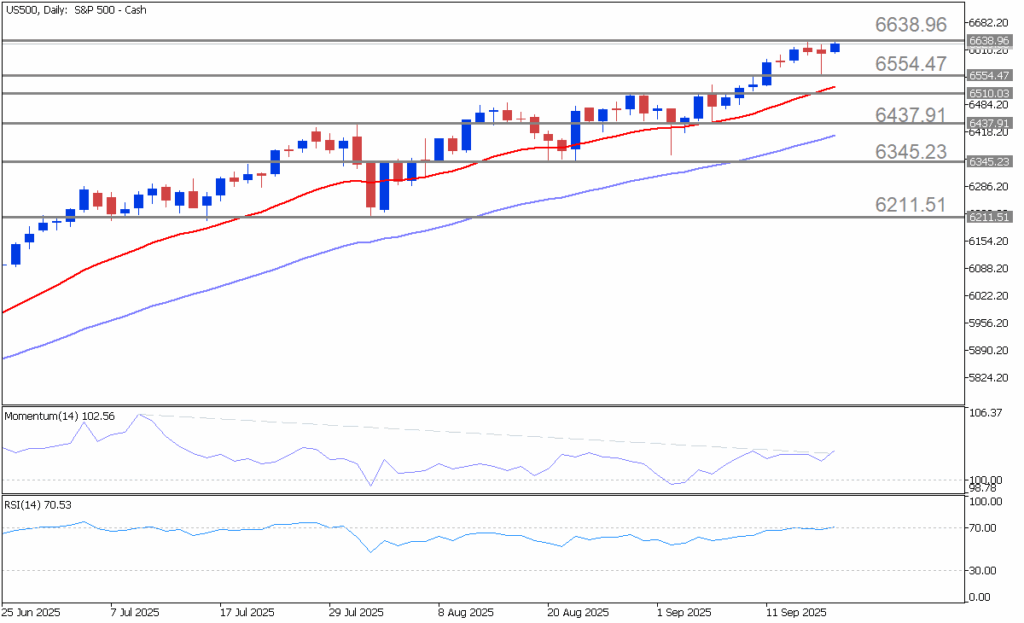
Since bottoming at 4,800.73 on April 7, the S&P 500 has maintained a sustained uptrend. The initial reversal took shape through a failure swing, with the subsequent trough at 5,100.90 holding above the prior low, before momentum accelerated on a breakout above key resistance at 5,492.67. This structural shift established a clear sequence of higher highs and higher lows, reinforcing the market’s bullish bias.
Trend strength has been validated by a “Golden Cross” between the 20- and 50-period EMAs, with both averages advancing and the shorter-term EMA leading. Price action remains firmly above these moving averages, underscoring persistent upward momentum. The breakout through 6,510.03 confirmed a new all-time high at 6,538.96, leaving scope for additional upside.
Momentum indicators remain constructive: the Momentum oscillator is holding above its 100 baseline, while RSI continues to sustain readings above 50. However, a negative divergence between price and the Momentum oscillator has emerged, signaling the risk of a short-term consolidation within the broader uptrend. The RSI’s move into overbought territory further cautions that a pullback may precede the next leg higher.
Should the bulls maintain market control, traders may direct their attention toward the four potential resistance levels below:
6638.96: The initial resistance is 6638.96, which aligns with the daily high from September 16.
6766.59: The second price target is identified at 6766.59, corresponding to the weekly resistance, R3, calculated using the standard Pivot Point methodology.
6898.20: The third target is established at 6898.20.
6989.93: An additional price target is estimated at 6989.93, mirroring the 423.6% Fibonacci Extension drawn from 6510.031 to 6361.76.
Should the sellers take market control, traders may consider the four potential support levels listed below:
6554.47: The first support level is identified at 6554.47, representing the weekly Pivot Point, PP, calculated using the standard methodology.
6437.91: The second support level is positioned at 6437.91, corresponding to the high point from July 31.
6345.23: The third line of support is established at 6345.23, representing the low point marked on August 20.
6211.51: An additional downward target is observed at 6211.51, reflecting the trough marked on August 1.
The Federal Reserve cut its benchmark interest rate by 0.25 percentage points to a range of 4%–4.25%, citing slower growth, cooling job gains, and persistent inflation pressures. Policymakers acknowledged heightened uncertainty, noting that downside risks to employment have increased. The Fed reiterated its commitment to maximum employment and returning inflation to 2%, while signaling that future moves will depend on incoming data and evolving risks. The central bank will continue reducing its holdings of Treasuries and mortgage-backed securities as planned. The decision passed with one dissent, who preferred a larger 0.50 percentage point cut.
The Federal Reserve signaled a more cautious policy path, projecting just one interest rate cut in 2026—less than markets had anticipated. Its updated “dot plot” shows a median federal funds rate of 3.4% by the end of 2026, compared with 3.6% for 2025 after this year’s expected reductions. Markets, by contrast, are pricing in two to three cuts next year. The forecasts revealed wide disagreement among policymakers, with some calling for multiple cuts in 2026, reflecting uncertainty over labor trends, data reliability, and shifting government policies. The Fed also revised growth slightly higher for 2026 but sees inflation remaining firmer than earlier projections. Powell’s pending departure in May 2026 adds another layer of uncertainty to the outlook.
With major central bank decisions and labor data on deck, markets are poised for heightened volatility. The S&P 500 remains technically strong, supported by a clear bullish structure and new all-time highs, though momentum divergences point to the risk of near-term consolidation. On the macro front, the Fed’s latest rate cut and cautious forward guidance highlight lingering uncertainties, particularly around growth, inflation, and leadership transition in 2026. Traders should remain alert to policy signals and incoming data, as both fundamentals and technicals suggest opportunities alongside elevated risks.



AUDUSD continues to maintain a bullish Elliott Wave structure on the Weekly timeframe.

The EURUSD H4 chart shows a developing bullish Elliott Wave structure following the completion of a significant corrective decline.

Get the FXGT App