Important Note!
We use cookies to ensure you get the best experience on our website.
By clicking ‘Agree,’ you accept our use of cookies as outlined in our cookies policy

EURUSD’s technical landscape remains tilted to the upside, with price action supported by key moving averages and momentum studies. However, the presence of negative divergence signals that short-term consolidation cannot be ruled out before the broader uptrend resumes. On the fundamental side, with the ECB on hold, the Fed shifting to a more accommodative stance, and the BOJ decision pending, traders should brace for potential volatility as policy paths across major central banks continue to diverge. Maintaining flexibility and monitoring both resistance and support levels will be key in navigating the sessions ahead.
Friday Tentative – Japan: BOJ Policy Rate (JPY)
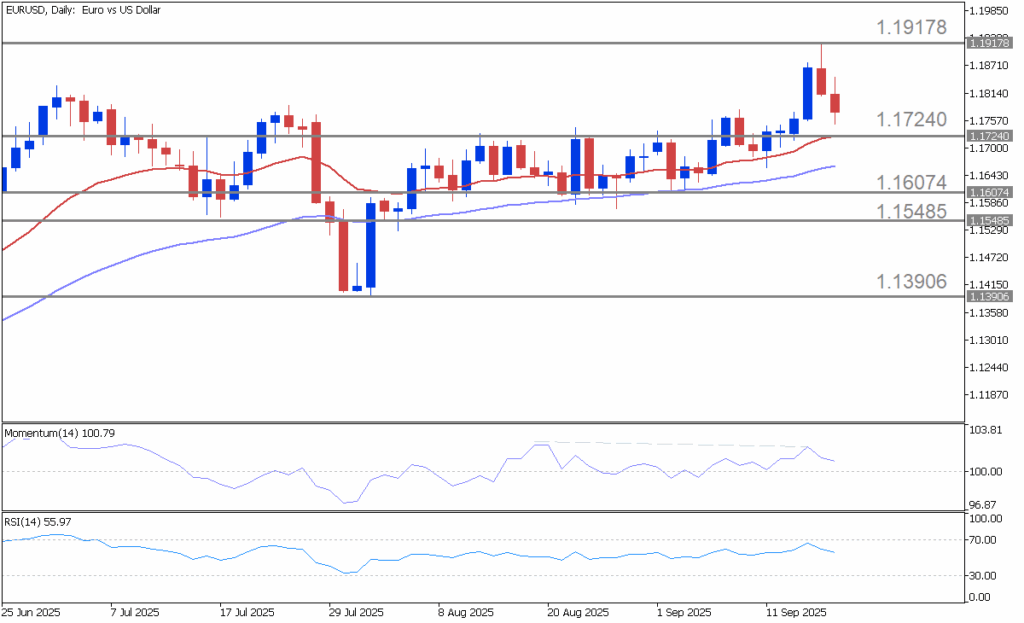
Since establishing a low at 1.13906 on August 1, the EURUSD has transitioned into a clear uptrend, defined by a steady sequence of higher highs and higher lows—signaling a shift in market sentiment. The initial technical trigger came with a Bullish Harami formation, later reinforced by a strong bullish candle that carried price action decisively above the key moving averages.
Currently, the pair holds above both the 20- and 50-period EMAs, highlighting persistent upside momentum and strengthening the bullish outlook. Supporting signals from momentum studies add weight to the bias: the Momentum Oscillator remains anchored above the 100 line, indicating short-term strength, while the RSI is positioned comfortably above the 50 midpoint, reflecting sustained buying interest.
That said, a negative divergence emerging between the Momentum Oscillator and price action warrants caution, suggesting the risk of a near-term consolidation phase before the broader uptrend can extend further.
Should the buyers maintain market control, traders may direct their attention toward the four potential resistance levels below:
1.19178: The initial price target is set at 1.19178, reflecting the daily high from September 17.
1.20999: The second resistance level is established at 1.20999, which mirrors the 161.8% Fibonacci Extension drawn from 1.18290 to 1.13906.
1.22654: The third price objective is observed at 1.22654, corresponding to a resistance from a higher timeframe.
1.23484: An additional upside target is projected at 1.23484.
Should the sellers take market control, traders may consider the four potential support levels listed below:
1.17240: The initial support level is seen at 1.17240, corresponding to the weekly Pivot Point, PP, calculated using the standard methodology.
1.16074: The second support level is estimated at 1.16074, representing the daily low marked on September 3.
1.15485: The third support level is identified at 1.15485, reflecting the weekly support, S3, estimated using the standard Pivot Points methodology.
1.13906: An additional downside target is 1.13906, mirroring the trough from August 1.
On September 11, the European Central Bank kept its key interest rates unchanged, with the deposit rate at 2.00%, the main refinancing rate at 2.15%, and the marginal lending rate at 2.40%. Inflation is close to the 2% target, and updated projections remain broadly consistent with June, with headline inflation expected to average 2.1% in 2025, 1.7% in 2026, and 1.9% in 2027. Growth is forecast at 1.2% in 2025—up from 0.9% previously—before easing to 1.0% in 2026 and 1.3% in 2027. The ECB continues to let its asset purchase portfolios decline as reinvestments have ended. Policymakers reaffirmed a data-dependent, meeting-by-meeting approach and stressed readiness to adjust policy tools if necessary to ensure price stability and safeguard monetary policy transmission across the euro area.
On September 17, 2025, the Federal Reserve lowered the federal funds rate by 25 basis points to a target range of 4.00%–4.25%, citing moderating growth, slower job gains, and elevated inflation. Policymakers noted that downside risks to employment have increased, while uncertainty around the economic outlook remains high. The Fed reaffirmed its commitment to its dual mandate of maximum employment and 2% inflation, emphasizing a data-dependent, meeting-by-meeting approach for future policy adjustments. Balance sheet reduction through Treasuries and mortgage-backed securities will continue as planned. The decision passed with one dissent, who favored a larger 50 basis point cut.
Friday’s calendar highlights the Bank of Japan (BOJ) on its policy rate, a key event that could inject volatility into the yen and broader forex markets. With investors already digesting recent policy signals from both the ECB and the Federal Reserve, attention now shifts to Tokyo, where the BOJ’s stance will provide fresh insight into the central bank’s tolerance for inflation trends and its outlook on monetary easing.



Gold (XAUUSD) is currently showing signs of a potential recovery after experiencing a sharp corrective decline from the recent high area.


Gold (XAUUSD) on the H4 timeframe is showing signs of a significant corrective phase following the strong bullish advance seen throughout August.

Get the FXGT App