Important Note!
We use cookies to ensure you get the best experience on our website.
By clicking ‘Agree,’ you accept our use of cookies as outlined in our cookies policy

This week’s key events include UK inflation, rate decisions from the Fed, Bank of Canada, and Bank of England, plus growth and jobs data from New Zealand and Australia. GBPUSD has climbed over 4% since early August, but momentum signals suggest a possible pullback. In fundamentals, the Fed is expected to cut rates as US data shows resilient consumer spending, while the UK labor market weakens with rising claims, falling payrolls, and slower wage growth.
Wednesday 09:00 am (GMT+3) – UK: CPI y/y (GBP)
Wednesday 16:45 (GMT+3) – Canada: Overnight Rate (CAD)
Wednesday 21:00 (GMT+3) – USA: Federal Funds Rate (USD)
Thursday 1:45 am (GMT+3) – New Zealand: GDP q/q (NZD)
Thursday 04:30 am (GMT+3) – Australia: Employment Change (AUD)
Thursday 14:00 (GMT+3) – UK: Official Bank Rate (GBP)
Friday Tentative – Japan: BOJ Policy Rate (JPY)
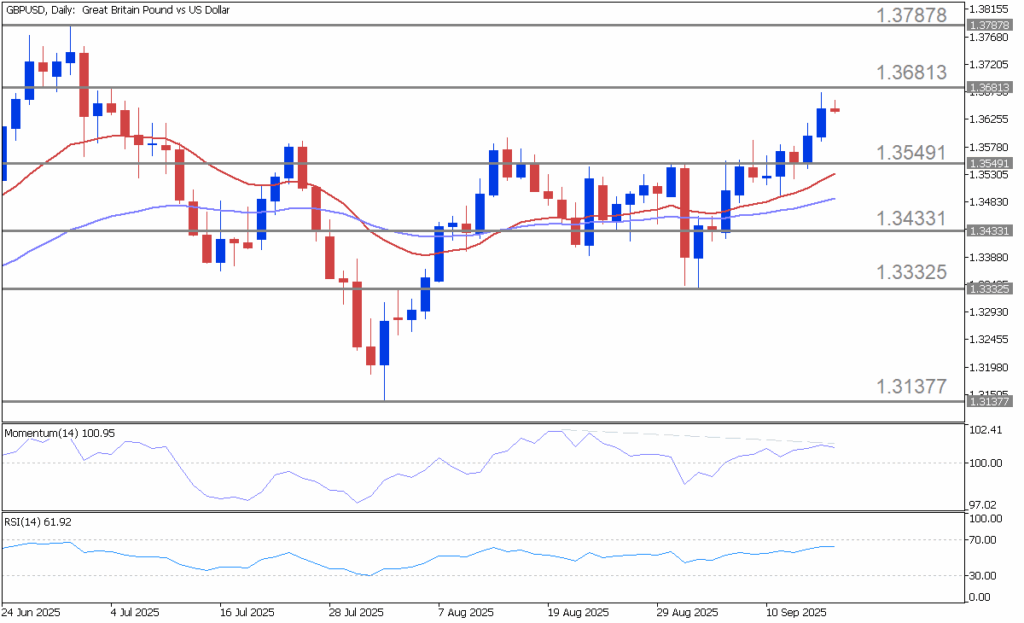
Since establishing a cycle low at 1.31377 on August 1, GBPUSD has advanced more than 4% from trough to peak, reaching its highest level in eleven weeks. The initial inflection point was signaled by a Bullish Engulfing candlestick pattern, which disrupted the preceding downtrend and laid the groundwork for a trend reversal.
Further confirmation of the shift came with a “Golden Cross,” where the 20-period Exponential Moving Average crossed above the 50-period EMA. From a trend-following perspective, this crossover is typically interpreted as a constructive signal for medium-term price action.
Technical conditions remain broadly supportive. Momentum continues to track above the 100 threshold, while the Relative Strength Index is holding comfortably above the 50 neutral line, both consistent with persistent buying interest.
That said, a developing negative divergence between price action and the Momentum Oscillator suggests underlying strength may be waning. This divergence raises the risk of a consolidation phase or corrective retracement before the broader uptrend can resume.
If buyers maintain control of the market, traders may shift their focus to the following four potential resistance levels:
1.36813: The first level of resistance is identified at 1.36813, which aligns with the 161.8% Fibonacci Extension drawn from 1.35491 to 1.33325.
1.37878: The second price target is established at 1.37878, representing the daily high marked on July 1.
1.38952: The third price target is established at 1.38952, representing the 261.8% Fibonacci Extension drawn from 1.35491 to 1.33325.
1.42412: An additional price objective is estimated at 1.42412, mirroring 423.6% Fibonacci Extension drawn from 1.35491 to 1.33325.
If sellers take control of the market, traders may focus on the following four key support levels:
1.35491: The initial support level is seen at 1.35491, representing the high point from September 1.
1.34331: The second support level is positioned at 1.34331, aligning with the weekly support, S2, calculated using the standard Pivot Points methodology.
1.33325: The third downside target is noted at 1.33325, corresponding to the swing low marked on September 3.
1.31377: An additional downside target is observed at 1.31377, reflecting the trough from August 1.
The Federal Reserve is expected to cut interest rates later today after months of weak job growth and rising unemployment. Inflation is still above target, but markets see a near-certain chance of a small 0.25% cut, with more reductions likely later this year.
US retail sales rose in August 2025, showing steady consumer spending. Sales reached $732 billion, up 0.6% from July and 5% higher than a year ago. For the summer months (June through August), sales were 4.5% above last year’s level.
Retail trade also grew 0.6% from July and nearly 5% compared to August 2024. Online and other nonstore retailers led the gains with a 10% jump from last year, while restaurants and bars saw sales climb 6.5%.
Overall, the data points to resilient consumer demand heading into late 2025.
The UK labour market is showing signs of strain. In August 2025, unemployment claims rose sharply by 20,300, reversing the drop in July and bringing the total number of claimants to 1.69 million.
Employment levels also weakened, with payrolled employees falling by 142,000 compared with last year and by another 127,000 in early August estimates. Job vacancies continued their long decline, dropping for the 38th month in a row to 728,000.
Wage growth is slowing as inflation eases. Regular pay rose 4.8% in the three months to July, while total pay, including bonuses, was up 4.7%. With average weekly pay at £679, pay pressures appear to be stabilising, but the overall picture points to a softer job market.
In short: fewer jobs, more people claiming benefits, and slower wage growth signal a cooling UK labour market.
With a packed week of central bank decisions and key economic releases, markets are set for heightened volatility. GBPUSD remains in an uptrend but faces signs of waning momentum, while fundamentals highlight diverging themes: resilient US consumption versus a cooling UK labour market. Traders should watch for policy outcomes and data surprises that could determine whether the current trends extend or give way to consolidation.



Financial markets were shaped by a busy week of economic data, central bank decisions, and corporate earnings.

Markets face a busy week of high-impact economic events, with central bank policy, inflation, employment, growth and energy data all in focus.

Get the FXGT App