Important Note!
We use cookies to ensure you get the best experience on our website.
By clicking ‘Agree,’ you accept our use of cookies as outlined in our cookies policy

Markets are poised for heightened volatility this week, with several high-impact economic events scheduled for Thursday. Key data releases include Australia’s Employment Change, the UK’s monthly GDP report, and the US Producer Price Index (PPI) and Retail Sales figures due later in the day. These indicators could offer fresh insights into the health of major economies and influence market expectations for upcoming central bank policy moves.
Meanwhile, gold continues to dominate headlines after extending its record-breaking rally, driven by persistent geopolitical risks, a weaker US dollar, and speculation of an imminent Federal Reserve rate cut. Traders are closely watching how this week’s data might shape global risk sentiment and determine whether gold’s momentum can sustain its historic climb or face a near-term correction.
Thursday 03:30 am (GMT+3) – Australia: Employment Change (AUD)
Thursday 09:00 am (GMT+3) – UK: GDP m/m (GBP)
Thursday Tentative (GMT+3) – USA: PPI m/m (USD)
Thursday Tentative – USA: Retail Sales m/m (USD)
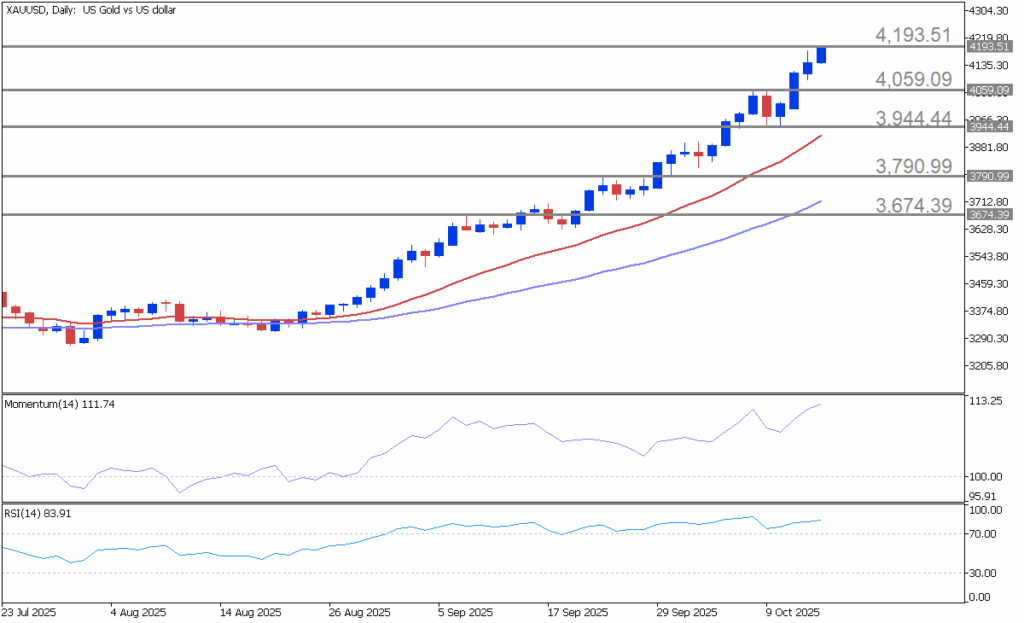
Gold extended its rally to a new record high of $4,193.51 per troy ounce on October 15, supported by a mix of macroeconomic and geopolitical drivers. The move reflects stronger safe-haven demand amid persistent geopolitical risks, heightened uncertainty around both the US and global economy, concerns over the US government shutdown, and rising market expectations for an imminent Federal Reserve rate cut.
From a technical standpoint, the broader uptrend remains intact, with spot prices holding above the 50-period Exponential Moving Average (EMA). Momentum indicators continue to support the bullish bias: the Momentum oscillator is holding above the 100 mark, while the Relative Strength Index (RSI) remains firmly above 50, signaling sustained buying pressure. However, key oscillators across daily, weekly, and monthly timeframes have pushed into overbought territory, flagging the risk of a short-term pullback.
Should the bulls maintain market control, traders may direct their attention toward the four potential resistance levels below:
4,193.51: The initial resistance is set at $4,193.51, which corresponds to the daily high reached on October 15.
4,264.27: The second price objective is projected at $4,264.27, corresponding to the weekly resistance, R3, calculated using the standard Pivot Points methodology.
4,442,34: The third price target is established at $4,442.34, aligning with the monthly resistance, R3, calculated using the standard Pivot Points methodology.
4,500.00: An additional price target is seen at $4,500.00, mirroring a psychological price target.
Should the sellers take market control, traders may consider the four potential support levels listed below:
4,050.99: The initial support level is identified at $4,050.99, mirroring the daily high marked on October 8.
3,944.44 The second support level is positioned at $3,944.44, reflecting the low point from October 9.
3,790.99: The third support level is situated at $3,790.99, in alignment with the daily high on September 23.
3,674.39: An additional downside target is noted at $3,674.39, corresponding to the daily high established on September 9.
Gold has surged more than 50% in the first 10 months of 2025, hitting record highs over 30 times this year despite steady demand and supply. Analysts attribute the rally to massive central bank purchases — exceeding 1,000 tonnes annually since 2022 — alongside geopolitical tensions, US tariff policies, and a weakening dollar. Central banks, particularly in India and China, have rapidly increased reserves, and nearly all surveyed institutions expect further accumulation. With the US dollar down 11% in the first half of 2025, gold’s inverse correlation to the greenback and ongoing official-sector buying suggest the bull run could continue, though future gains will hinge on global economic and geopolitical developments.
On another note, financial advisors urge caution, noting that gold’s long-term returns often trail traditional markets. Experts say its appeal lies in protecting against a weakening dollar and providing diversification, though its performance isn’t always uncorrelated with stocks. Analysts warn the rally above $4,000 may not last if fear-driven demand fades. Investors can choose physical gold, ETFs, or mining stocks, but advisors recommend keeping gold as only a small part of a balanced portfolio.
Gold’s record-breaking rally underscores the strength of current safe-haven demand amid global uncertainty, yet caution remains warranted as markets brace for key economic data releases later this week. While strong central bank buying, a weaker US dollar, and heightened geopolitical risks continue to support the bullish outlook, technical indicators suggest the possibility of short-term consolidation. Traders should monitor upcoming macroeconomic data and Fed policy signals for cues on whether gold can extend its historic run toward new highs or enter a corrective phase before the next leg higher.



The XAUUSD H4 chart is showing an interesting potential bullish reversal structure after a significant decline from the 4,650–4,690 region toward the 4,080–4,085 area....


The AUDUSD weekly chart continues to show an interesting bullish Elliott Wave structure following the strong recovery from the previous major low.

Get the FXGT App