Important Note!
We use cookies to ensure you get the best experience on our website.
By clicking ‘Agree,’ you accept our use of cookies as outlined in our cookies policy

The Australian dollar has come under renewed pressure as sentiment shifts toward the prospect of monetary easing amid signs of a softer labour market. Following a steady decline since mid-September, AUDUSD continues to trade with a bearish tone, weighed down by weak domestic data and technical indicators confirming downward momentum. Traders now turn their attention to key price levels for potential inflection points as the pair navigates a fragile environment marked by cautious market sentiment.
Thursday 03:30 am (GMT+3) – Australia: Employment Change (AUD)
Thursday 09:00 am (GMT+3) – UK: GDP m/m (GBP)
Thursday Tentative (GMT+3) – USA: PPI m/m (USD)
Thursday Tentative – USA: Retail Sales m/m (USD)
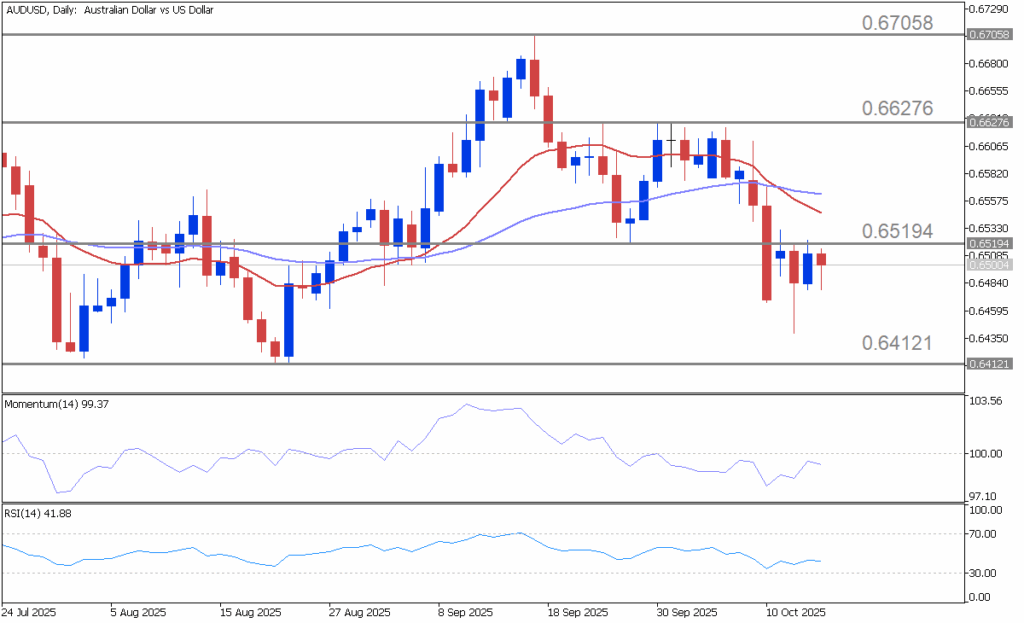
Since reaching a high of 0.67058 on September 17, the AUDUSD pair has declined more than 3% from peak to trough, underscoring the currency’s cooling job market and the potential of a rate cut by the Reserve Bank of Australia.
A key technical catalyst behind the decline was the emergence of a bearish failure swing where the peak at 0.66276 failed to surpass the previous high and subsequently price fell below the last trough thus signaling a change in the trend direction, Also, the formation of a “Death Cross,” where the 20-period Linear Weighted Moving Average (LWMA) crossed below the 50-period LWMA, signaled a bearish shift in trend. At present, AUDUSD remains firmly below both moving averages. Meanwhile, the Momentum oscillator is holding below the 100 level, and the Relative Strength Index (RSI) is hovering below the 50 threshold—both indicative of sustained bearish momentum.
If buyers take control of the market, traders may shift their focus to the following four potential resistance levels:
0.65194: The first level of resistance is determined at 0.65194, which reflects the swing low from September 26.
0.66276: The second resistance level is projected at 0.66276, which aligns with the swing high marked on October 1.
0.67058: The third price target is established at 0.67058, which corresponds to the peak from 17 September.
0.67294: An additional price objective is estimated at 0.67294, mirroring the weekly resistance, R3, estimated using the standard Pivot Points methodology.
If sellers maintain control of the market, traders may focus on the following four key support levels:
0.64121: The initial support level is seen at 0.64121, representing the trough marked on August 22.
0.63443: The second support level is positioned at 0.63443, aligning with the 261.8% Fibonacci Extension drawn from 0.65194 to 0.66276.
0.62361: The third downside target is noted at 0.62361.
0.61693: An additional downside target is determined at 0.61693, reflecting the 423.6% Fibonacci Extension drawn from 0.65194 to 0.66276.
Australia’s unemployment rate rose to 4.5% in September, the highest level in four years, after 34,000 jobs were lost and only 15,000 gained, according to new figures. The rise reflects a jump in the participation rate to 67%, meaning more Australians are seeking work than there are jobs available.
The news sent the Australian dollar down 0.5% to 64.85 US cents, while bond yields fell as markets priced in a possible Reserve Bank rate cut. Analysts say the data points to a gradual cooling in the labour market but may also prompt calls for policy easing to support spending and investment.
Unemployment rose most sharply in Victoria at 4.7%, followed by South Australia at 4.5%, with job losses more pronounced among women.
The soft labour figures have renewed hopes for monetary easing but also raised concerns about a slowing economy heading into the end of the year.
In summary, the outlook for AUDUSD remains tilted to the downside as weak labour data and bearish technical signals reinforce a cautious tone across markets. With the pair trading below key moving averages and momentum indicators pointing lower, sellers currently hold the advantage. Unless upcoming data surprises to the upside or sentiment improves significantly, the Australian dollar may continue to struggle, with traders closely watching support levels for signs of stabilization or further weakness ahead.



Gold (XAUUSD) is currently showing signs of a potential recovery after experiencing a sharp corrective decline from the recent high area.


Gold (XAUUSD) on the H4 timeframe is showing signs of a significant corrective phase following the strong bullish advance seen throughout August.

Get the FXGT App