Important Note!
We use cookies to ensure you get the best experience on our website.
By clicking ‘Agree,’ you accept our use of cookies as outlined in our cookies policy

Markets enter Friday’s session on a cautious note ahead of the Eurozone’s Final CPI data release, a key indicator that could influence euro sentiment and broader risk appetite. Investor confidence remains fragile following a week marked by renewed US credit concerns, falling bond yields, and persistent geopolitical tensions. Equity markets have turned defensive, with the S&P 500 losing momentum after its recent peak and safe-haven demand lifting gold and government bonds. Traders are likely to stay alert for any inflation surprises from the Eurozone that could impact monetary policy expectations and short-term volatility across global markets.
Friday 12:00 pm (GMT+3): Eurozone: Final CPI y/y (EUR)
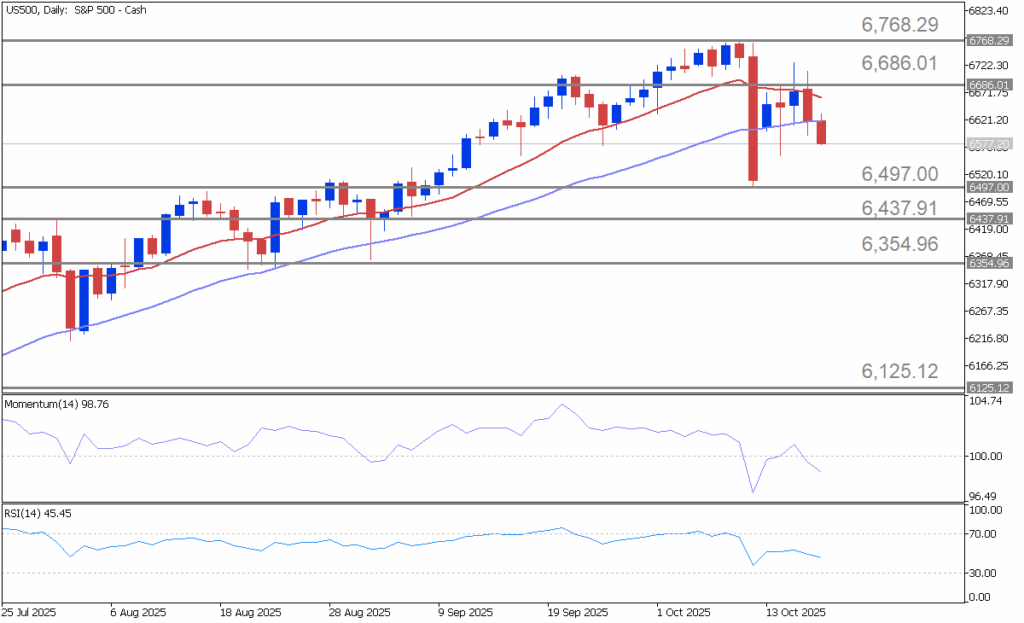
Since peaking at 6,768.29 on October 9, the S&P 500 has retreated by more than 2%, as mounting geopolitical and trade tensions weighed on risk sentiment. The initial sign of exhaustion emerged on October 10, when a large bearish candlestick disrupted the preceding uptrend, marking a potential inflection point for a trend reversal.
Subsequent price action has reinforced the shift in tone, with the index now trading below the 20- and 50-period Linear Weighted Moving Averages (LWMAs). While a formal bearish crossover between the two averages has yet to occur, the setup suggests waning upside momentum and growing investor caution.
From a technical standpoint, momentum indicators confirm the deterioration in market strength. The Momentum Oscillator has slipped below the 100 level, and the Relative Strength Index (RSI) remains firmly beneath the 50 neutral mark, both reflecting sustained selling pressure and an emerging bearish bias across the broader market environment. A decisive breach of the key support level at 6,497.00 would reinforce the bearish structure and open the door to additional downside potential.
If buyers maintain control of the market, traders may shift their focus to the following four potential resistance levels:
6,686.01: The first level of resistance is identified at 6,686.01, which aligns with the weekly resistance, R1, calculated using the standard Pivot Points methodology.
6,768.29: The second price target is established at 6,768.29, representing the all-time high reached on October 9.
6,862.80: The third price target is established at 6,862.80, representing the weekly resistance, R2, estimated using the standard Pivot Points methodology.
6,914.58: An additional price objective is estimated at 6,914.58, mirroring the 261.8% Fibonacci Extension drawn from 6,703.61 to 6,573.22.
If sellers take control of the market, traders may focus on the following four key support levels:
6,497.00: The initial support level is seen at 6,497.00, representing the low point from October 10.
6,437.91: The second support level is positioned at 6,437.91, aligning with a high point from July.
6,354.96: The third downside target is noted at 6,354.96, corresponding to the 161.8% Fibonacci Extension drawn from 6,497.00 to 6,726.84.
6,125.12: An additional downside target is observed at 6,125.12, reflecting the 261.8% Fibonacci Extension drawn from 6,497.00 to 6,726.84.
Global equities extended losses as renewed US credit concerns, and regional bank selloffs spurred a broad shift toward safe-haven assets. The S&P Regional Banks Index plunged 6.3% after fresh loan losses and fallout from the collapse of Tricolor Holdings, intensifying worries about lending standards.
Investors moved into bonds, gold, and the yen, pushing Treasury yields to multi-year lows and driving gold and silver to record highs. The two-year Treasury yield fell to its lowest level since 2022, while the 10-year dropped below 4 percent.
Analysts said the turmoil reflects risk aversion rather than systemic stress, though sentiment remains fragile amid US-China trade tensions, potential government shutdown risks, and AI-driven market bubbles. Asian and European shares followed Wall Street lower, led by declines in financials and technology stocks.
In commodities, Brent crude hovered near 61 dollars a barrel, heading for a third weekly loss as oversupply fears deepened. Meanwhile, the White House’s plan to ease auto tariffs offered some relief to carmakers but did little to calm broader market anxiety.
Overall, market sentiment remains cautious as investors navigate a fragile macro environment marked by tightening financial conditions, renewed credit concerns, and persistent geopolitical uncertainty. Technical indicators on the S&P 500 point to weakening momentum and the potential for further downside if key support levels give way. In the near term, attention will center on the Eurozone’s Final CPI release for signals on inflation trends and policy direction, which could influence short-term volatility and guide broader risk appetite heading into next week.



Gold (XAUUSD) is currently showing signs of a potential recovery after experiencing a sharp corrective decline from the recent high area.


Gold (XAUUSD) on the H4 timeframe is showing signs of a significant corrective phase following the strong bullish advance seen throughout August.

Get the FXGT App