Important Note!
We use cookies to ensure you get the best experience on our website.
By clicking ‘Agree,’ you accept our use of cookies as outlined in our cookies policy

Traders head into the week’s close with eyes firmly set on Jackson Hole, where Fed Chair Jerome Powell’s speech is expected to provide fresh signals on monetary policy and the interest rate path ahead. With US and Eurozone PMI data showing solid growth but also renewed inflationary pressures, markets remain on edge. EURUSD, meanwhile, continues to trade under technical pressure, with sellers in control as the pair trends lower.
Friday 17:00 (GMT+3) – USA: Fed Chair Powell Speaks (USD)
Friday All Day – USA: Jackson Hole Symposium (USD)
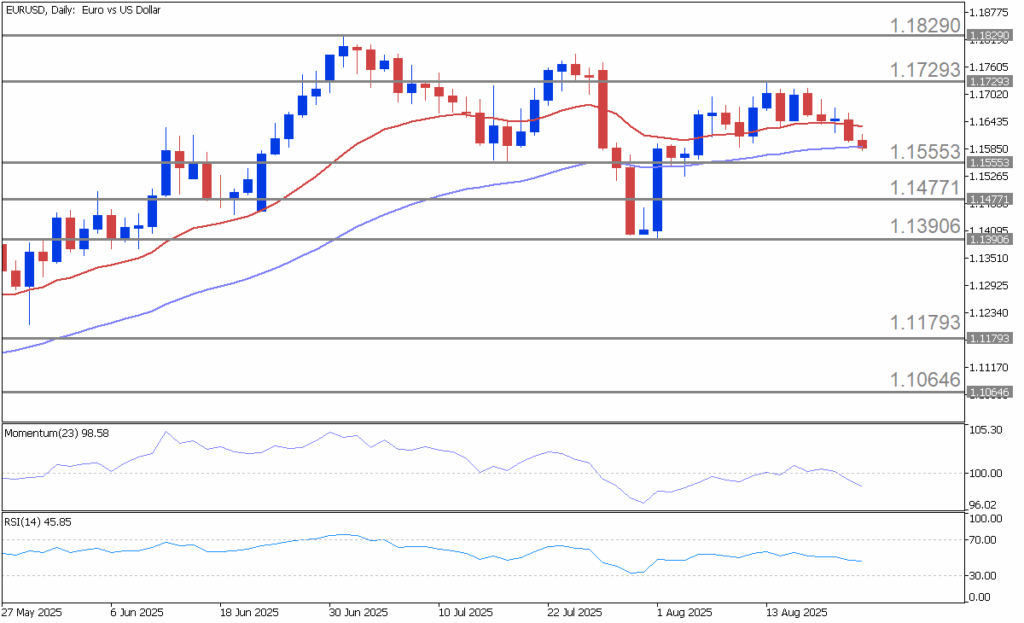
Since peaking at 1.18290 on July 1, EURUSD has trended lower, forming a consistent pattern of lower highs and lower lows—evidence of a decisive shift in sentiment. The initial technical warning appeared with the formation of a Hanging Man candlestick, followed by a classic failure swing. The subsequent rebound to 1.17877 failed to surpass the prior high, and the break of support at 1.15553 confirmed the establishment of a bearish sequence.
At present, the pair trades below both the 20- and 50-period Exponential Moving Averages (EMAs), underscoring growing downside pressure. However, the absence of a confirmed bearish crossover between the two averages suggests the trend is not yet fully validated from a moving-average perspective.
Momentum indicators reinforce the bearish bias. The Momentum Oscillator has slipped below the 100 threshold, pointing to short-term downside momentum, while the Relative Strength Index (RSI) remains suppressed below the neutral 50 level—signaling sustained selling pressure and limited evidence of bullish participation.
Should the buyers take market control, traders may direct their attention toward the four potential resistance levels below:
1.17293: The initial price target is set at 1.17293, reflecting the swing high from August 13.
1.18290: The second resistance level is established at 1.18290, which mirrors the high point reached on July 1.
1.18794: The third price objective is observed at 1.18794, corresponding to the weekly resistance, R3, estimated using the standard Pivot Points methodology.
1.22286: An additional upside target is projected at 1.22286, mirroring the 423.6% Fibonacci Extension drawn from 1.16303 to 1.14454.
Should the sellers maintain market control, traders may consider the four potential support levels listed below:
1.15553: The initial support level is seen at 1.15553, corresponding to the swing low marked on July 17.
1.14771: The second support level is estimated at 1.14771, representing the weekly support, S3, calculated using the standard Pivot Points methodology.
1.13906: The third support level is identified at 1.13906, reflecting the daily low marked on August 1.
1.11793: An additional downside target is 1.11793, mirroring the 261.8% Fibonacci Extension drawn from 1.15553 to 1.17877.
Business activity in the Eurozone picked up to its strongest level in 15 months, according to the latest HCOB Flash PMI survey. For the first time since mid-2023, new orders increased, ending more than a year of decline.
The improvement was driven mainly by manufacturing, which saw its fastest production growth in nearly three and a half years. Services activity also grew, but at a slower pace. Germany’s economy strengthened on the back of strong factory output, while France showed signs of stabilizing.
Companies continued to add jobs, especially in services, though German employment fell slightly. Inflation pressures also increased, with both input costs and selling prices rising faster than in July.
Despite the recovery in orders and output, business confidence slipped to a four-month low, as companies remained cautious about the outlook.
On the other side of the Atlantic, US business activity expanded strongly in August, reaching its fastest pace this year, according to S&P Global’s Flash PMI survey. Both manufacturing and services grew, with factory output jumping to its highest level in more than three years. Hiring also picked up, as companies added staff to keep up with rising demand and backlogs of work.
However, inflation pressures resurfaced. Tariff-related costs pushed input prices higher, leading to the steepest rise in selling prices in three years. This suggests consumer inflation may stay above the Federal Reserve’s 2% target, raising the risk that policymakers lean toward further rate hikes instead of cuts.
With Jackson Hole in focus, markets are bracing for Powell’s remarks to shape expectations on the Fed’s policy path. Stronger PMI data on both sides of the Atlantic highlight resilient growth, but the renewed build-up in inflation pressures keeps monetary tightening risks alive. For EURUSD, the technical outlook remains skewed to the downside, with sellers holding control unless key resistance levels are reclaimed.

Financial markets were shaped by a busy week of economic data, central bank decisions, and corporate earnings.


Gold (XAUUSD) is currently showing signs of a potential recovery after experiencing a sharp corrective decline from the recent high area.


Get the FXGT App