Important Note!
We use cookies to ensure you get the best experience on our website.
By clicking ‘Agree,’ you accept our use of cookies as outlined in our cookies policy

Markets are gearing up for a busy Thursday with a series of high-impact PMI releases from Germany, the UK, and the U.S. These data points will offer fresh insights into manufacturing and services activity across major economies, setting the tone for short-term volatility in EUR, GBP, and USD pairs. Against the backdrop of shifting technical signals in GBPUSD, elevated UK inflation, and ongoing fiscal debates in the U.S., traders are likely to pay close attention to how the numbers shape expectations for growth, inflation, and central bank policy.
Thursday 10:30 am (GMT+3) – Germany: Manufacturing PMI (EUR)
Thursday 10:30 am (GMT+3) – Germany: Services PMI (EUR)
Thursday 11:30 am (GMT+3) – UK: Manufacturing PMI (GBP)
Thursday 11:30 am (GMT+3) – UK: Services PMI (GBP)
Thursday 16:45 (GMT+3) – USA: Manufacturing PMI (USD)
Thursday 16:45 (GMT+3) – USA: Services PMI (USD)
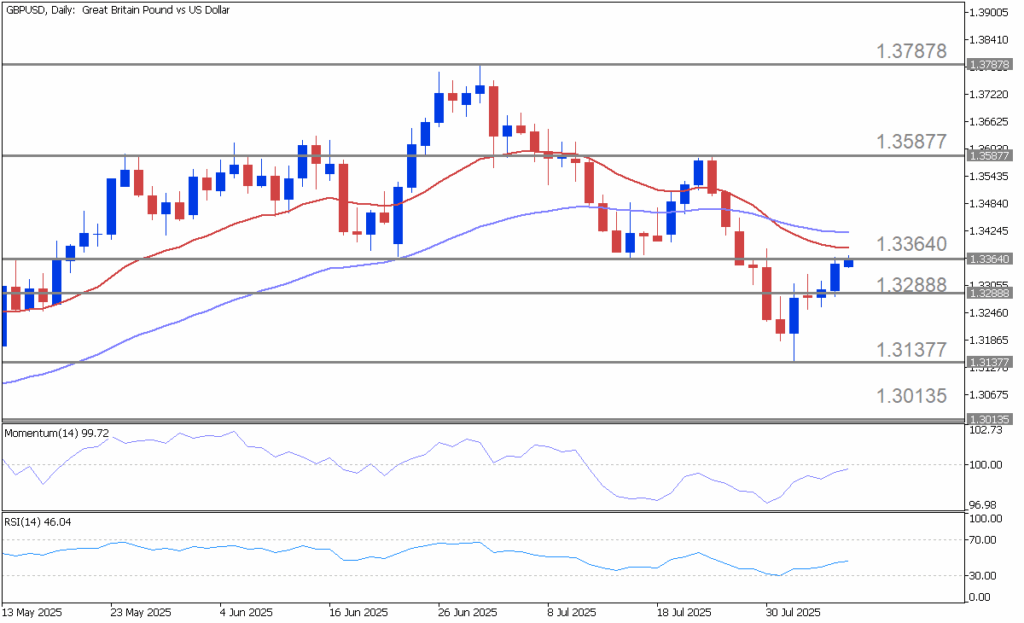
Since peaking at 1.37878 on July 1, GBPUSD has maintained a downward trajectory, characterized by a sequence of lower highs and lower lows—signaling a clear shift in sentiment. The first technical warning emerged with a classic failure swing, where the interim rally to 1.35877 failed to break the prior high and was followed by a decisive breach of support at 1.33640, thereby confirming a bearish sequence.
Further downside confirmation was provided by the formation of a “Death Cross,” as the 20-period Exponential Moving Average (EMA) crossed below the 50-period EMA. However, after finding support at 1.31377, the pair staged a rebound and reclaimed levels above both moving averages, injecting a degree of indecision into the outlook.
Momentum signals remain mixed. The Momentum Oscillator has pushed back above the 100 level, reflecting short-term positive momentum. In contrast, the Relative Strength Index (RSI) remains below the neutral 50 mark, highlighting lingering selling pressure and the absence of strong bullish conviction.
Should the buyers take market control, traders may direct their attention toward the four potential resistance levels below:
1.35144: The initial price target is set at 1.35144, reflecting the weekly Pivot Point, PP, calculated using the standard methodology.
1.35938: The second resistance level is established at 1.35938, which mirrors the swing high reached on August 14.
1.37099: The third price objective is observed at 1.37099, corresponding to the weekly resistance, R2, estimated using the standard Pivot Points methodology.
1.37878: An additional upside target is projected at 1.37878, mirroring the swing high from July 1.
Should the sellers maintain market control, traders may consider the four potential support levels listed below:
1.33640: The initial support level is seen at 1.33640, corresponding to the daily low marked on July 16.
1.32395: The second support level is estimated at 1.32395, representing the weekly support, S3, calculated using the standard Pivot Points methodology.
1.31377: The third support level is identified at 1.31377, reflecting the swing low marked on August 1.
1.30135: An additional downside target is 1.30135, mirroring a peak from March 20.
UK inflation edged higher in July 2025. The CPIH rose 4.2% year-on-year (vs. 4.1% in June), while CPI increased 3.8% (vs. 3.6%). On a monthly basis, CPI gained 0.1%, compared with a 0.2% decline a year earlier. Transport, especially air fares, drove the upward pressure, partly offset by lower housing and household services costs.
Core measures were mixed: Core CPIH eased slightly to 4.2% (from 4.3%), while Core CPI ticked up to 3.8% (from 3.7%). Goods inflation accelerated to 2.7%, and services inflation held firm at elevated levels—5.2% for CPIH and 5.0% for CPI—underscoring persistent price pressures in the services sector.
On the other side of the Atlantic, the US has retained its AA+ credit rating with S&P Global, as analysts conclude that revenues from President Trump’s tariff increases are helping offset the fiscal impact of his tax cuts. Despite earlier fears of economic fallout, S&P projects the U.S. deficit will average 6% of GDP between 2025–2028, down from 7.5% last year, though government debt is expected to exceed 100% of GDP within three years. Treasury Secretary Scott Bessent now anticipates tariff revenues above 1% of GDP in 2025, while the Congressional Budget Office (CBO) estimates the recently passed budget law will add $3.4 trillion to the deficit over the next decade.
With PMI data from Germany, the UK, and the U.S. set to shape near-term sentiment, markets are entering a phase of heightened event risk. GBPUSD continues to trade under mixed technical signals, with resistance and support levels clearly defined but conviction still lacking. Fundamentally, sticky UK inflation and U.S. fiscal dynamics add further complexity to the macro backdrop. Traders should remain alert to data surprises, as they could provide the catalyst for directional moves across major currencies.



The week of October 5–9, 2026, featured important economic data, corporate earnings, and market movements.

The XAUUSD H4 chart is showing an interesting potential bullish reversal structure after a significant decline from the 4,650–4,690 region toward the 4,080–4,085 area....


Get the FXGT App