Important Note!
We use cookies to ensure you get the best experience on our website.
By clicking ‘Agree,’ you accept our use of cookies as outlined in our cookies policy

This week’s economic calendar is packed with high-impact events that could shape market sentiment, particularly for the US dollar and safe-haven assets like gold. Key data releases include the ISM Manufacturing PMI, US unemployment claims, nonfarm payrolls, and the ISM Services PMI, alongside Switzerland’s CPI figures. With gold already trading at record highs amid political uncertainty, looming US government shutdown risks, and shifting Fed policy expectations, traders will be watching these events closely for clues on the next move in global markets.
Wednesday 17:00 (GMT+3) – USA: ISM Manufacturing PMI (USD)
Thursday 09:30 am (GMT+3) – Switzerland: CPI m/m (CHF)
Thursday 15:30 (GMT+3) – USA: Unemployment Claims (USD)
Friday 15:30 (GMT+3) – USA: Nonfarm Employment Change (USD)
Friday 17:00 (GMT+3) – USA: ISM Services PMI (USD)
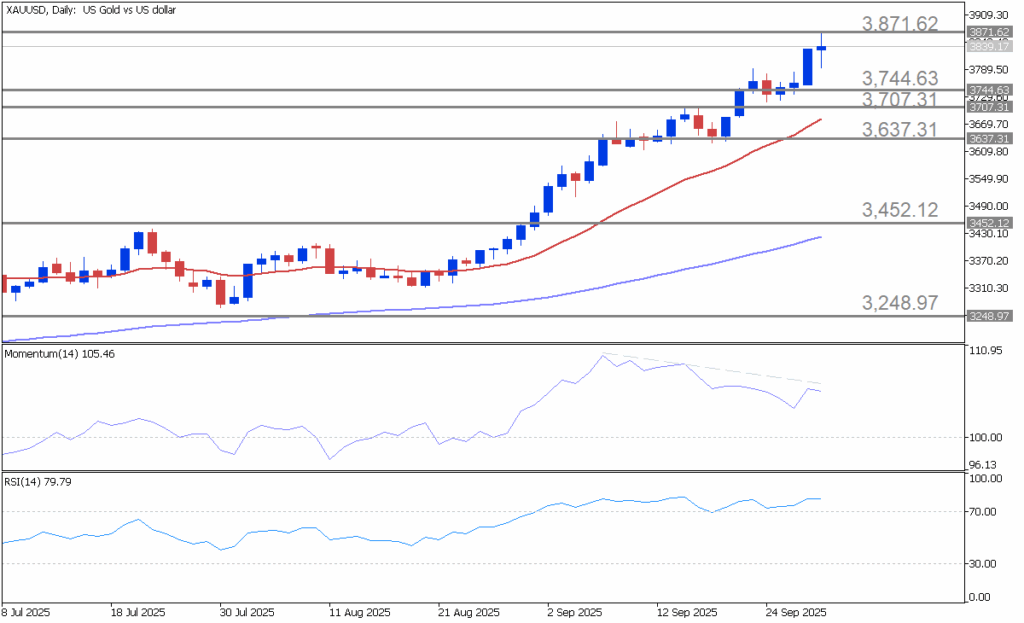
Gold extended its rally to a new record high of $3,871.61 per troy ounce on September 30, supported by a mix of macroeconomic and geopolitical drivers. The move reflects stronger safe-haven demand amid persistent geopolitical risks, heightened uncertainty around both the US and global economy, concerns over a potential US government shutdown, and rising market expectations for an imminent Federal Reserve rate cut.
From a technical standpoint, the broader uptrend remains intact, with spot prices holding above the 50-period Exponential Moving Average (EMA). Momentum indicators continue to support the bullish bias: the Momentum oscillator is holding above the 100 mark, while the Relative Strength Index (RSI) remains firmly above 50, signaling sustained buying pressure. However, key oscillators across daily, weekly, and monthly timeframes have pushed into overbought territory, flagging the risk of a short-term pullback. Moreover, the emergence of negative divergence between price action and the Momentum oscillator adds a cautionary note, suggesting that corrective pressures could develop despite the prevailing bullish trend.
Should the bulls maintain market control, traders may direct their attention toward the four potential resistance levels below:
3,871.62: The initial resistance is set at $3,871.62, which corresponds to the daily high reached on September 30.
3,912.92: The second price objective is projected at $3,912.92, corresponding to the weekly resistance, R3, calculated using the standard Pivot Points methodology.
3,964.35: The third price target is established at $3,964.35, aligning with the 423.6% Fibonacci Extension level, calculated from $3,707.31 to $3,677.88.
3,991.80: An additional price target is seen at $3,991.80 mirroring the 423.6% Fibonacci Extension level, calculated from $3,438.83 to $3,6267.95.
Should the sellers take market control, traders may consider the four potential support levels listed below:
3,744.63: The initial support level is identified at 3,744.63, based on the weekly Pivot Point, PP, calculated using the standard methodology.
3,707.31: The second support level is positioned at 3,707.31, corresponding to the daily high established on September 17.
3,647.31: The third support level is situated at 3,637.31, in alignment with the weekly support, S2, estimated using the standard Pivot Points methodology.
3,452.12: An additional downside target is noted at 3,452.12, corresponding to the daily high established on June 16.
A US government shutdown is looming as partisan battles over federal funding and health care provisions stall progress in Congress. If lawmakers fail to pass a short-term funding extension, the government could shut down at 12:01 am, affecting non-essential services and risking furloughs for thousands of workers. Gold surged on safe-haven demand as a looming US government shutdown stirs political uncertainty, with prices up 3% over two days before easing in European trading. While a last-minute deal could spark a pullback, dip buyers are likely to reenter, given gold’s 45% jump this year — its strongest run since 1979. The rally reflects not only shutdown risks but also trade tensions, Fed rate cut bets, and waning confidence in US exceptionalism. The dollar has weakened alongside, and history shows shutdowns typically deepen that trend. One side effect: the US Treasury’s gold reserves now top $1 trillion in value, far above their official book value.
Gold remains at the center of market attention as political uncertainty, Fed expectations, and shifting risk sentiment drive prices to record highs. While the technical picture supports the broader uptrend, overbought signals and negative divergence highlight the risk of a short-term pullback. With key economic releases on deck and the threat of a US government shutdown looming, traders should stay alert to volatility, as upcoming data and policy developments will likely set the tone for gold’s next move.



Gold (XAUUSD) is currently showing signs of a potential recovery after experiencing a sharp corrective decline from the recent high area.


Gold (XAUUSD) on the H4 timeframe is showing signs of a significant corrective phase following the strong bullish advance seen throughout August.

Get the FXGT App