Important Note!
We use cookies to ensure you get the best experience on our website.
By clicking ‘Agree,’ you accept our use of cookies as outlined in our cookies policy

This week’s final trading sessions bring several key economic releases that could shape market direction. On Thursday, Switzerland’s CPI will provide a regional inflation update, though its direct impact on European equities is expected to be limited. The more critical focus will be on U.S. unemployment claims, as labor market signals tend to steer global risk sentiment and could influence the DAX’s next move.
Looking ahead to Friday, attention shifts firmly to the United States, where Nonfarm Payrolls and ISM Services PMI stand out as the most significant data points of the week. Both are closely tied to expectations for Federal Reserve policy and carry the potential to move global markets.
Thursday 09:30 am (GMT+3) – Switzerland: CPI m/m (CHF)
Thursday 15:30 (GMT+3) – USA: Unemployment Claims (USD)
Friday 15:30 (GMT+3) – USA: Nonfarm Employment Change (USD)
Friday 17:00 (GMT+3) – USA: ISM Services PMI (USD)
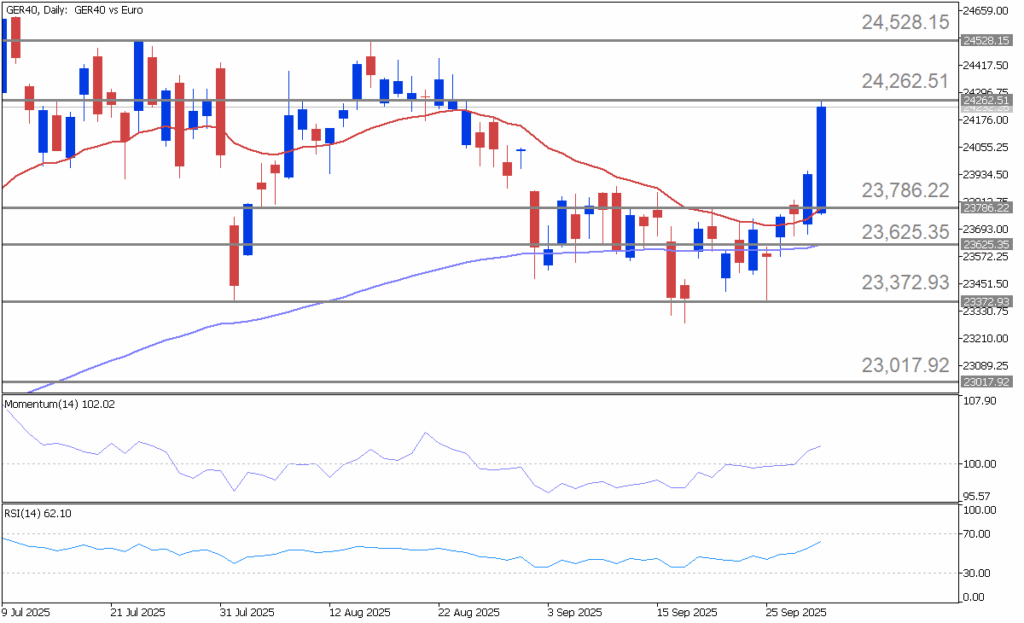
The DAX has staged a notable rebound since bottoming at 23,279.46 on September 17. The initial bullish reversal was signaled by a Japanese candlestick pattern and later validated by a failure swing, as the subsequent trough at 23,372.93 held above the prior low and prices broke through resistance at 23,786.22. This sequence confirms a constructive technical setup.
The 20-period EMA remains above the 50-period EMA, reflecting a shift toward bullish sentiment, while price action continues to trade firmly above the short-term average. Momentum indicators strengthen the case: the oscillator has advanced beyond the 100 level and the RSI remains comfortably above 50, both pointing to persistent buying pressure.
That said, near-term caution is justified. The index is consolidating, and without a decisive breakout above 24,631.49, the risk remains that the rally could stall. A sustained close above this threshold would open the way for further upside.
Should the buyers maintain market control, traders may direct their attention toward the four potential resistance levels below:
24,262.51: The initial resistance level is identified at 24,262.51, aligning with the weekly resistance, R3, calculated using the standard Pivot Points methodology.
24,528.15: The second price target is set at 24,528.15, aligning with the peak from August 15.
24,868.21: The third price objective is observed at 24,868.21.
25,123.63: An additional upside target is projected at 25,123.63, mirroring the 423.6% Fibonacci Extension drawn from 23,786.26 to 23,372.93.
Should the sellers take market control, traders may consider the four potential support levels listed below:
23,786.22: The initial support level is estimated at 23,786.22, corresponding to the peak marked September 19.
23,625.35: The second support level is 23,625.35, mirroring the weekly Pivot Point, PP, estimated using the standard methodology.
23,372.93: A third support level is identified at 23,372.93, representing the low point marked on September 25.
23,017.92: An additional downside target is seen at 23,017.92, reflecting the low point from June 19.
German Chancellor Friedrich Merz has pledged to revive Europe’s largest economy by cutting red tape and embracing digitalization and AI. At a press conference following an informal summit in Copenhagen, Merz outlined a “modernization agenda” with 23 key projects, including faster business formation, digital vehicle registration, AI tools for legal and visa processes, and streamlined recognition of foreign medical qualifications.
The government aims to reduce bureaucracy by 25%, potentially saving €16 billion annually, while also investing heavily in infrastructure and defence after years of economic contraction. The cabinet also approved €1.7 billion for a nuclear fusion project and advanced legislation to speed hydrogen infrastructure development.
In summary, while Switzerland’s CPI offers only limited implications for European equities, the focus firmly rests on U.S. labor and services data, which could determine whether the DAX breaks higher or remains range-bound. With the index showing constructive technical signals but still consolidating below key resistance, the upcoming releases may provide the decisive push that sets the market’s near-term direction.



Financial markets were shaped by a busy week of economic data, central bank decisions, and corporate earnings.

Markets face a busy week of high-impact economic events, with central bank policy, inflation, employment, growth and energy data all in focus.

Get the FXGT App