Important Note!
We use cookies to ensure you get the best experience on our website.
By clicking ‘Agree,’ you accept our use of cookies as outlined in our cookies policy

Bitcoin continues to face elevated volatility as broader market caution and shifting risk sentiment weigh on price action. Recent movements reflect a mix of macro uncertainty and routine profit-taking by long-term holders, leaving traders focused on how technical structure and momentum signals are shaping the near-term outlook.
Friday 12:00 pm (GMT+2) – Europe: Flash GDP q/q (EUR)
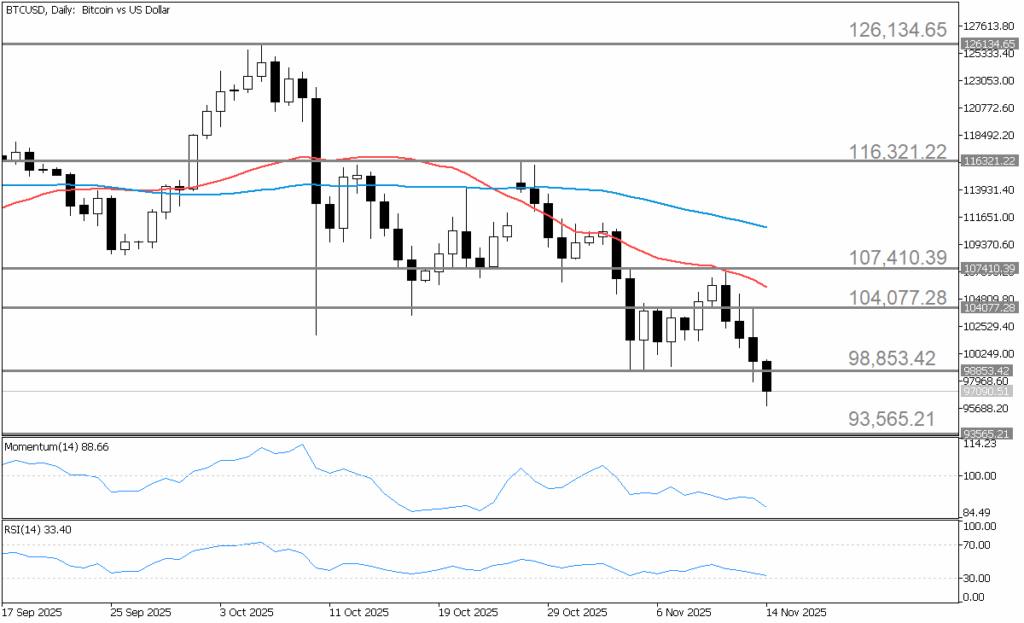
Since posting a cyclical high at 126,134.65 on October 6, BTCUSD has retreated more than 23%, extending its decline amid deteriorating sentiment and renewed selling pressure from long-term holders as the US government reopens. The shift in tone was initially flagged by a Shooting Star candlestick, followed by a Long Black candle and a subsequent Death Cross, with the 20-period EMA crossing below the 50-period EMA—an early indication that market momentum was turning decisively lower. A failure swing, with the recent peak at 116,321.22 remaining below the prior high, added further confirmation of weakening structure and invited additional downside follow-through.
Momentum readings support this bearish configuration. The Momentum Oscillator remains below the 100 line, validating the strength and persistence of the current downtrend. Likewise, the RSI holding firmly beneath 50 reflects sustained selling pressure and reinforces that bearish dominance remains in place.
Taken together, the combination of macro headwinds and aligned technical signals suggests BTCUSD is skewed toward further near-term downside, with sellers maintaining clear control of the market landscape.
Should the buyers take market control, traders may direct their attention toward the four potential resistance levels below:
98,853.42: The initial resistance level is identified at 98,853.42, which mirrors the swing low from November 4.
104,077.28: The second price target is seen at 104,077.28, reflecting the weekly Pivot Point, PP, estimated using the standard methodology.
107,410.39: The third price objective is projected at 107,410.39, which corresponds to the swing high marked on November 11.
116,321.22: An additional price target is established at 116,321.22, aligning with the high point from October 27.
Should the sellers maintain market control, traders may consider the four potential support levels listed below:
93,565.21: The initial support level is identified at 93,565.21, corresponding to the 161.8% Fibonacci Extension drawn from 98,853.42 to 107,410.39.
91,769.45: The second support level is identified at 91,769.45, representing the weekly support, S1, calculated using the standard Pivot Points methodology.
85,008.24: The third support level is identified at 85,008.24, corresponding to the 261.8% Fibonacci Extension drawn from 98,853.42 to 107,410.39.
71,163.07: An additional downside target is noted at 71,163.07, reflecting the 423.6% Fibonacci Extension drawn from 98,853.42 to 107,410.39.
According to analysts, recent Bitcoin whale selling appears to be typical late-cycle activity, not evidence of a mass exit. A large BTC transfer to an exchange contributed to concerns, but on-chain data suggests the selling pattern is consistent with normal profit-taking rather than panic.
Long-term holders have been steadily increasing their distribution, with average daily outflows rising from around 12,000 BTC in early July to roughly 26,000 BTC more recently. This gradual rise reflects routine late-stage profit realization by older investors, a pattern seen in previous market cycles.
Overall, whales are selling, but the behavior looks controlled, expected, and in line with historical bull-market dynamics rather than a sudden or destabilizing shift.
Bitcoin’s decline reflects a broader risk-off mood driven by weak corporate results, uncertainty around future US monetary policy, and unreliable economic data following the prolonged government shutdown. Heavy liquidations amplified the move, but analysts see no signs of insider-driven selling. Instead, BTC is tracking wider concerns about valuations and economic momentum. A recovery will depend on clearer signals about US growth and policy direction.
Overall, Bitcoin remains under pressure as technical weakness aligns with a cautious macro backdrop and controlled distribution from long-term holders. With momentum indicators firmly bearish and sentiment still fragile, the path of least resistance appears tilted to the downside in the near term. A more constructive outlook will require stabilization in broader risk conditions and clearer signs of renewed buyer conviction.



Crypto markets remain in focus as stronger US economic data, evolving regulation and growing institutional adoption shape investor sentiment.

Gold (XAUUSD) is currently showing signs of a potential recovery after experiencing a sharp corrective decline from the recent high area.


Get the FXGT App