Important Note!
We use cookies to ensure you get the best experience on our website.
By clicking ‘Agree,’ you accept our use of cookies as outlined in our cookies policy

With a packed economic calendar and major data releases on the horizon, markets are entering a period where both technical signals and macro developments may rapidly shift intraday sentiment. AUDUSD continues to show early signs of bullish momentum, but full confirmation remains dependent on stronger trend signals and follow-through. Meanwhile, uncertainty surrounding delayed US data keeps global visibility limited, reinforcing the need for caution as traders navigate potential volatility from GDP, inflation, labour figures, and crude inventories. Staying vigilant and adaptable will be essential as the next wave of market-moving information unfolds.
Thursday 02:30 am (GMT+2) – Australia: Employment Change (AUD)
Thursday 09:00 am (GMT+2) – UK: GDP m/m (GBP)
Thursday Tentative – USA: CPI m/m (USD)
Thursday Tentative – USA: Unemployment Claims (USD)
Thursday 19:00 (GMT+2) – USA: Crude Oil Inventories (USD)
Friday Tentative – USA: PPI m/m (USD)
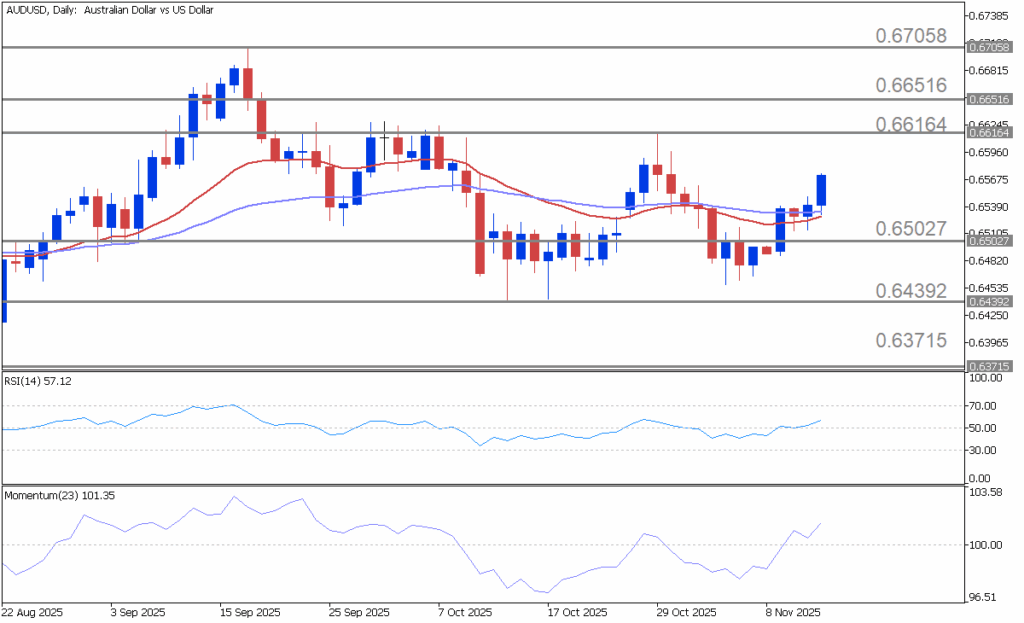
Since bottoming at 0.64392 on October 14, AUDUSD has begun to establish a clearer upward bias, attempting to break out of the month-long consolidation that previously constrained price action. Stronger-than-expected employment figures combined with a softer unemployment rate have improved market sentiment, a shift reflected on the chart as the pair now trades comfortably above the 20- and 50-period Exponential Moving Averages (EMAs).
Momentum conditions also support the bullish case: the Momentum oscillator has convincingly pushed above the 100 mark, while the Relative Strength Index (RSI) remains well above the 50 line, highlighting sustained buying pressure and a constructive tone for the Australian dollar.
That said, a critical technical trigger remains absent. The shorter-term EMA has not yet delivered a decisive crossover above the longer-term EMA, indicating that a complete confirmation of trend reversal is still forthcoming. Traders may therefore look for clearer follow-through before validating a more durable bullish structure.
If buyers maintain control of the market, traders may shift their focus to the following four potential resistance levels:
0.66164: The first level of resistance is determined at 0.66164, which reflects the high point from October 29.
0.66516: The second resistance level is projected at 0.66516, which aligns with the weekly resistance, R3, calculated using the standard Pivot Points methodology.
0.67058: The third price target is established at 0.67058, which corresponds to the daily high marked on September 17.
0.67581: An additional price objective is estimated at 0.67581.
If sellers take control of the market, traders may focus on the following four key support levels:
0.65027: The initial support level is seen at 0.65027, representing the weekly Pivot Point, PP, calculated using the standard methodology.
0.64392: The second support level is positioned at 0.64392, aligning with the low point marked on October 14.
0.63715: The third downside target is noted at 0.63715.
0.63448: An additional downside target is determined at 0.63448, reflecting the 261.8% Fibonacci Extension drawn from 0.65194 to 0.66276.
Australian jobs surged in October, with 42,200 positions added—mostly full-time—and the unemployment rate easing to 4.3% from 4.5%. The strong labour data lifted the Australian dollar and pushed bond futures lower as markets sharply cut expectations for further Reserve Bank of Australia rate reductions next year. With inflation still elevated and the labour market proving resilient, analysts now see little urgency for additional policy easing, suggesting the current rate-cutting cycle may be nearing its end.
The end of the prolonged US government shutdown will restart the flow of economic data, but key indicators may remain unreliable for months. September payroll figures may arrive soon, yet October data are severely compromised—most notably because the household survey that determines the unemployment rate was never conducted. With gaps in employment, inflation, and retail sales data, the Federal Reserve may have to delay policy decisions, as Chair Jerome Powell warns that incomplete information leaves policymakers “driving in the fog.” Despite market relief, the shutdown’s aftermath means economic visibility will stay limited.
A busy trading session lies ahead, with several high-impact data releases poised to shape volatility across major currency pairs and commodities. Markets will be watching closely as the UK prints monthly GDP, and the US releases key inflation and labor data—pending delays linked to the recent government shutdown. Crude oil traders will also focus on inventory levels, which remain a crucial driver of energy-market sentiment. Together, these events could influence short-term market direction and provide fresh momentum for trend-driven setups, particularly in AUDUSD.



The XAUUSD H4 chart is showing an interesting potential bullish reversal structure after a significant decline from the 4,650–4,690 region toward the 4,080–4,085 area....


The AUDUSD weekly chart continues to show an interesting bullish Elliott Wave structure following the strong recovery from the previous major low.

Get the FXGT App