Important Note!
We use cookies to ensure you get the best experience on our website.
By clicking ‘Agree,’ you accept our use of cookies as outlined in our cookies policy

Friday brings high-impact releases with Canada’s GDP and the US Core PCE Price Index due this afternoon, both of which could trigger volatility in CAD and USD pairs. Looking ahead, Australia’s parliamentary elections over the weekend add a layer of political risk for AUD markets when trading resumes on Monday. Meanwhile, USDCHF continues to build on its mid-September rebound, with technical signals hinting at further upside potential.
Friday 15:30 (GMT+3) – Canada: GDP m/m (CAD)
Friday 15:30 (GMT+3) – USA: Core PCE Price Index m/m (USD)
Saturday All Day – Australia: Parliamentary Elections (AUD)
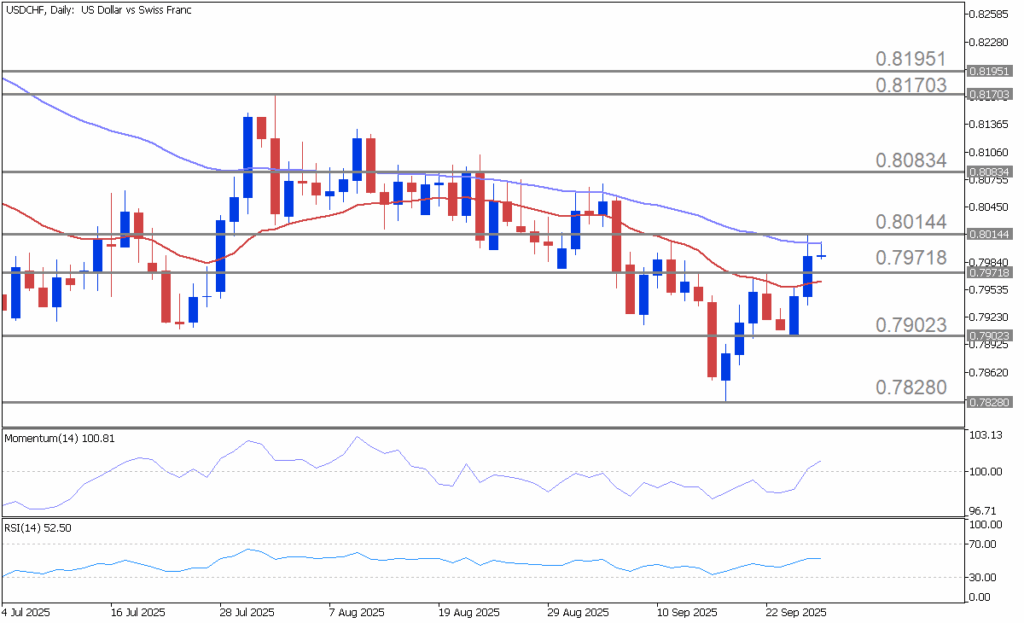
Since bottoming at 0.78280 on September 17, USDCHF has staged an impressive rebound of over 2%. The move was confirmed by a failure swing reversal pattern, with the trough at 0.79023 holding above the prior low, followed by a break above the last swing high at 0.79718—opening the door for further upside momentum.
Price action is currently consolidating above the 20-period EMA, though it remains capped beneath the 50-period EMA. A crossover signal has yet to materialize, with the faster EMA still trailing the slower one, leaving some caution warranted until confirmation.
Momentum studies continue to underpin the bullish bias. The Momentum Oscillator has advanced above the 100 threshold, while the Relative Strength Index (RSI) holds firm above 50, collectively pointing to sustained buying pressure and improving market sentiment.
Should the bulls maintain market control, traders may direct their attention toward the four potential resistance levels below:
0.80144: The initial resistance level is determined at 0.80144, reflecting the 161.8% Fibonacci Extension drawn from 0.79718 to 0.79023.
0.80834: The second resistance level is set at 0.80834, which mirrors the 261.8% Fibonacci Extension drawn from 0.79718 to 0.79023.
0.81703: The third resistance level is seen at 0.81703, corresponding to the daily high marked on August 1.
0.81951: An additional price target has been established at 0.81951, which reflects the 423.6% Fibonacci Extension drawn from 0.79718 to 0.79023.
Should the sellers take market control, traders may consider the four potential support levels listed below:
0.79718: The initial support level is seen at 0.79718, corresponding to the swing high from September 22.
0.79023: The second support level is estimated at 0.79023, representing the swing low marked on September 24.
0.78280: The third support level is identified at 0.78280, reflecting the low point formed on September 17.
0.77730: An additional downside target is 0.77730, mirroring the weekly support, S2, calculated using the standard Pivot Points methodology.
The Swiss National Bank (SNB) kept its policy rate unchanged at 0% and reaffirmed its readiness to intervene in the foreign exchange market if needed. Inflationary pressure remains subdued, with inflation edging up slightly from –0.1% in May to 0.2% in August, mainly due to higher prices in tourism and imported goods. The SNB’s conditional forecast continues to see average annual inflation at 0.2% in 2025, 0.5% in 2026, and 0.7% in 2027, assuming a steady 0% policy rate.
Globally, economic growth slowed in early 2025 amid US tariffs and heightened uncertainty. The SNB expects subdued global activity in the coming quarters, with risks skewed to the downside from potential trade escalations.
In Switzerland, GDP rose 0.5% in Q2 after a strong Q1, driven by fluctuations in the pharmaceuticals sector. Services provided some support, but unemployment has been rising. US tariffs are weighing on exports and investment, particularly in machinery and watchmaking, though services remain resilient. The SNB forecasts GDP growth of 1–1.5% in 2025 and just under 1% in 2026, with unemployment likely to continue increasing. The outlook remains highly uncertain, shaped by global trade and economic risks.
With key data releases and political risk events unfolding, markets face the prospect of heightened volatility into the weekend. USDCHF has shown constructive technical signals, but confirmation hinges on a sustained break above resistance levels. Fundamentally, the SNB’s cautious stance, coupled with global trade headwinds, leaves the broader outlook uncertain. Traders may find near-term opportunities, but risk management remains essential given the mix of economic catalysts and geopolitical uncertainty.



Overview The week of October 19–23, 2026, featured several important economic developments that influenced global financial markets. Inflation increased in Canada and the...

The week of October 26–30, 2026, promises to be particularly eventful for global financial markets, with several major central banks announcing interest rate decisions.

Get the FXGT App