Important Note!
We use cookies to ensure you get the best experience on our website.
By clicking ‘Agree,’ you accept our use of cookies as outlined in our cookies policy

This week closes with high-impact economic events that could inject volatility into global markets. On Friday, both Canada’s Employment Change and the U.S. Non-Farm Payrolls (NFP) data will be released, providing critical insight into labor market strength and shaping expectations around central bank policy. With these releases scheduled at 15:30 (GMT+3), traders should prepare for heightened price swings across major currencies, commodities, and cryptocurrencies.
Friday 15:30 (GMT+3) – Canada: Employment Change (CAD)
Friday 15:30 (GMT+3) – USA: Non-Farm Employment Change (USD)
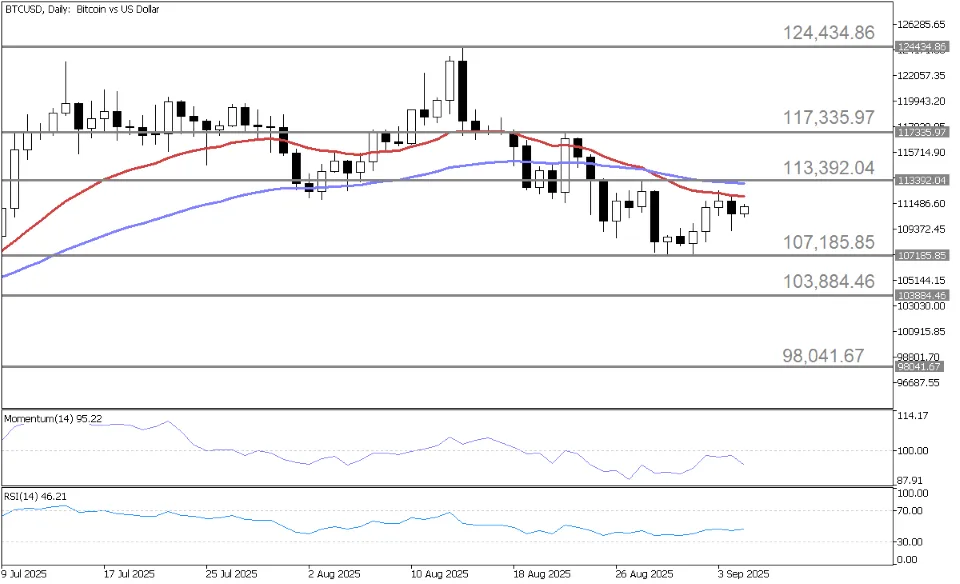
Since peaking at an all-time high of $124,434.86 on August 14, BTCUSD has retreated by roughly 11%, with renewed demand for gold amplifying the downside pressure. The reversal began immediately after the peak, marked by the formation of a Long Bearish Body—a textbook indicator of potential trend exhaustion. This was further confirmed by a non-failure swing pattern: while price briefly pushed above the prior high, the subsequent breakdown below the earlier trough at $111,831.31 signaled a decisive shift in sentiment and accelerated bearish momentum.
From a trend perspective, the decline has been reinforced by a Death Cross, where the 20-period EMA slipped beneath the 50-period EMA. Importantly, Bitcoin remains below both moving averages, highlighting persistent downside bias. A clear breach of the key support at $107,185.85 would likely pave the way for deeper losses.
Momentum studies align with this bearish outlook. The Momentum Oscillator has fallen under the critical 100 mark, confirming the strength of the current downtrend. Likewise, the RSI is holding below 50, signaling continued selling pressure and suggesting that bears maintain firm control.
Should the buyers take market control, traders may direct their attention toward the four potential resistance levels below:
113,392.04: The initial resistance level is identified at 113,392.04, which mirrors the daily high from August 28.
117,335.97: The second price target is seen at 117,335.97, reflecting the high point marked on August 22.
124,434.86: The third price objective is projected at 124,434.86, which corresponds to the all-time high recorded on August 14.
130,192.50: An additional price target is established at 130,192.50, representing the 161.8% Fibonacci Extension drawn from 123,179.39 to 111,831.31.
Should the sellers maintain market control, traders may consider the four potential support levels listed below:
107,185.85: The initial support level is identified at 107,185.85, corresponding to the trough formed on September 1.
103,884.46: The second support level is identified at 103,884.46, representing the 161.8% Fibonacci Extension drawn from the high point 123,179.39 to the low point 111,831.31.
98,041.67: The third support level is identified at 98,041.67, corresponding to the daily low marked on June 22.
89,898.94: An additional downside target is noted at 89,898.94, reflecting the 461.8% Fibonacci Extension drawn from the low point 123,179.39 to the high point 111,831.31.
Bitcoin has been stuck around $110,000, but analysts believe it could rebound later this year as big institutions step in. Nearly $90 billion from corporate treasuries, upcoming Federal Reserve rate cuts, and friendlier regulations are expected to create a solid price floor, making sharp rallies more likely if demand surges.
Recent rule changes, such as cheaper and easier ETF redemptions and new investment products tied to Bitcoin, are helping Wall Street bring more money into the market. This growing institutional support is making Bitcoin feel less like a fringe asset and more like a mainstream financial instrument.
Historically, Bitcoin performs best in the final quarter of the year and early into the next, suggesting seasonal momentum could add fuel to the recovery. Looking further ahead, some experts see countries eventually holding Bitcoin as part of their reserves, with Japan seen as a possible early mover.
The broader message is that in an era of money printing and economic uncertainty, Bitcoin is viewed as one of the hardest and scarcest assets—potentially strong enough to challenge the U.S. dollar’s dominance in the future.
With labor market data from both Canada and the U.S. on deck, markets are bracing for a surge in volatility that could ripple across currencies, commodities, and digital assets. For Bitcoin, the technical picture points to sustained downside risks unless key resistance levels are reclaimed, while fundamentals suggest that institutional demand and seasonal strength could provide a medium-term cushion. Traders should remain cautious in the near term, but keep an eye on upcoming economic releases and institutional flows that may set the tone for Bitcoin’s next major move.



Crypto markets remain in focus as stronger US economic data, evolving regulation and growing institutional adoption shape investor sentiment.

Gold (XAUUSD) is currently showing signs of a potential recovery after experiencing a sharp corrective decline from the recent high area.


Get the FXGT App