Important Note!
We use cookies to ensure you get the best experience on our website.
By clicking ‘Agree,’ you accept our use of cookies as outlined in our cookies policy

Markets face a busy week with high-impact data releases from the UK, Germany, and the US likely to drive volatility across major currencies. Inflation figures, PMI surveys, and central bank developments remain in focus as traders assess the balance between slowing growth momentum and lingering price pressures. At the same time, monetary policy shifts in New Zealand and escalating trade measures from the US add further layers of uncertainty to the global outlook.
Wednesday 09:00 am (GMT+3) – UK: CPI y/y (GBP)
Thursday 10:30 am (GMT+3) – Germany: Manufacturing PMI (EUR)
Thursday 10:30 am (GMT+3) – Germany: Services PMI (EUR)
Thursday 11:30 am (GMT+3) – UK: Manufacturing PMI (GBP)
Thursday 11:30 am (GMT+3) – UK: Services PMI (GBP)
Thursday 16:45 (GMT+3) – USA: Manufacturing PMI (USD)
Thursday 16:45 (GMT+3) – USA: Services PMI (USD)
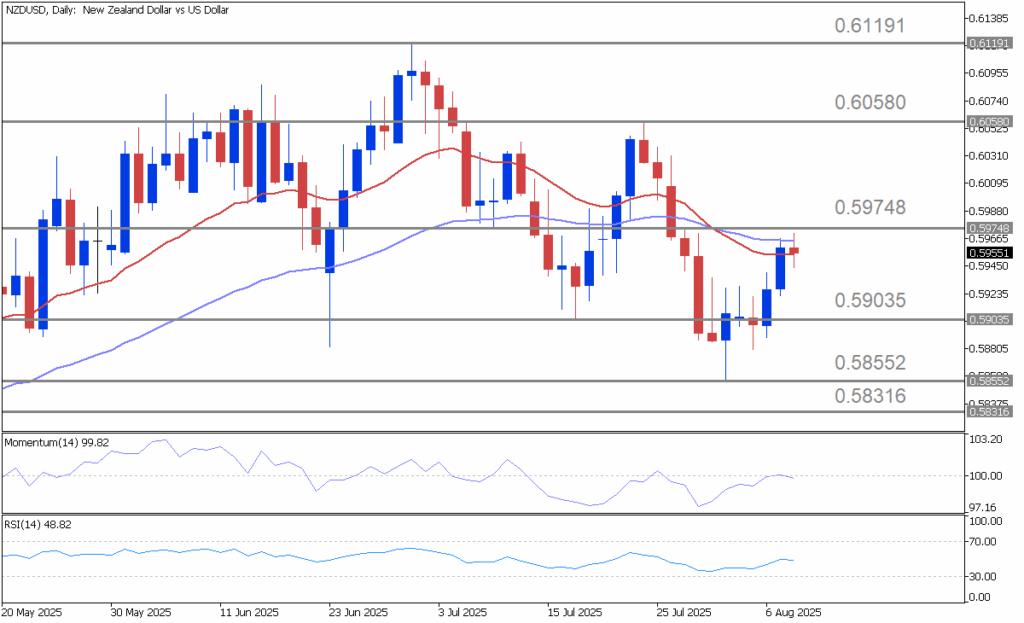
Since topping out at 0.61191 on July 1, NZDUSD has been entrenched in a downward trajectory. The initial reversal was signaled by a failure swing, later reinforced by a double crossover formation, with downside pressure accelerating after the RBNZ’s 25-basis-point rate cut, which further undermined the currency.
Technically, the rally to 0.60421 failed to surpass the prior high, while the subsequent break below the 0.59748 trough confirmed a bearish continuation. This move coincided with the formation of a “Death Cross,” as the 20-period EMA slipped beneath the 50-period EMA, amplifying negative sentiment. Prices now remain lodged below both moving averages, with downward-sloping trajectories that point to sustained bearish momentum.
Momentum studies reinforce the outlook. The Momentum Oscillator holds firmly below the 100 baseline, signaling ongoing selling pressure, while the RSI continues to trade beneath the 50 neutral threshold, highlighting the absence of bullish conviction.
If buyers take control of the market, traders may shift their focus to the following four potential resistance levels:
0.58552: The initial resistance level is estimated at 0.58552, mirroring the swing low from August 1.
0.59401: The second price target is seen at 0.59401, reflecting the weekly Pivot Point, PP, calculated using the standard methodology.
0.59946: The third price target is established at 0.59946, corresponding to the high point reached on August 13.
0.60580: An additional price objective is estimated at 0.60580, representing the swing high from July 24.
If sellers maintain control of the market, traders may focus on the following four key support levels:
0.58080: The initial support level is seen at 0.58080, representing the 161.8% Fibonacci Extension drawn from the low point, 0.59035, to the high point, 0.60580.
0.57691: The second support level is positioned at 0.57691, aligning with the 161.8% Fibonacci Extension drawn from the swing low, 0.58552, to the swing high, 0.59946.
0.56535: The third downside target is noted at 0.56535, corresponding to the 261.8% Fibonacci Extension drawn from the low point, 0.59035, to the high point, 0.60580.
0.58080: An additional downside target is determined at 0.58080, reflecting the 423.6% Fibonacci Extension drawn from the swing low, 0.58552, to the swing high, 0.59946.
On 20 August 2025, the Reserve Bank of New Zealand’s Monetary Policy Committee voted by majority (4–2) to cut the Official Cash Rate by 25 basis points to 3 percent. The decision reflects subdued domestic activity, with GDP contracting in the second quarter, household spending under pressure, and housing market weakness persisting.
Annual CPI inflation stood at 2.7 percent in June and is expected to rise temporarily to 3.0 percent in September due to higher food, energy, and administered prices, before easing back toward the 2 percent midpoint by mid-2026 as spare capacity and slowing domestic demand restrain underlying pressures. The Committee noted balanced risks to the outlook and signaled scope for further OCR reductions if medium-term inflation continues to ease as expected.
On the other hand, the Trump administration expanded its 50% tariffs on steel and aluminum to cover 407 additional product categories, including car parts, machinery, plastics, construction materials, and specialty chemicals. The Commerce Department said the move aims to close loopholes and strengthen US steel and aluminum industries.
Economists warn the expansion could significantly raise costs for businesses and consumers. Estimates suggest the tariffs now cover at least $320 billion worth of imports, up from roughly $190 billion, adding further cost-push inflationary pressure to the US economy.
In summary, global markets are navigating a mix of softening growth signals, shifting central bank policies, and heightened trade tensions. With critical inflation and PMI data due from major economies, alongside the RBNZ’s rate cut and the US tariff expansion, traders should brace for elevated volatility and remain alert to both downside risks and potential policy-driven shifts in sentiment.



Financial markets were shaped by a busy week of economic data, central bank decisions, and corporate earnings.

Markets face a busy week of high-impact economic events, with central bank policy, inflation, employment, growth and energy data all in focus.

Get the FXGT App