Important Note!
We use cookies to ensure you get the best experience on our website.
By clicking ‘Agree,’ you accept our use of cookies as outlined in our cookies policy

Market attention turns to Friday’s Canadian employment data, which could inject volatility into CAD pairs and influence broader risk sentiment. NZDUSD remains under sustained selling pressure, driven by both technical and fundamental factors. Weakening labour market data from New Zealand, coupled with signs of a gradual slowdown in the US jobs market, has reinforced the bearish bias. Traders will be watching closely for how upcoming economic releases interact with prevailing trends, especially as central bank policy expectations continue to shift.
Friday 15:30 (GMT+3) – Canada: Employment Change (CAD)
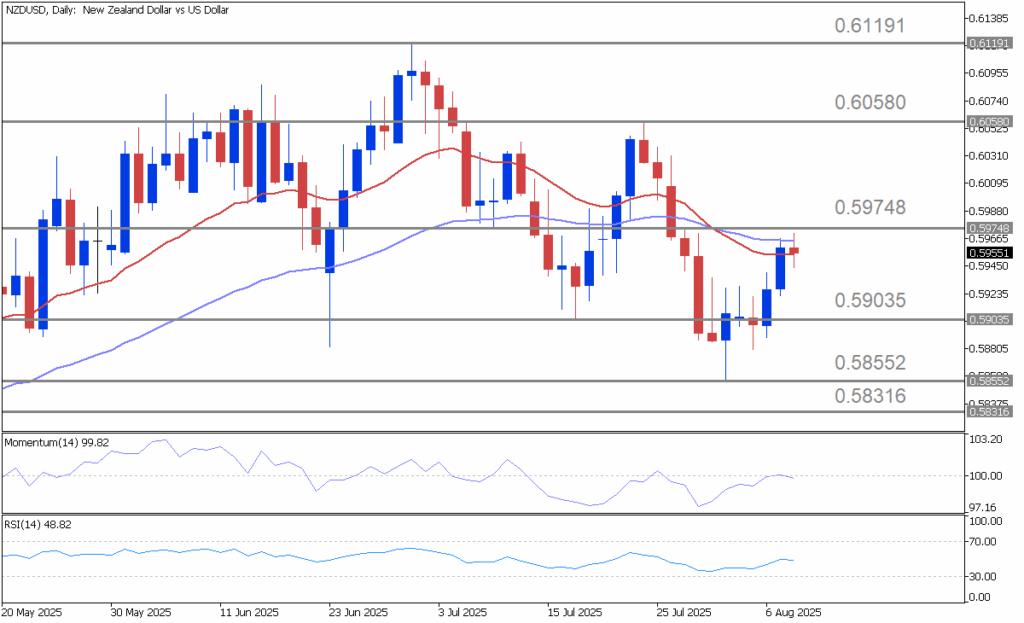
The NZDUSD has maintained a downward trajectory since the July 1 pullback from 0.61191, marked by the formation of a Spinning Top candlestick pattern that reflected waning buying pressure and heightened indecision. This pattern preceded a break below the 20-period Exponential Moving Average (EMA), paving the way for a failure swing reversal. In this sequence, the peak at 0.60421 fell short of the prior high, followed by a breach of support at 0.59748, opening the path for additional downside.
Bearish momentum was further confirmed by the emergence of a Death Cross double crossover, with the 20-period EMA crossing below the 50-period EMA, reinforcing the broader downtrend.
From a technical standpoint, momentum indicators remain aligned with the bearish bias. The Momentum Oscillator is holding below its 100 baseline, reflecting persistent selling pressure, while the Relative Strength Index (RSI) remains capped beneath the neutral 50 level, underscoring the market’s lack of bullish conviction.
If buyers take control of the market, traders may shift their focus to the following four potential resistance levels:
0.59748: The initial resistance level is estimated at 0.59748, mirroring the swing low from July 9.
0.60580: The second price target is seen at 0.60580, reflecting the swing high marked on July 24.
0.61191 The third price target is established at 0.61191, corresponding to the highest price reached in 2025.
0.61840: An additional price objective is estimated at 0.61840, representing the weekly resistance, R3, calculated using the standard Pivot Points methodology.
If sellers maintain control of the market, traders may focus on the following four key support levels:
0.59035: The initial support level is seen at 0.59035, representing the trough marked July 17.
0.58552: The second support level is positioned at 0.58552, aligning with the swing low from August 1.
0.58316: The third downside target is noted at 0.58316, corresponding to the weekly support, S1, calculated using the standard Pivot Points methodology.
0.58080: An additional downside target is determined at 0.58080, reflecting the 161.8% Fibonacci Extension drawn from 0.59035 to 0.60580.
New Zealand’s labour market continued to soften in Q2, with the unemployment rate rising to 5.2% — its highest since late 2020 and above the 5.1% recorded in Q1. Employment slipped 0.1%, participation fell to a three-year low of 70.5%, and wage growth slowed for the ninth straight quarter, highlighting weaker worker bargaining power amid elevated living costs. The downturn is hitting younger workers particularly hard, while broader economic indicators — from consumer spending to manufacturing — point to a deepening slowdown. With inflation easing and growth faltering, pressure is building on the Reserve Bank of New Zealand to cut rates, with markets widely expecting a 25-basis-point reduction to 3% at the August 20 meeting.
Meanwhile, US initial jobless claims rose more than expected to 226,000 in the week ending August 2, up 7,000 from the prior week, while the four-week average edged slightly lower to 220,750. Continuing claims climbed by 38,000 to 1.974 million in the week ending July 26 — the highest since November 2021 — with their four-week average ticking up to 1.95 million, signaling a gradual softening in the labor market.
In summary, NZDUSD remains firmly positioned within a bearish framework, with technical signals and weakening fundamentals reinforcing the downside bias. Key support levels remain in focus as sellers maintain control, while upcoming Canadian employment data could add cross-currency volatility. Traders should remain alert to shifts in sentiment, especially with central bank policy expectations in flux and economic headwinds persisting across both New Zealand and the US.

Financial markets were shaped by a busy week of economic data, central bank decisions, and corporate earnings.


Markets face a busy week of high-impact economic events, with central bank policy, inflation, employment, growth and energy data all in focus.

Get the FXGT App