Important Note!
We use cookies to ensure you get the best experience on our website.
By clicking ‘Agree,’ you accept our use of cookies as outlined in our cookies policy

The New Zealand dollar extended its rebound against the U.S. dollar this week as investors reacted to the Reserve Bank of New Zealand’s rate cut and shifting expectations around U.S. monetary policy. Markets remain focused on upcoming U.S. data, particularly the Core PCE Price Index—one of the Federal Reserve’s preferred measures of inflation—which could provide fresh clues on the timing and extent of future rate adjustments.
Meanwhile, the U.S. dollar has softened amid weaker consumer data and growing anticipation of a Fed rate cut in December, while the kiwi is finding support from improving domestic economic conditions and a more stable outlook following the latest policy easing.
Wednesday 15:30 (GMT+2) – USA: Unemployment Claims (USD)
Wednesday 15:30 (GMT+2) – USA: Core PCE Price Index m/m (USD)
Friday 15:30 (GMT+2) – Canada: GDP m/m (CAD)
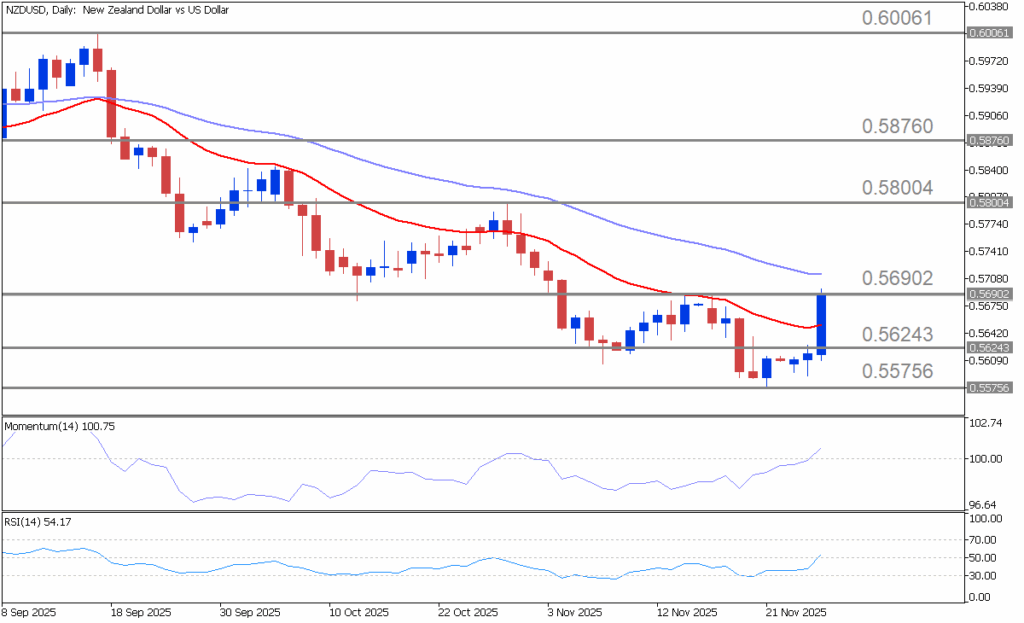
Since bottoming at 0.55756 on November 21, the NZDUSD has staged a modest rebound of just over 2% from trough to peak, as markets recalibrated expectations following the RBNZ’s rate cut earlier today. Despite the recovery, the pair has encountered notable resistance near 0.56902, and a clear break above this level remains essential to confirm a shift toward a sustained bullish phase.
At present, prices are trading above the 20-period Exponential Moving Average (EMA), which still lies below the 50-period EMA—a configuration that maintains a bearish structural bias, albeit with improving near-term momentum.
From a technical perspective, momentum indicators reinforce the emerging bullish tone. The Momentum Oscillator has risen above the 100 baseline, signaling renewed buying interest, while the Relative Strength Index (RSI) remains comfortably above the 50 neutral line, reflecting underlying demand for the kiwi. However, for a bullish non-failure swing reversal to be confirmed, the pair must achieve a decisive close above 0.56902 and a sustained move above the 50-period EMA, which would validate the directional shift and strengthen the case for further upside.
If buyers take control of the market, traders may shift their focus to the following four potential resistance levels:
0.56902: The initial resistance level is estimated at 0.56902, mirroring the high point from November 14.
0.58004: The second price target is seen at 0.58004, reflecting the peak marked on October 29.
0.58760: The third price target is established at 0.58760, corresponding to the 261.8% Fibonacci Extension drawn from the swing high, 0.56902, to the swing low, 0.55756.
0.60061: An additional price objective is estimated at 0.60061, representing the swing high point from September 17.
If sellers maintain control of the market, traders may focus on the following four key support levels:
0.56243: The initial support level is seen at 0.56243, representing the weekly Pivot Point, PP, calculated using the standard methodology.
0.55756: The second support level is positioned at 0.55756, aligning with the swing low from November 21.
0.55120: The third downside target is noted at 0.55120, corresponding to the weekly support, S2, estimated using the standard Pivot Points methodology.
0.54674: An additional downside target is determined at 0.54674, reflecting the 261.8% Fibonacci Extension drawn from the swing low, 0.56051, to the swing high, 0.56902.
The Reserve Bank of New Zealand (RBNZ) cut the Official Cash Rate (OCR) by 25 basis points to 2.25% on November 26, 2025, as the economy continues to recover from a period of weak growth.
Annual inflation rose to 3% in the September quarter, at the top of the RBNZ’s 1–3% target band, but is expected to ease to around 2% by mid-2026 as spare capacity in the economy keeps price pressures in check.
Economic activity, which slowed through mid-2025, is now showing early signs of improvement. Lower interest rates are encouraging household spending, the labour market is stabilising, and the weaker New Zealand dollar is boosting export incomes.
The RBNZ noted that while financial conditions have eased and the banking system remains stable, risks to inflation are balanced. The recovery could slow if households and businesses remain cautious, but it could accelerate if demand responds more strongly to cheaper borrowing costs.
On the other hand, the U.S. dollar weakened on Tuesday after a batch of mixed economic data reinforced expectations that the Federal Reserve will cut interest rates next month.
September retail sales rose just 0.2%, falling short of forecasts for 0.4% and slowing from August’s 0.6% increase, suggesting softer consumer demand. Producer prices climbed 0.3%, matching expectations, while core prices edged up only 0.1%, hinting at easing inflation pressures. Meanwhile, consumer confidence dropped sharply to 88.7 in November from 95.5 in October, signaling growing caution among households.
The combination of sluggish spending, mild price growth, and weaker sentiment supported market bets that the Fed could deliver another quarter-point rate cut in December. Recent dovish remarks from officials have strengthened that view, leaving traders alert to further volatility.
Overall, the New Zealand dollar is showing tentative signs of recovery, supported by improving domestic conditions and expectations that lower interest rates will stimulate growth. However, the broader direction of NZDUSD remains closely tied to upcoming U.S. data, particularly the Core PCE Price Index, which could influence the Federal Reserve’s next policy move. A softer U.S. inflation reading may add further pressure on the dollar and strengthen the kiwi’s upward momentum, while a stronger print could revive demand for the greenback and cap near-term gains. Until a decisive break above 0.56902 occurs, the pair is likely to remain in a consolidation phase with a cautiously bullish bias.



The week of October 26–30, 2026, promises to be particularly eventful for global financial markets, with several major central banks announcing interest rate decisions.

The XAUUSD H4 chart is showing an interesting potential bullish reversal structure after a significant decline from the 4,650–4,690 region toward the 4,080–4,085 area....


Get the FXGT App