Important Note!
We use cookies to ensure you get the best experience on our website.
By clicking ‘Agree,’ you accept our use of cookies as outlined in our cookies policy

The Nasdaq 100 Index has come under significant pressure following its February 18 peak, as a combination of technical weakness and escalating macroeconomic concerns weigh on sentiment. With key economic events on the horizon — including inflation data from the US, growth figures from Canada, and manufacturing activity from China — traders will be closely monitoring how global data flow impacts both risk appetite and monetary policy expectations.
Friday All Day – Germany: Prelim CPI m/m (EUR)
Friday 15:30 (GMT+2) – Canada: GDP m/m (CAD)
Friday 15:30 (GMT+2) – USA: Core PCE Price Index m/m (USD)
Saturday 03:30 am (GMT+2) – China: Manufacturing PMI (CNY)
Since peaking at 22,244.49 on February 18, the Nasdaq 100 Index has undergone a notable decline, driven by a combination of technical signals and fundamental pressures. A series of candlestick reversal patterns near the peak indicated early signs of buyer exhaustion and a potential shift in market sentiment. This initial signal was confirmed by a non-failure swing, with the peak at 22,244.49 holding above the prior high, followed by a decisive break below 21,323.78, confirming a bearish reversal.
The downside bias was further reinforced as the Index breached both the 20-period and 50-period Exponential Moving Averages (EMAs), signaling a broader structural shift. The subsequent formation of a “Death Cross” double crossover, where the 20-period EMA crossed below the 50-period EMA, added further validation to the building downside momentum.
Momentum indicators provided additional confirmation, with both the Momentum Oscillator and the Relative Strength Index (RSI) breaking below key thresholds of 100 and 50, respectively — highlighting the increasing strength of the emerging downtrend.
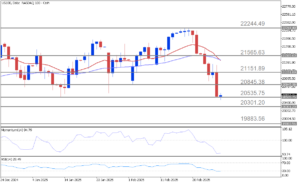
If buyers take control of the market, traders may shift their focus to the following four potential resistance levels:
20845.38: The initial price target is established at 20845.38, corresponding to the daily low formed on February 3.
21151.89: The second level of resistance is seen at 21151.89, which aligns with the weekly support (turned to resistance), S2, calculated using the standard Pivot Points methodology.
21565.63: The third price target is determined at 21565.63, representing the 61.8% Fibonacci Retracement drawn from the high point, 22244.49 to the low point, 20467.38.
21808.97: An additional price objective is estimated at 21808.97, mirroring the weekly Pivot Point, PP, estimated using the standard methodology.
If sellers maintain control of the market, traders may focus on the following four key support levels:
20301.20: The initial support level is established at 20301.20, representing a daily low marked November 19.
19883.56: The second support level is seen at 19883.56, aligning with strong support from October 31.
19633.06: The third downside target is 19633.06, corresponding to the weekly support, S2, estimated using the standard Pivot Points methodology.
19479.75: An additional downside target is observed at 19479.75, reflecting the 161.8% Fibonacci Extension drawn from 20535.75 to 22244.49.
Stocks plunged sharply, led by an 8.48% selloff in Nvidia, as its latest earnings failed to reignite the AI rally. The Nasdaq 100 slid 2.75% while the S&P 500 dropped 1.6%, wiping out its 2025 gains. Concerns over Donald Trump’s planned tariffs on Mexico, Canada, and China added to market jitters.
Economic data painted a mixed picture: fourth-quarter GDP held steady at 2.3%, but inflation came in hotter than expected at the end of 2024. Jobless claims jumped to 242,000, raising concerns about the labor market.
Investor sentiment turned sharply bearish, with pessimism hitting levels rarely seen outside of major downturns. Meanwhile, tariffs dominated corporate earnings calls, highlighting growing fears over trade policy’s impact on inflation, growth, and global markets.
All eyes are now on the Fed’s preferred inflation gauge, with January data expected to show some cooling — but progress remains slow, keeping rate cut expectations in check.
The Nasdaq 100 remains under pressure as technical factors align with rising macroeconomic uncertainty. With key economic releases ahead and persistent concerns over inflation, trade policy, and global growth, traders should prepare for continued volatility. Monitoring key support and resistance levels, alongside evolving fundamental drivers, will be essential for navigating the near-term outlook.

Gold (XAUUSD) is currently showing signs of a potential recovery after experiencing a sharp corrective decline from the recent high area.


Gold (XAUUSD) on the H4 timeframe is showing signs of a significant corrective phase following the strong bullish advance seen throughout August.

Get the FXGT App