Important Note!
We use cookies to ensure you get the best experience on our website.
By clicking ‘Agree,’ you accept our use of cookies as outlined in our cookies policy

This week’s major economic events, including inflation data from Australia and Germany and GDP reports from the U.S. and Canada, could drive market sentiment. The Fed’s Core PCE Price Index may also provide insight into future rate decisions.
Technically, the Euro maintains bullish momentum against the U.S. dollar, with a “Golden Cross” and key moving average breakouts signaling further upside. Meanwhile, economic uncertainty and the Fed’s cautious stance remain critical market drivers.
With volatility likely, traders should stay alert to shifts in sentiment and price action.
Wednesday 02:30 am (GMT+2) – Australia: CPI y/y (AUD)
Thursday 15:30 (GMT+2) – USA: Prelim GDP q/q (USD)
Thursday 15:30 (GMT+2) – USA: Unemployment Claims (USD)
Friday All Day – Germany: Prelim CPI m/m (EUR)
Friday 15:30 (GMT+2) – Canada: GDP m/m (CAD)
Friday 15:30 (GMT+2) – USA: Core PCE Price Index m/m (USD)
Saturday 03:30 am (GMT+2) – China: Manufacturing PMI (CNY)
Since bottoming at 1.01768 on January 13, the Euro has gained strong bullish traction against the U.S. dollar, supported by key technical signals that suggest sustained upward momentum. The formation of a Long-legged Doji candlestick at the bottom signaled a shift in market sentiment, as sellers failed to extend the downtrend, paving the way for a rebound.
Further reinforcing the bullish outlook, the pair broke above the 20- and 50-period Exponential Moving Averages (EMAs), confirming a structural shift. The subsequent emergence of a “Golden Cross,” with the 20-period EMA crossing above the 50-period EMA, added to the positive momentum. Additionally, both the Momentum Oscillator and Relative Strength Index (RSI) surpassed their key thresholds of 100 and 50, respectively, further validating the strength of the uptrend.
A decisive break above the key resistance at 1.05321 would likely accelerate gains, positioning EURUSD for further appreciation.
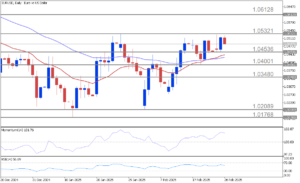
If buyers maintain control of the market, traders may shift their focus to the following four potential resistance levels:
1.05321: The initial price target is established at 1.05321, corresponding to the swing high marked on January 27.
1.06128: The second level of resistance is seen at 1.06128, which aligns with the weekly resistance, R3, calculated using the standard Pivot Points methodology.
1.07318: The third price target is determined at 1.07318, representing the 161.8% Fibonacci Extension drawn from 1.05321 to 1.02089.
1.10550: An additional price objective is estimated at 1.10550, mirroring the 261.8% Fibonacci Extension drawn from 1.05321 to 1.02089.
If sellers take control of the market, traders may focus on the following four key support levels:
1.04536: The initial support level is established at 1.04536, representing the weekly Pivot Point, PP, estimated using the standard methodology.
1.04001: The second support level is seen at 1.04001, aligning with the daily low from February 19.
1.03480: The third downside target is 1.03480, corresponding to the weekly support, S3, calculated using the standard Pivot Points methodology.
1.02089: An additional downside target is observed at 1.02089, reflecting the trough formed on January 13.
Richmond Fed President Tom Barkin emphasized the need for the central bank to stay “modestly restrictive” on monetary policy until inflation returns to the 2% target. He acknowledged uncertainty surrounding economic conditions, policy shifts in Washington, and potential long-term inflationary pressures, including the federal deficit, labor market changes, and migration trends. Barkin stressed patience in adjusting interest rates despite optimism about inflation cooling. He also pointed to risks from economic policies, including tariffs and workforce reductions, noting their impact remains uncertain. While the labor market remains strong, Barkin cautioned that persistent inflationary headwinds may require further Fed intervention.
On a similar note, U.S. consumer confidence dropped sharply in February, marking the steepest decline since August 2021, as concerns over the economic outlook and inflation grew. The Conference Board’s index fell to 98.3, below forecasts, with pessimism rising across age groups and income levels. Expectations for inflation over the next year reached their highest since May 2023, fueled by rising prices and anticipated tariff impacts. Consumers expressed uncertainty over jobs, business conditions, and financial stability, with a growing share expecting a recession.
With key economic data releases ahead, market volatility is expected to remain elevated. The Euro’s bullish momentum against the U.S. dollar is reinforced by strong technical indicators, though resistance levels will be key in determining the next move. Meanwhile, economic uncertainty, the Fed’s cautious stance, and inflation concerns continue to shape market sentiment. Traders should remain vigilant, monitoring data releases and price action for potential shifts in trend direction.

AUDUSD continues to maintain a bullish Elliott Wave structure on the Weekly timeframe.


The EURUSD H4 chart shows a developing bullish Elliott Wave structure following the completion of a significant corrective decline.

Get the FXGT App