Important Note!
We use cookies to ensure you get the best experience on our website.
By clicking ‘Agree,’ you accept our use of cookies as outlined in our cookies policy

As markets await a series of high-impact economic releases, investor attention turns to data that could influence monetary policy and currency moves. Key US figures — including GDP, jobless claims, and Core PCE — will be closely watched, alongside Germany’s CPI, Canada’s GDP, and China’s PMI. EURUSD remains under pressure after a sharp pullback, though support near the 50-period EMA suggests the downtrend is not yet fully confirmed. With both the Fed and ECB signaling caution, this week’s data may offer crucial direction.
Thursday 15:30 (GMT+3) – USA: Prelim GDP q/q (USD)
Thursday 15:30 (GMT+3) – USA: Unemployment Claims (USD)
Friday All Day – Germany: Prelim CPI m/m (EUR)
Friday 15:30 (GMT+3) – Canada: GDP m/m (CAD)
Friday 15:30 (GMT+3) – USA: Core PCE Price Index m/m (USD)
Saturday 4:30 am (GMT+3) – China: Manufacturing PMI (CNY)
Since peaking at 1.15724 on April 21, EURUSD has retreated by over 4% (peak to trough) before finding support near the 50-period Exponential Moving Average (EMA). A clear break below the recent swing low at 1.10646 could open the door to further downside in the pair.
Currently, the EURUSD is trading below the 20-period EMA, indicating growing bearish momentum. This is reinforced by technical indicators: the Momentum Oscillator has slipped below the 100 threshold, while the Relative Strength Index (RSI) remains subdued under the 50 level, both signaling persistent selling pressure.
Nonetheless, price action continues to hover just above the 50-period EMA, and the 20-period EMA has not yet crossed below the 50-period EMA. These conditions suggest that while downside risks are building, a confirmed trend shift remains unverified and warrants caution.
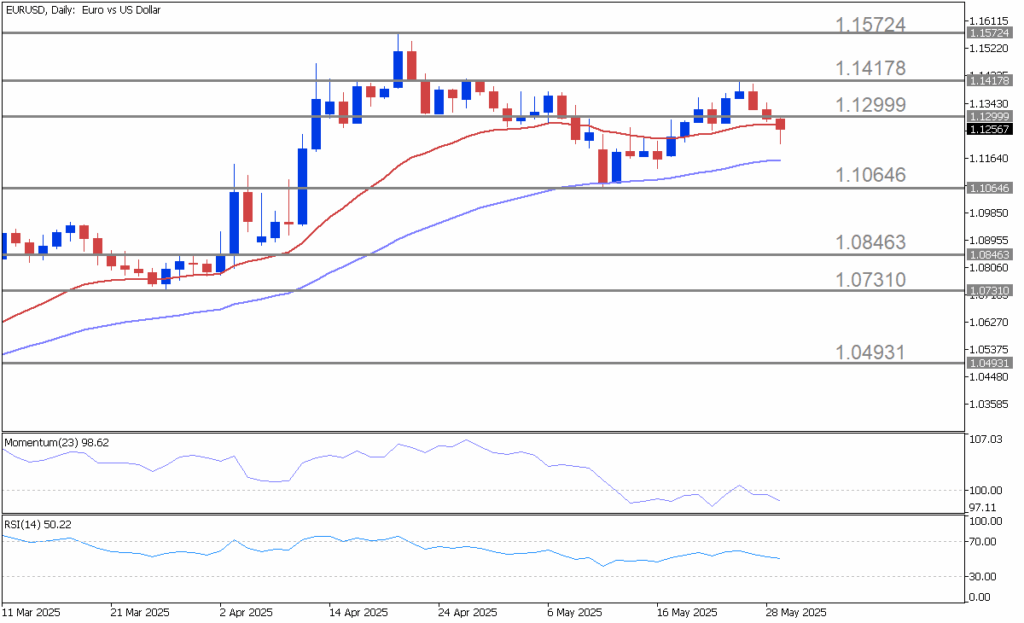
Should the bulls take market control, traders may direct their attention toward the four potential resistance levels below:
1.12999: The initial resistance level is set at 1.12999, which mirrors the weekly Pivot Point, PP, estimated using the standard methodology.
1.14178: The second resistance level is seen at 1.14178, which represents the peak marked May 26.
1.15724: The third price target is identified at 1.15724, corresponding to the peak reached on April 21.
1.16913: An additional price target has been established at 1.16913.
Should the sellers maintain market control, traders may consider the four potential support levels listed below:
1.10646: The initial support level is seen at 1.10646, corresponding to the swing low formed on May 12.
1.08463: The second support level is estimated at 1.08463, representing the 161.8% Fibonacci Extension drawn from the low point, 1.10646 to the high point, 1.14178.
1.07310: The third support level is identified at 1.07310, reflecting the trough from March 27.
1.04931: An additional downside target is 1.04931, mirroring the 261.8% Fibonacci Extension drawn from the low point, 1.10646, to the high point, 1.14178.
The Eurozone economy expanded marginally in April, with the HCOB Composite PMI falling to a two-month low of 50.4 from 50.9 in March, signaling a subdued and slowing pace of growth. Services activity nearly stagnated, with its PMI slipping to 50.1 — a five-month low — while manufacturing output saw its strongest rise in over two years.
Weak demand persisted across the region, with new orders declining for the 11th consecutive month, forcing firms to rely on backlogs to sustain output. Despite this, employment ticked up modestly, driven solely by the services sector.
Business confidence deteriorated further, hitting an 18-month low, and price pressures eased, with both input and output inflation softening. Regionally, France remained in contraction, while Ireland led growth despite a slower pace.
On the other hand, Federal Reserve officials, in the May 6–7 FOMC meeting, expressed concern that tariffs and shifting trade policies could reignite inflation, forcing the central bank into “difficult tradeoffs” if growth and employment weaken simultaneously. While acknowledging solid growth and a balanced labor market, policymakers opted to keep rates steady at 4.25%–4.5%, emphasizing a cautious stance amid growing economic uncertainty.
Officials reiterated the need for more clarity on fiscal and trade developments before considering further policy moves. The Fed also discussed the limits of its current inflation strategy in a high-volatility environment but confirmed it would maintain the 2% inflation target.
With a dense calendar of key economic releases ahead, markets are entering a critical phase that could shape expectations for central bank policy and currency direction. EURUSD remains under pressure amid weakening Eurozone fundamentals and cautious Fed messaging, yet technical signals urge restraint until stronger confirmation of trend continuation emerges. As investors parse incoming data from the U.S., Germany, Canada, and China, the coming days may prove pivotal in defining sentiment and volatility across major asset classes. Caution and flexibility remain essential as global macro risks continue to evolve.

The week of October 26–30, 2026, promises to be particularly eventful for global financial markets, with several major central banks announcing interest rate decisions.


The XAUUSD H4 chart is showing an interesting potential bullish reversal structure after a significant decline from the 4,650–4,690 region toward the 4,080–4,085 area....


Get the FXGT App