Important Note!
We use cookies to ensure you get the best experience on our website.
By clicking ‘Agree,’ you accept our use of cookies as outlined in our cookies policy

With EURUSD holding above key technical levels and central banks maintaining a cautious stance, market participants will remain alert to both price signals and upcoming data releases. While the broader trend points higher, signs of weakening momentum suggest a potential pause or correction could be ahead. As always, traders should stay flexible and monitor both technical setups and macro developments closely.
Thursday 01:45 am (GMT+3) – New Zealand: GDP q/q (NZD)
Thursday 04:30 am (GMT+3) – Australia: Employment Change (AUD)
Thursday 10:30 am (GMT+3) – Switzerland: SNB Policy Rate (CHF)
Thursday 14:00 (GMT+3) – UK: Official Bank Rate (GBP)
Friday 09:00 am (GMT+3) – UK: Retail Sales m/m (GBP)
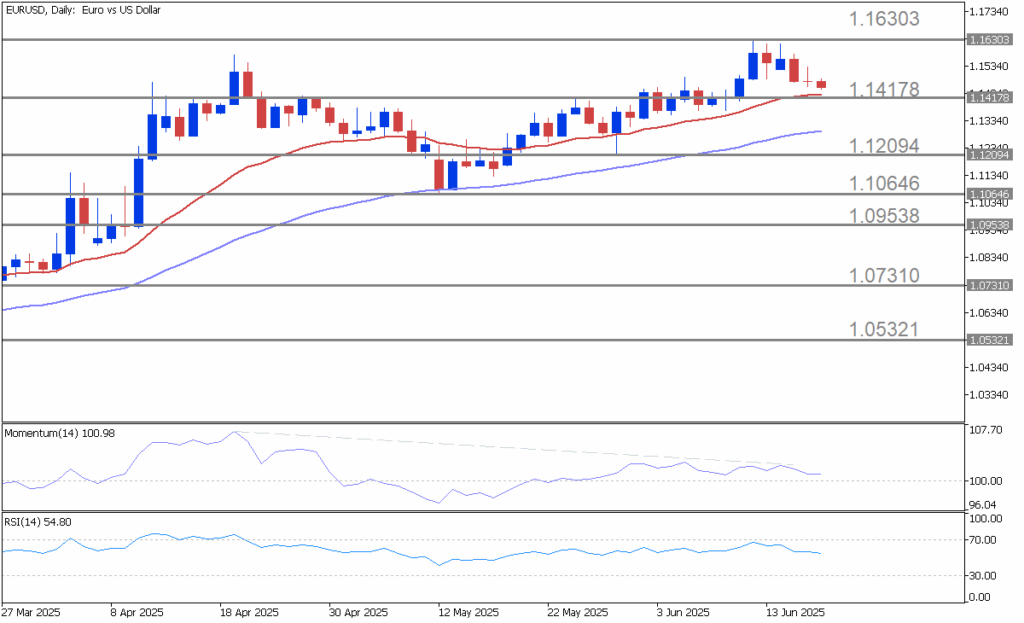
Since establishing a cycle low at 1.01768 on January 13, EURUSD has advanced over 14%, reaching a year-to-date high of 1.16303. The initial reversal was signaled by a classic failure swing pattern, which disrupted the prevailing downtrend and laid the foundation for a bullish transition.
The subsequent formation of a “Golden Cross”—with the 20-period Exponential Moving Average crossing above the 50-period EMA—provided further confirmation of a medium-term trend shift. This crossover is widely interpreted as a positive signal by trend-following strategies.
Technical conditions remain supportive of the upside bias. Momentum remains elevated above the 100 line, and the Relative Strength Index (RSI) continues to hold above the neutral 50 mark—both indicative of sustained bullish interest.
That said, the emergence of a negative divergence between price and the Momentum Oscillator warrants attention. This discrepancy suggests that the underlying strength of the rally may be waning, raising the risk of a consolidation phase or corrective pullback in the sessions ahead.
If buyers maintain control of the market, traders may shift their focus to the following four potential resistance levels:
1.16303: The first level of resistance is identified at 1.16303, which aligns with the daily high marked on June 12.
1.17550: The second price target is established at 1.17550, representing the 261.8% Fibonacci Extension drawn from 1.14178 to 1.12094.
1.19178: The third price target is established at 1.19178, representing the weekly resistance, R3, estimated using the standard Pivot Points methodology.
1.20922: An additional price objective is estimated at 1.20922, mirroring the 423.6% Fibonacci Extension drawn from 1.14178 to 1.12094.
If sellers take control of the market, traders may focus on the following four key support levels:
1.14178: The initial support level is seen at 1.14178, representing the high point from May 26.
1.12094: The second support level is positioned at 1.12094, aligning with the low point marked on May 29.
1.10646: The third downside target is noted at 1.10646, corresponding to the low point marked on May 12.
1.09538: An additional downside target is observed at 1.09538, reflecting the daily high established on March 18.
The Federal Reserve kept the federal funds rate steady at 4.25%–4.50%, citing solid economic growth, a strong labor market, and still-elevated inflation. While uncertainty around the outlook has lessened, it remains high. The Fed reaffirmed its commitment to its dual mandate of maximum employment and 2% inflation. The Committee will continue reducing its balance sheet and monitor incoming data to guide future rate decisions. All members voted in favor of the policy stance.
On the other hand, the ECB cut interest rates by 25 basis points in June, citing improved inflation and economic forecasts. Inflation is now expected to reach the 2% target in 2025, down from earlier projections, and remain near that level through 2027.
As markets move through the week, price action across major currency pairs continues to offer clear signals. Technical setups are developing in key areas, with EURUSD drawing particular attention following a sustained upward move. Traders remain focused on chart structure, trend signals, and potential levels of interest on both sides of the market.

Gold (XAUUSD) is currently showing signs of a potential recovery after experiencing a sharp corrective decline from the recent high area.


Gold (XAUUSD) on the H4 timeframe is showing signs of a significant corrective phase following the strong bullish advance seen throughout August.

Get the FXGT App