Important Note!
We use cookies to ensure you get the best experience on our website.
By clicking ‘Agree,’ you accept our use of cookies as outlined in our cookies policy

A packed Friday calendar brings several high-impact releases from the UK, Germany, and the United States—events that could inject fresh volatility into EURUSD and broader FX markets. With key retail and PMI figures due throughout the day, traders will be watching closely for signals on consumer strength, industrial momentum, and service-sector resilience across major economies. These data points arrive at a time when EURUSD is already under sustained bearish pressure, making today’s updates particularly important for short-term direction.
Friday 09:00 am (GMT+2) – UK: Retail Sales m/m (GBP)
Friday 10:30 am (GMT+2) – Germany: Flash Manufacturing PMI (EUR)
Friday 10:30 am (GMT+2) – Germany: Flash Services PMI (EUR)
Friday 11:30 am (GMT+2) – UK: Flash Manufacturing PMI (GBP)
Friday 11:30 am (GMT+2) – UK: Flash Services PMI (GBP)
Friday 16:45 (GMT+2) – USA: Flash Manufacturing PMI (USD)
Friday 16:45 (GMT+2) – USA: Flash Services PMI (USD)
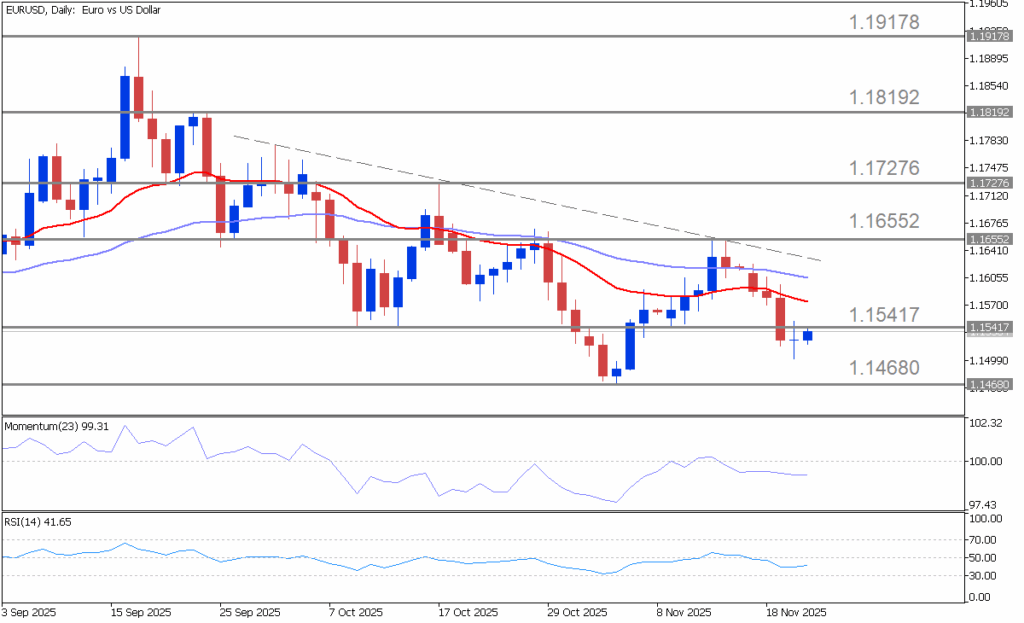
Since topping out at 1.19178 on September 17, EURUSD has retreated more than 3.5% peak-to-trough, carving out a clear sequence of lower highs and lower lows that signals a decisive shift toward bearish control. The initial warning came from a Bearish Harami formation, which was subsequently validated by a failure-swing pattern: the rebound toward 1.18192 stalled below the prior swing high, followed by a clean break beneath 1.17253, opening the door for sustained downside momentum.
Bearish conviction strengthened as a “Death Cross” developed, with the 20-period EMA crossing below the 50-period EMA, confirming the prevailing downtrend. Momentum studies echo this posture: the Momentum Oscillator remains firmly below the 100-line, signaling persistent weakness, while the RSI holds beneath 50, pointing to continued selling pressure.
At the time of writing, EURUSD has staged a modest 0.6% rebound, with price consolidating around 1.15415, though the broader technical landscape continues to favour sellers.
Should the buyers take market control, traders may direct their attention toward the four potential resistance levels below:
1.15417: The initial price target is set at 1.15417, reflecting the trough from October 14.
1.16552: The second resistance level is established at 1.16552, which mirrors the peak formed on November 13.
1.17276: The third price objective is observed at 1.17276, corresponding to the peak marked on October 17.
1.18192: An additional upside target is set at 1.18192, reflecting the daily high recorded on September 23.
Should the sellers maintain market control, traders may consider the four potential support levels listed below:
1.14680: The initial support level is seen at 1.14680, corresponding to the swing low marked on November 5.
1.14392: The second support level is estimated at 1.14392, representing the weekly support, S3, calculated using the standard Pivot Points methodology.
1.13523: The third support level is identified at 1.13523, reflecting the 161.8% Fibonacci Extension drawn from 1.14680 to 1.16552.
1.11651: An additional downside target is 1.11651, mirroring the 261.8% Fibonacci Extension drawn from 1.14680 to 1.16552.
US job growth was modest in September, with employers adding 119,000 jobs, roughly matching the slow pace seen since the spring—the unemployment rate held at 4.4 percent, only slightly higher than a year earlier. Most of the job gains came from health care, along with restaurants, bars, and social assistance roles. In contrast, transportation and warehousing saw clear declines, including losses in delivery and storage jobs, while federal government employment continued to edge lower.
Wages increased slightly in September, rising 0.2 percent for the month and 3.8 percent over the past year, and the average workweek remained essentially unchanged. The release of this report was delayed by six weeks due to the federal government shutdown. Because of that disruption, there will be no October jobs report. Instead, October’s establishment data will be published together with November’s figures on December 16, while the household survey skipped October entirely and will not be retroactively collected.
In summary, EURUSD remains under clear bearish pressure, with technical signals and momentum indicators continuing to favour sellers despite the pair’s modest intraday rebound. The cluster of high-impact data releases throughout the day adds an additional layer of event-driven risk, and any surprises in UK, German, or U.S. figures could influence short-term direction. With fundamentals showing slower U.S. job growth and lingering uncertainty from the recent data disruptions, traders should remain alert to shifting sentiment and be prepared for heightened volatility as markets digest the incoming numbers.



The XAUUSD H4 chart is showing an interesting potential bullish reversal structure after a significant decline from the 4,650–4,690 region toward the 4,080–4,085 area....


The AUDUSD weekly chart continues to show an interesting bullish Elliott Wave structure following the strong recovery from the previous major low.

Get the FXGT App