Important Note!
We use cookies to ensure you get the best experience on our website.
By clicking ‘Agree,’ you accept our use of cookies as outlined in our cookies policy

This week, traders face a packed calendar of high-impact economic releases, including inflation data from the UK, PMI figures from France, Germany, the UK, and the US, and retail sales reports from both the UK and Canada. These events are likely to shape expectations around central bank policy and economic momentum across major economies.
Against this macroeconomic backdrop, the Dow Jones Industrial Average continues to exhibit a constructive technical setup, having rebounded decisively from its April lows. While momentum indicators support the current uptrend, emerging signs of negative divergence highlight the need for caution.
Wednesday 09:00 am (GMT+3) – UK: CPI y/y (GBP)
Thursday 10:15 am (GMT+3) – France: Flash Manufacturing PMI (EUR)
Thursday 10:15 am (GMT+3) – France: Flash Services PMI (EUR)
Thursday 10:30 am (GMT+3) – Germany: Flash Manufacturing PMI (EUR)
Thursday 10:30 am (GMT+3) – Germany: Flash Services PMI (EUR)
Thursday 11:30 am (GMT+3) – UK: Flash Manufacturing PMI (GBP)
Thursday 11:30 am (GMT+3) – UK: Flash Services PMI (GBP)
Thursday 15:30 (GMT+3) – USA: Unemployment Claims (USD)
Thursday 16:45 (GMT+3) – USA: Flash Manufacturing PMI (USD)
Thursday 16:45 (GMT+3) – USA: Flash Services PMI (USD)
Friday 09:00 am (GMT+3) – UK: Retail Sales (GBP)
Friday 15:30 (GMT+3) – Canada: Retail Sales m/m (CAD)
Since establishing a low at 36,486.13 on April 7, the Dow Jones Industrial Average (DJIA) has staged a meaningful recovery. The initial indication of a trend reversal emerged with the development of a bottom failure swing pattern. This was characterized by a higher subsequent low at 37,826.60, followed by a decisive breakout above the prior high of 40,921.23—signaling a bullish structural shift and setting the stage for continued upward momentum.
Technical validation was provided by the emergence of a “Golden Cross,” as the 20-period Exponential Moving Average (EMA) crossed above the 50-period EMA. This crossover is often interpreted as a medium-term trend shift in favor of the bulls.
Momentum indicators corroborate the positive technical setup. The Momentum Oscillator remains firmly above the 100 threshold, suggesting continued strength, while the Relative Strength Index (RSI) holds above the 50 level, consistent with a sustained bullish bias.
That said, the presence of a negative divergence between price and the Momentum Oscillator introduces an element of caution. While the broader trend remains constructive, this divergence warrants close monitoring for potential signs of weakening internal strength.
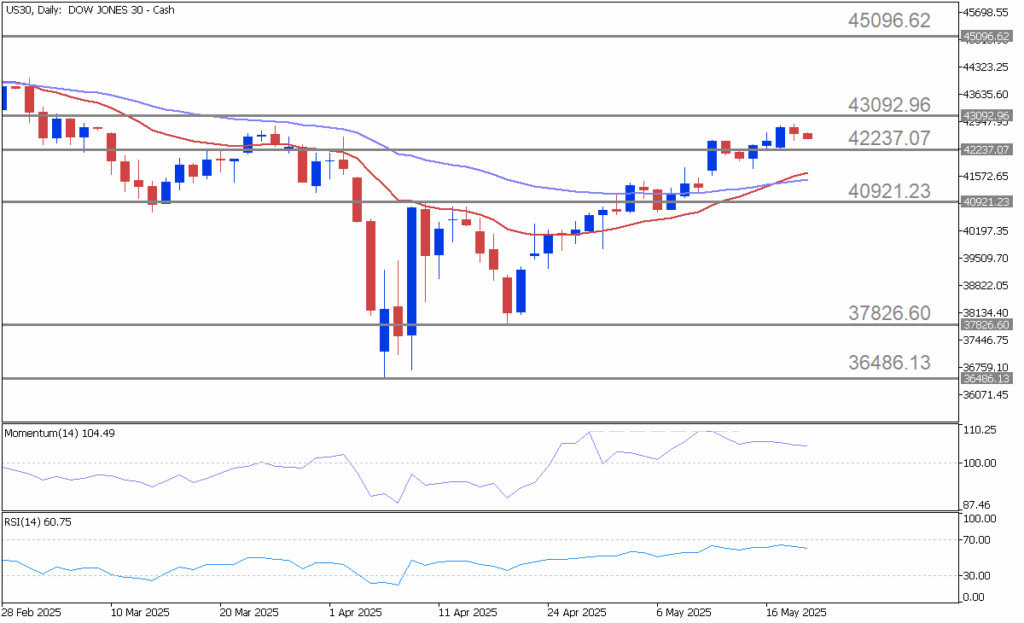
If buyers maintain control of the market, traders may shift their focus to the following four potential resistance levels:
43,092.96: The first level of resistance is projected at 43,092.96, which aligns with the daily low marked February 28.
45,096.62: The second price target is seen at 45,096.62, corresponding to the Dow Jones Industrial Average all-time high.
46,106.61: The third upside target is noted at 46,106.61, mirroring the 261.8% Fibonacci Extension drawn from the high point, 40,921.23, to the low point, 37,826.60.
51,223.90: An additional upside target is determined at 51,223.90, reflecting the 423.6% Fibonacci Extension drawn from the high point, 40,921.23, to the low point, 37,826.60.
If sellers take control of the market, traders may focus on the following four key support levels:
42,237.07: The initial support level is seen at 42,237.07, representing the weekly Pivot Point, PP, estimated using the standard methodology.
40,921.23: The second support level is positioned at 40,921.23, aligning with the swing high from April 10.
37,826.60: The third downside target is noted at 37.826.60, corresponding to the trough formed on April 21.
36,486.13: An additional downside target is determined at 36,486.13, reflecting the trough marked April 7.
US equities dropped Monday after Moody’s downgraded the US’s last remaining AAA credit rating, citing fiscal and political instability. The Dow fell nearly 300 points (-0.6%), the S&P 500 slid 1%, and the Nasdaq lost 1.3%. Treasury yields spiked, with the 30-year yield topping 5%, while gold and the VIX moved higher as investors sought safety.
The downgrade, though widely anticipated, marks a symbolic end to the US’s risk-free credit status and raises concerns over rising borrowing costs and weakening corporate balance sheets. Analysts warned the move could accelerate capital outflows to Europe and Asia.
With a dense lineup of economic releases and renewed fundamental risks in play, markets are entering a critical phase. While the Dow’s technical structure remains broadly bullish, momentum divergences and macro headwinds—particularly following Moody’s US downgrade—add layers of uncertainty. Traders should stay alert to key support and resistance levels as data unfolds throughout the week, and remain adaptive as shifting yields, inflation trends, and PMI figures shape near-term market direction.

Financial markets were shaped by a busy week of economic data, central bank decisions, and corporate earnings.


Markets face a busy week of high-impact economic events, with central bank policy, inflation, employment, growth and energy data all in focus.

Get the FXGT App