Important Note!
We use cookies to ensure you get the best experience on our website.
By clicking ‘Agree,’ you accept our use of cookies as outlined in our cookies policy

After a sharp pullback in the S&P 500, market participants move through the week looking for clarity on whether the recent downside momentum will persist or stabilize. With sentiment already on edge, traders are now watching the remaining high-impact economic releases that could influence volatility across global markets.
Wednesday 09:00 am (GMT+2) – UK: CPI y/y (GBP)
Thursday 15:30 (GMT+2) – USA: Non-Farm Employment Change (USD)
Friday 09:00 am (GMT+2) – UK: Retail Sales m/m (GBP)
Friday 10:30 am (GMT+2) – Germany: Flash Manufacturing PMI (EUR)
Friday 10:30 am (GMT+2) – Germany: Flash Services PMI (EUR)
Friday 11:30 am (GMT+2) – UK: Flash Manufacturing PMI (GBP)
Friday 11:30 am (GMT+2) – UK: Flash Services PMI (GBP)
Friday 16:45 (GMT+2) – USA: Flash Manufacturing PMI (USD)
Friday 16:45 (GMT+2) – USA: Flash Services PMI (USD)
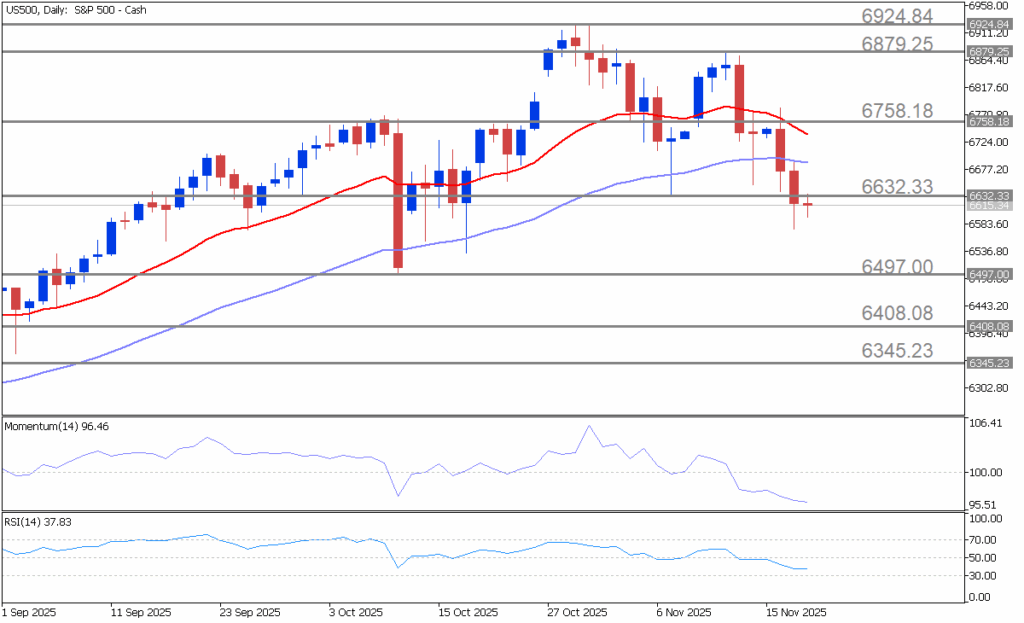
Since reaching a high of 6,924.84 on October 30, the S&P 500 has fallen more than 5%, with escalating geopolitical and trade tensions dampening risk appetite. The first indication of fatigue surfaced when a Spinning Top candlestick interrupted the preceding uptrend, signaling a possible turning point. This was followed by a failure swing: the subsequent peak at 6,879.25 fell short of the prior high, and the break below the 6,632.33 trough confirmed a transition into a downward phase.
Price action since then has reinforced the shift in sentiment. The index is now trading beneath both the 20- and 50-period Exponential Moving Averages (EMAs). Although a bearish EMA crossover has not yet materialized, the current configuration points to fading upward momentum and rising investor caution.
Technical indicators echo this deterioration. The Momentum Oscillator has moved below the 100 threshold, while the Relative Strength Index (RSI) continues to hold under the neutral 50 level—together underscoring persistent selling pressure and an increasingly bearish undertone in the broader market.
If buyers take control of the market, traders may shift their focus to the following four potential resistance levels:
6,632.33: The first level of resistance is identified at 6,632.33, which aligns with the swing low from November 7.
6,758.18: The second price target is established at 6,758.18, representing the weekly Pivot Point, PP, calculated using the standard methodology.
6,879.25: The third price target is established at 6,879.25, representing the swing high marked on November 12.
6,924.84: An additional price objective is estimated at 6,924.84, mirroring the high point marked on October 30.
If sellers maintain control of the market, traders may focus on the following four key support levels:
6,497.00: The initial support level is seen at 6,497.00, representing the low point from October 10.
6,408.08: The second support level is positioned at 6,408.08, aligning with the weekly support, S3, estimated using the standard Pivot Points methodology.
6,345.23: The third downside target is noted at 6,345.23, corresponding to the low point from August 20.
6,232.81: An additional downside target is observed at 6,232.81, reflecting the 261.8% Fibonacci Extension drawn from 6,632.33 to 6,879.25.
The latest jobless-claims data offer only a partial and inconclusive picture of US labor-market conditions. The release from the Labor Department shows initial claims at 232,000 for the week of October 18, with no data published for the three weeks before or after due to the government shutdown. State-level numbers indicate claims have steadied between 220,000 and 230,000, but this stability masks emerging risks: several large companies have recently announced sizable layoffs, and hiring appears to be softening. ADP’s weekly gauge suggests firms are marginally reducing headcount. More definitive insight is expected later this week when the Labor Department clears its data backlog and releases the delayed September employment report—figures the Federal Reserve is watching closely as policymakers debate the need for additional rate cuts.
With the S&P 500 still trading under technical strain, the market moves through the remainder of the week focused on whether momentum will further weaken or begin to stabilize. Several key releases are still ahead, and these could set the tone for volatility into the weekend. Given the combination of fragile sentiment and mixed fundamental signals, traders are likely to stay cautious, looking for clarity from both the upcoming data and how the index behaves around its major support and resistance levels.



Markets face a busy week of high-impact economic events, with central bank policy, inflation, employment, growth and energy data all in focus.

Gold (XAUUSD) is currently showing signs of a potential recovery after experiencing a sharp corrective decline from the recent high area.


Get the FXGT App