Important Note!
We use cookies to ensure you get the best experience on our website.
By clicking ‘Agree,’ you accept our use of cookies as outlined in our cookies policy

With key economic releases from the UK and Canada on the horizon, market participants should prepare for increased volatility in GBP and CAD pairs. GBPUSD remains technically pressured following a confirmed bearish reversal and continued weakness in momentum indicators. The upcoming Bank of England rate decision and Employment Change data from Canada will likely serve as catalysts for the next directional move. Coupled with broader geopolitical developments—such as Trump’s proposed semiconductor tariffs—traders should stay alert for shifts in sentiment and adjust positions accordingly based on evolving fundamentals and technical signals.
Thursday 14:00 (GMT+3) – UK: Official Bank Rate (GBP)
Friday 15:30 (GMT+3) – Canada: Employment Change (CAD)
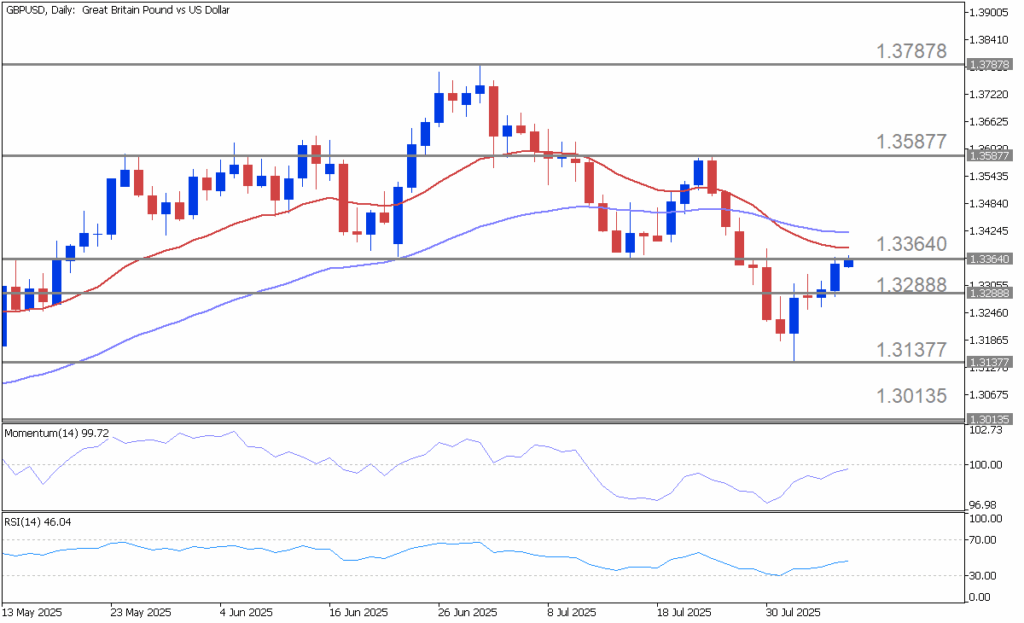
Since peaking at 1.37878 on July 1, GBPUSD has declined by over 4% from its high, marking a notable shift in market sentiment. The initial sign of reversal emerged through a classic failure swing pattern, where the interim peak at 1.35877 failed to surpass the previous high and was followed by a decisive break below the preceding trough at 1.33640—effectively confirming a bearish sequence.
Technical confirmation of the downtrend was further reinforced by a “Death Cross” formation, as the 20-period Exponential Moving Average (EMA) crossed below the 50-period EMA. This double crossover supports the bearish outlook and highlights a shift in short- to medium-term momentum. While the pair has seen a brief bounce, GBPUSD continues to trade beneath both moving averages, reinforcing the view of sustained downward pressure.
Momentum indicators corroborate the bearish bias. The Momentum Oscillator remains entrenched below the 100 level, reflecting continued negative momentum. Meanwhile, the Relative Strength Index (RSI) remains subdued below the 50 mark, suggesting persistent selling interest and lack of bullish conviction.
Should the buyers take market control, traders may direct their attention toward the four potential resistance levels below:
1.33640: The initial price target is set at 1.33640, reflecting the swing low marked on July 16.
1.35877: The second resistance level is established at 1.35877, which mirrors the swing high reached on July 24.
1.37878: The third price objective is observed at 1.37878, corresponding to the high point from July 1.
1.40553: An additional upside target is projected at 1.40553, mirroring the 261.8% Fibonacci Extension drawn from 1.36315 to 1.33696.
Should the sellers maintain market control, traders may consider the four potential support levels listed below:
1.32888: The initial support level is seen at 1.32888, corresponding to the weekly Pivot Point, PP, calculated using the standard methodology.
1.31377: The second support level is estimated at 1.31377, representing the low point marked on August 1.
1.30135: The third support level is identified at 1.30135, reflecting the 261.8% Fibonacci Extension drawn from 1.33640 to 1.35877.
1.28119: An additional downside target is 1.28119, mirroring the weekly support, S3, estimated using the standard Pivot Points methodology.
The Bank of England is expected to cut interest rates by 25 basis points to 4.0% later today, marking its fifth reduction since August 2024. While the move aims to support the UK’s weakening economy—hit by rising unemployment, slowing growth, and US tariffs—analysts will closely watch for changes in the BoE’s growth and inflation forecasts. With inflation unexpectedly rising to 3.6% in June, divisions within the Monetary Policy Committee are likely, reflecting the challenge of balancing economic support against inflation risks.
In the US, Donald Trump announced plans to impose a 100% tariff on imported semiconductors but pledged exemptions for companies investing in U.S. manufacturing. The move, revealed alongside Apple CEO Tim Cook—who committed an additional $100 billion to U.S. operations—aims to push tech production back to the U.S. Firms like Apple, TSMC, Samsung, and SK Hynix are expected to avoid the tariffs due to their domestic investments. While the policy raises uncertainty across global supply chains, market reaction was tempered by the promise of exemptions and renewed investment commitments from major tech players.
GBPUSD remains under pressure ahead of two major economic events: the Bank of England’s expected rate cut on Thursday and Canada’s Employment Change data on Friday. Technical signals confirm a bearish trend, with key indicators and moving averages pointing to sustained downside risk. On the fundamentals side, the BoE faces a delicate balance between supporting growth and managing rising inflation, while global markets also react to Trump’s proposed 100% chip tariffs—though exemptions for firms investing in U.S. manufacturing have eased immediate concerns. Together, these developments set the stage for heightened volatility in GBP and CAD pairs.

Gold (XAUUSD) is currently showing signs of a potential recovery after experiencing a sharp corrective decline from the recent high area.


Gold (XAUUSD) on the H4 timeframe is showing signs of a significant corrective phase following the strong bullish advance seen throughout August.

Get the FXGT App