Important Note!
We use cookies to ensure you get the best experience on our website.
By clicking ‘Agree,’ you accept our use of cookies as outlined in our cookies policy

This week’s trading landscape is shaped by a series of high-impact economic releases, including U.S. GDP, Canada’s GDP, the U.S. Core PCE Price Index, and China’s Manufacturing PMI. These events are expected to drive volatility across major currency pairs, particularly those tied to USD, CAD, and CNY. Against this backdrop, AUDUSD has been consolidating within a defined range, with technical signals pointing to a bearish tilt while fundamentals highlight renewed inflationary pressures in Australia.
Thursday 15:30 (GMT+3) – USA: Prelim GDP q/q (USD)
Friday 15:30 (GMT+3) – Canada: GDP m/m (CAD)
Friday 15:30 (GMT+3) – USA: Core PCE Price Index m/m (USD)
Sunday 04:30 am (GMT+3) – China: Manufacturing PMI (CNY)
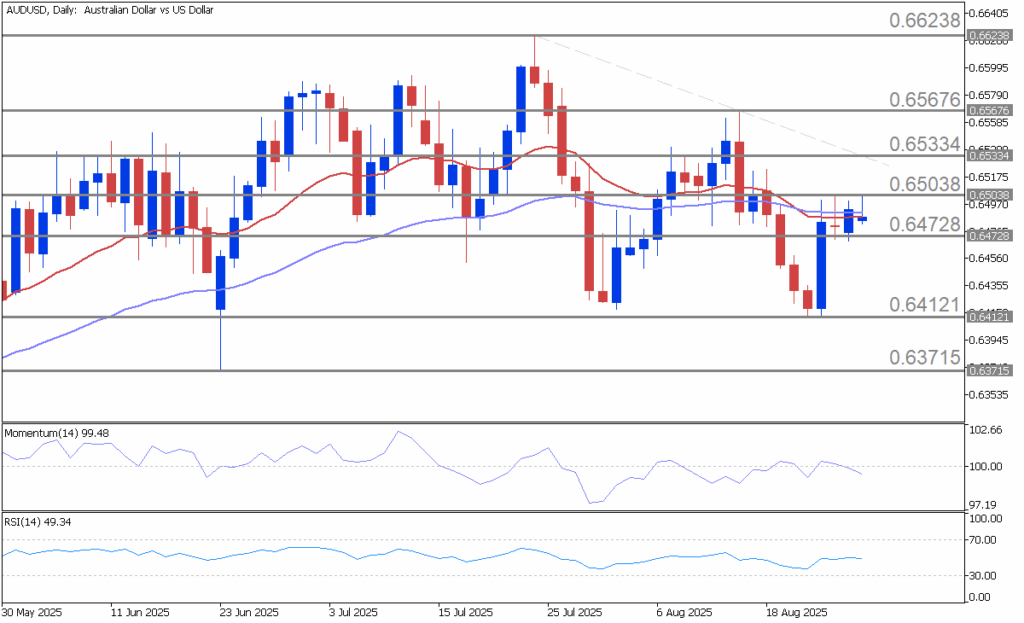
Since peaking at 0.66238 on July 24, AUDUSD has been consolidating within a sideways range, capped at the resistance of 0.66238 and supported at 0.64121. The reversal signal first emerged with a Shooting Star, followed by a “Three White Soldiers” pattern that marked a shift in sentiment, which ended the attempt to establish lasting upward traction.
The technical backdrop has since turned increasingly bearish. A crossover between the 20- and 50-period Exponential Moving Averages (EMAs) has formed a “Death Cross,” reinforcing downside bias. Momentum indicators also align with this view: the Momentum Oscillator has slipped below 100, pointing to weakening short-term strength, while the Relative Strength Index (RSI) at 50 suggests an underlying negative tilt.
A sustained break below 0.64121 would confirm renewed bearish momentum and open the way for further downside.
Should the buyers take market control, traders may direct their attention toward the four potential resistance levels below:
0.65038: The initial resistance level is set at 0.65038, reflecting the daily high marked on August 25.
0.65334: The second price target is set at 0.65334, representing the weekly resistance, R1, calculated using the standard Pivot Points methodology.
0.65676: The third price objective is observed at 0.65676, mirroring the peak from August 14.
0.66238: An additional upside target is projected at 0.66238, corresponding to the high point marked July 24.
Should the sellers maintain market control, traders may consider the four potential support levels listed below:
0.64728: The initial support level is estimated at 0.64728, representing the weekly Pivot Point, PP, estimated using the standard methodology.
0.64121: The second level is seen at 0.64121, corresponding to the low point from August 22.
0.63715: The third support level is identified at 0.63715, reflecting the daily low marked on June 23.
0.63116: An additional downside target is 0.63116, mirroring the weekly support, S3, estimated using the standard Pivot Points methodology.
The monthly CPI indicator rose 2.8 percent in the year to July, up from 1.9 percent in June. Excluding volatile items and holiday travel, inflation was 3.2 percent compared with 2.5 percent previously. Trimmed mean inflation, which smooths out temporary price swings, increased to 2.7 percent from 2.1 percent.
The main driver was electricity, which jumped 13.1 percent over the year as rebates were used up and new price reviews took effect. Without rebates, household electricity costs would have been more than 20 percent higher since mid-2023. Rents rose 3.9 percent, the slowest growth since 2022, while gas prices lifted 4.7 percent and new dwellings were 0.4 percent higher. Food and beverages eased slightly to 3.0 percent annual growth, though some items such as coffee, cocoa, and eggs recorded sharp increases. Holiday travel rose 3.3 percent after falling in June, reflecting school holiday demand. Automotive fuel prices fell 5.5 percent over the year, easing from an 8.0 percent decline the previous month.
Overall, July inflation showed renewed upward pressure, largely due to higher electricity costs, alongside moderate increases in rents, gas, and travel, partly offset by cheaper fuel.
In summary, AUDUSD remains range-bound but with a clear bearish tilt as technical signals weaken and momentum indicators turn negative. The key test lies at 0.64121, where a decisive break would likely trigger further downside. With inflationary pressures in Australia persisting and a series of high-impact global data releases ahead, traders should be prepared for heightened volatility and potential shifts in market sentiment.



Financial markets were shaped by a busy week of economic data, central bank decisions, and corporate earnings.

Markets face a busy week of high-impact economic events, with central bank policy, inflation, employment, growth and energy data all in focus.

Get the FXGT App